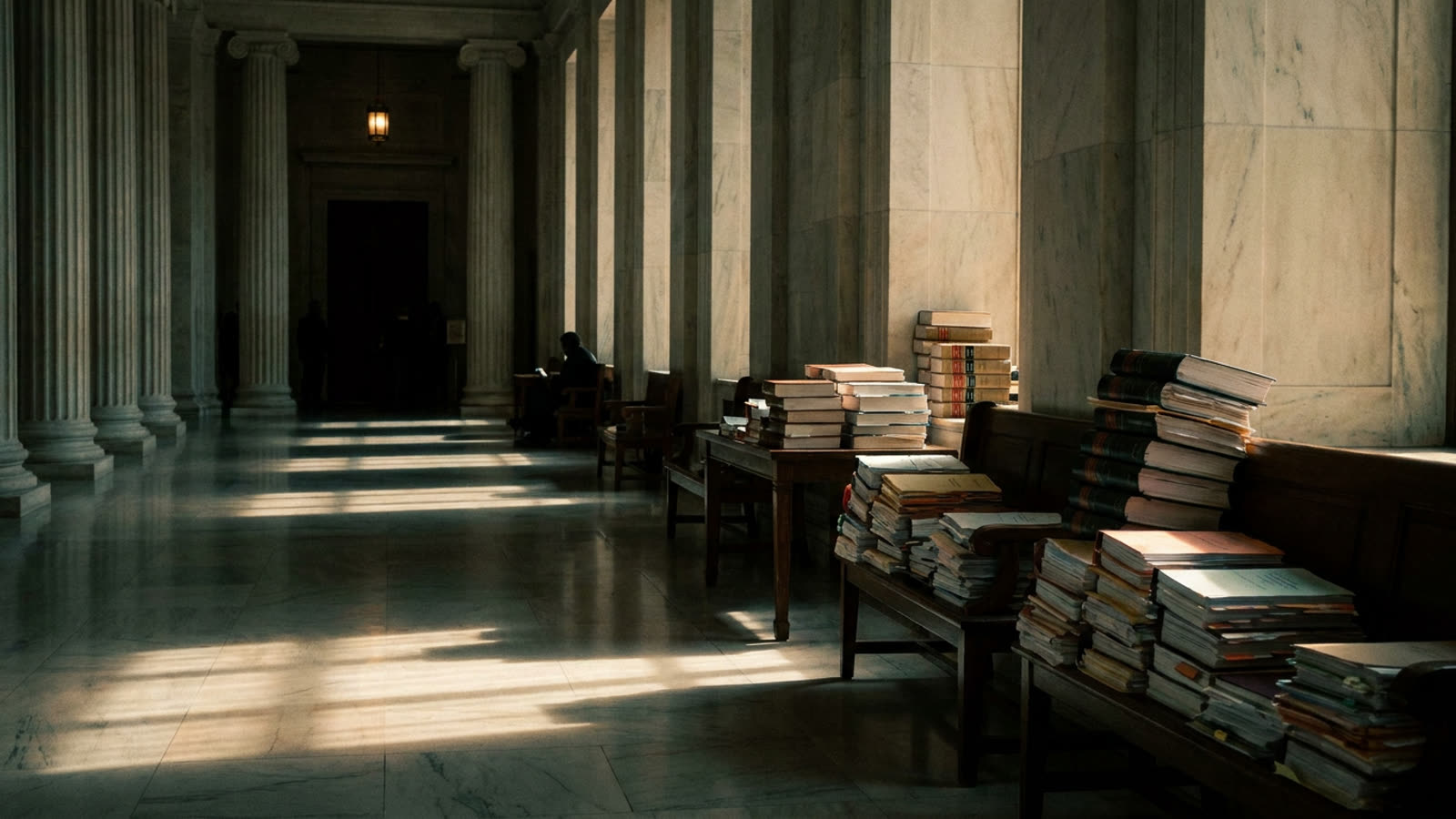
The highest court in the land has a time-management problem, and the justices themselves are running out of patience with it.
What was once a crisp hour of oral argument has metastasized into marathon sessions that regularly exceed two hours, with some stretching past three. The culprit is a procedural innovation the justices themselves embraced: the shift from a free-for-all questioning format to a structured system where each justice gets dedicated time. The result is a Court that hears more but decides no faster, where advocates struggle to complete sentences and justices openly grumble about the length of their own workdays.
The architecture of exhaustion
The current format emerged from the pandemic era, when remote arguments necessitated turn-taking. But what began as a practical accommodation calcified into permanent practice. Each justice now receives a guaranteed questioning period following the traditional free-form segment, effectively doubling or tripling argument length. Justice Samuel Alito has been particularly vocal about the fatigue factor, while Justice Elena Kagan has noted the irony of a system designed for fairness producing diminishing returns for everyone involved.
The mathematics are unforgiving. Nine justices, each with substantive questions, plus rebuttal time, plus the traditional opening segment—the clock becomes an enemy of depth rather than a friend of thoroughness.
Institutional vanity meets practical limits
The structured format solved a real problem: junior justices and those less inclined to verbal combat were routinely steamrolled by colleagues who dominated the old free-for-all. Justices Clarence Thomas and Sonia Sotomayor, who occupy opposite ends of the ideological spectrum, have both benefited from guaranteed airtime. But the cure has introduced its own pathology. Advocates now face a gauntlet rather than a conversation, and the justices themselves have become performers in a procedural theater that rewards quantity of questioning over quality of inquiry.
The Court has always resisted external reform efforts, jealously guarding its institutional prerogatives. That it now confronts a dysfunction of its own making carries a certain poetic justice.
Our take
The Supreme Court's oral-argument bloat is a microcosm of a larger institutional tendency: the belief that more process equals better outcomes. It does not. The justices created this problem when they prioritized individual airtime over collective efficiency, and only they can fix it. The simplest solution—strict time limits enforced without exception—would require the Court to do something it historically resists: impose discipline on itself. Given the current term's collision course with the executive branch on multiple fronts, the justices may soon discover they need those extra hours for writing opinions rather than listening to themselves ask questions they already know the answers to.