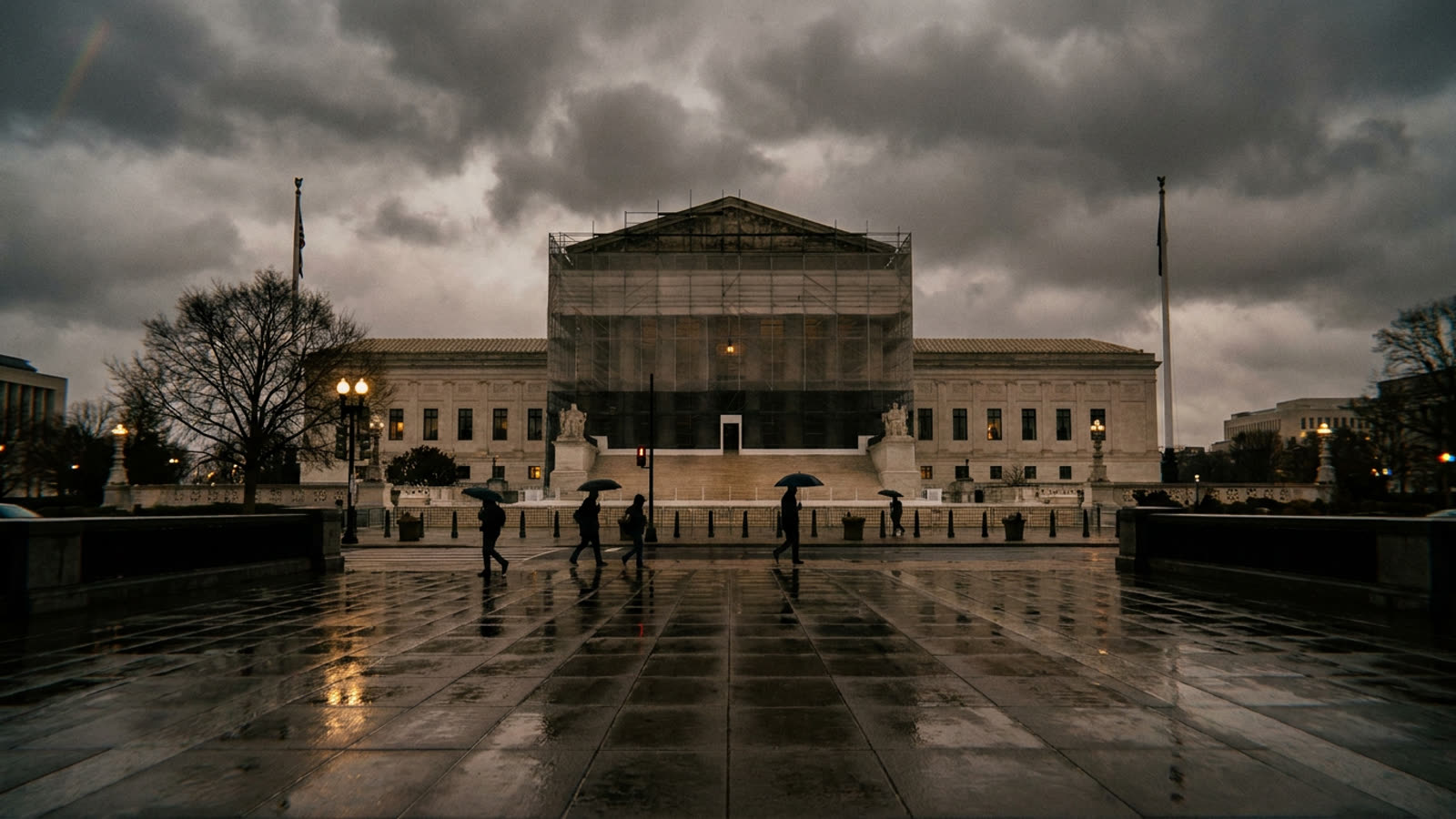
The Supreme Court has finally drawn a line around one of law enforcement's favorite surveillance shortcuts. In a 6-3 decision issued Monday, the Court ruled that geofence warrants—the increasingly common technique of demanding Google, Apple, or other tech giants hand over data on every device that passed through a crime scene—violate the Fourth Amendment's requirement of particularity. The government cannot, the majority held, go fishing through millions of Americans' location histories simply because a crime occurred somewhere.
The ruling lands at a moment when the relationship between digital privacy and state power has never been more contested. Geofence warrants exploded in use after 2016, with Google alone receiving over 60,000 such requests from American law enforcement agencies in recent years. The technique proved seductive: rather than identifying a suspect and then seeking evidence, police could define a time and place, then work backward to see who was present. The Court found this inversion of traditional investigative logic constitutionally intolerable.
The mechanics of mass surveillance
Geofence warrants work by exploiting the location data that smartphones continuously generate. When police investigate a bank robbery, they can ask Google for the anonymized identifiers of every device that pinged within, say, 200 meters of the bank during a 30-minute window. Google provides a list; police then narrow it down and request identifying information for promising candidates. The problem, as the majority noted, is that the initial sweep captures everyone—the elderly woman walking her dog, the delivery driver, the teenager cutting through an alley. All become suspects by geography alone.
Justice Gorsuch, writing for the majority, invoked the Founders' revulsion at general warrants—the British practice of authorizing searches without naming specific persons or places. "The digital age has not repealed the Fourth Amendment," he wrote. "A warrant that sweeps up the location data of thousands of innocent people is no less a general warrant because it is executed by algorithm rather than redcoat."
What changes now
The ruling does not ban geofence evidence entirely. Police can still seek location data, but they must now demonstrate probable cause that a specific individual was at the scene, rather than casting a net and hoping to catch someone. This returns digital surveillance to something closer to traditional warrant practice: identify your suspect, then gather your evidence.
Tech companies quietly cheered. Google had already begun limiting its compliance with geofence requests, and Apple has long resisted them on technical grounds. The ruling provides legal cover for continued resistance and may accelerate the industry's shift toward privacy-preserving architectures that make such bulk collection technically impossible.
Civil liberties groups called the decision the most significant Fourth Amendment ruling since Carpenter v. United States in 2018, which required warrants for historical cell-site location data. Together, the two cases establish that the mere fact of carrying a smartphone does not constitute consent to perpetual government tracking.
Our take
This is the Court at its best: applying 18th-century principles to 21st-century technology without pretending the Founders anticipated GPS. The dissent's argument—that location data voluntarily shared with Google cannot be private—misunderstands how modern life works. Nobody opts into surveillance; they opt into maps and weather apps, and surveillance follows uninvited. The majority grasped this. In an era when the Court seems determined to expand executive power at every turn, it is worth pausing to appreciate a decision that tells the government: not everything is yours for the taking.