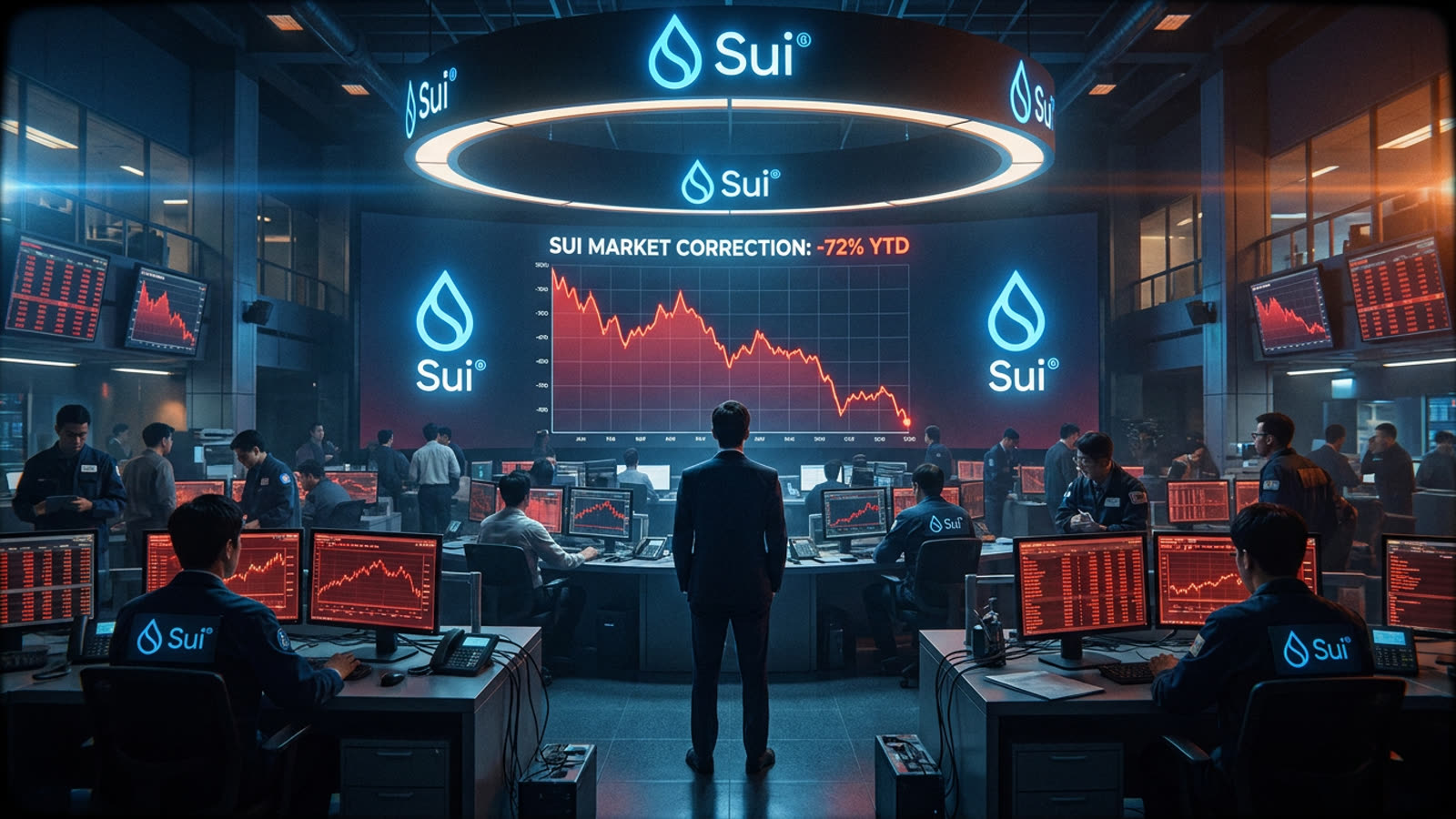
A year ago, Sui traded near $2.50 and its backers spoke of capturing Solana's momentum with superior technology. Today it sits at $0.70, down another 2% in the past 24 hours and nursing a 72% annual loss. The numbers are brutal, but they are also clarifying: the market has stopped paying premiums for "next-generation" Layer-1 chains that lack proportionate adoption.
Sui emerged from Mysten Labs in 2023, founded by former Meta engineers who had worked on the ill-fated Diem project. The pitch was compelling — a new virtual machine based on the Move programming language, parallel transaction execution, and theoretical throughput that dwarfed Ethereum. Venture capital obliged with hundreds of millions in funding. The token launched to considerable fanfare.
The adoption gap
Three years later, the technology works largely as advertised. Sui processes transactions quickly and cheaply. But so do Solana, Avalanche, and a dozen other chains. The differentiator was supposed to be developer adoption and killer applications. Neither has materialized at scale. Sui's total value locked hovers in the low hundreds of millions — respectable for a young chain, but nowhere near the billions that would justify its fully diluted valuation. Gaming partnerships have been announced; breakout games have not arrived.
The broader context matters. During the 2021 bull market, investors bet that blockchain demand would fragment across dozens of Layer-1 networks, each capturing specific use cases. That thesis assumed exponential growth in on-chain activity. Instead, activity consolidated. Ethereum retained DeFi's institutional capital. Solana captured retail speculation and memecoins. Bitcoin absorbed the treasury-reserve narrative. Everyone else has been fighting for scraps.
The vesting overhang
Sui's price action also reflects mechanical pressure. Large token unlocks have released supply into a market with limited organic demand. Early investors and team members receiving vested tokens face a choice: hold through uncertainty or realize gains while they can. Many have chosen the latter. This is not unique to Sui — nearly every VC-backed chain from the 2022-2023 vintage faces similar dynamics — but it compounds the fundamental weakness.
The chain's proponents argue that price is a lagging indicator, that developer tooling improvements and upcoming gaming launches will eventually attract users. Perhaps. But "eventually" is a difficult timeline when competitors are shipping now and capital is finite.
Our take
Sui is not dying; it is repricing to reality. The 2021 mental model — where every technically competent Layer-1 deserved a multi-billion-dollar valuation — was always a bubble phenomenon. What remains is a well-engineered blockchain searching for a reason to exist beyond its engineering. The Move language is elegant. The parallel execution is clever. But elegance and cleverness do not generate transaction fees. Until Sui finds its Uniswap or its Tensor — an application that makes the chain indispensable — the token will trade like what it currently is: an option on future relevance, priced accordingly.