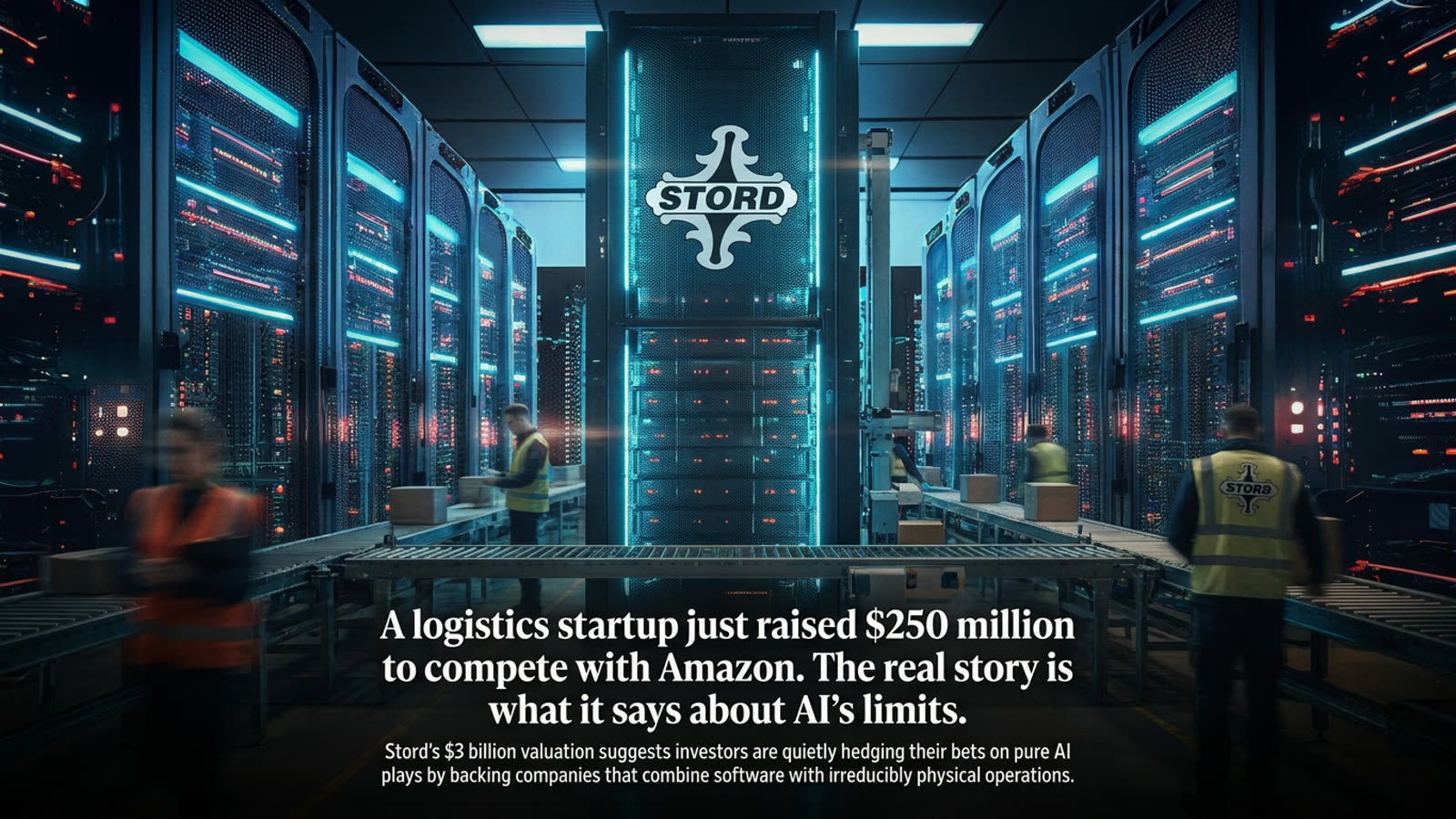
The venture capital market has spent three years chasing anything with "AI" in the pitch deck, but the smart money is starting to remember that atoms still matter. Stord, an Atlanta-based fulfillment and logistics company that competes directly with Amazon's third-party seller infrastructure, just closed a $250 million round at a $3 billion valuation—a remarkable figure for a company whose core business involves warehouses, trucks, and the deeply unglamorous work of moving boxes from point A to point B.
The round signals something important: investors are recalibrating their portfolios away from pure software plays toward companies that combine AI capabilities with physical moats. Stord uses machine learning for demand forecasting, inventory optimization, and route planning, but its actual competitive advantage lies in its network of fulfillment centers and carrier relationships—assets that cannot be replicated by a well-funded competitor with a better algorithm.
The Amazon problem nobody wants to discuss
Amazon's Fulfillment by Amazon (FBA) program has long held a near-monopoly on e-commerce logistics for small and mid-sized sellers. But FBA's fees have climbed relentlessly—storage costs increased roughly 30 percent over the past two years—and sellers increasingly complain about opaque policies, inventory limits, and the existential risk of building a business entirely dependent on a platform that also competes with them directly. Stord's pitch is straightforward: similar capabilities, lower costs, no conflict of interest.
The timing matters. E-commerce growth has normalized after the pandemic surge, which means sellers are scrutinizing unit economics more carefully. A fulfillment partner that can shave a few percentage points off logistics costs while providing comparable delivery speeds becomes genuinely attractive, not just a nice-to-have alternative.
Why VCs are suddenly interested in warehouses
The Stord round reflects a broader shift in how sophisticated investors think about AI's commercial applications. Pure-play AI companies face a brutal dynamic: their technology becomes commoditized quickly, margins compress as foundation model providers compete on price, and the winners tend to be the hyperscalers who can absorb AI as a feature rather than a product. Companies that apply AI to industries with high barriers to entry—logistics, healthcare, manufacturing—can capture more durable value.
Stord's investors are essentially betting that the company can use AI to operate its physical network more efficiently than Amazon operates its own, while avoiding the strategic conflicts that make Amazon a problematic partner for many sellers. It is a more modest thesis than "AI will transform everything," but it has the virtue of being testable against real-world performance metrics.
Our take
The AI gold rush produced a lot of picks-and-shovels rhetoric, but Stord represents something more interesting: a company that treats AI as an operational multiplier rather than a product category. At $3 billion, the valuation prices in significant execution risk—competing with Amazon in logistics is not for the faint-hearted—but it also reflects a market that is growing weary of AI companies whose only moat is being first to market with a feature that OpenAI or Google will ship for free in eighteen months. Sometimes the unsexy bet is the smart one.