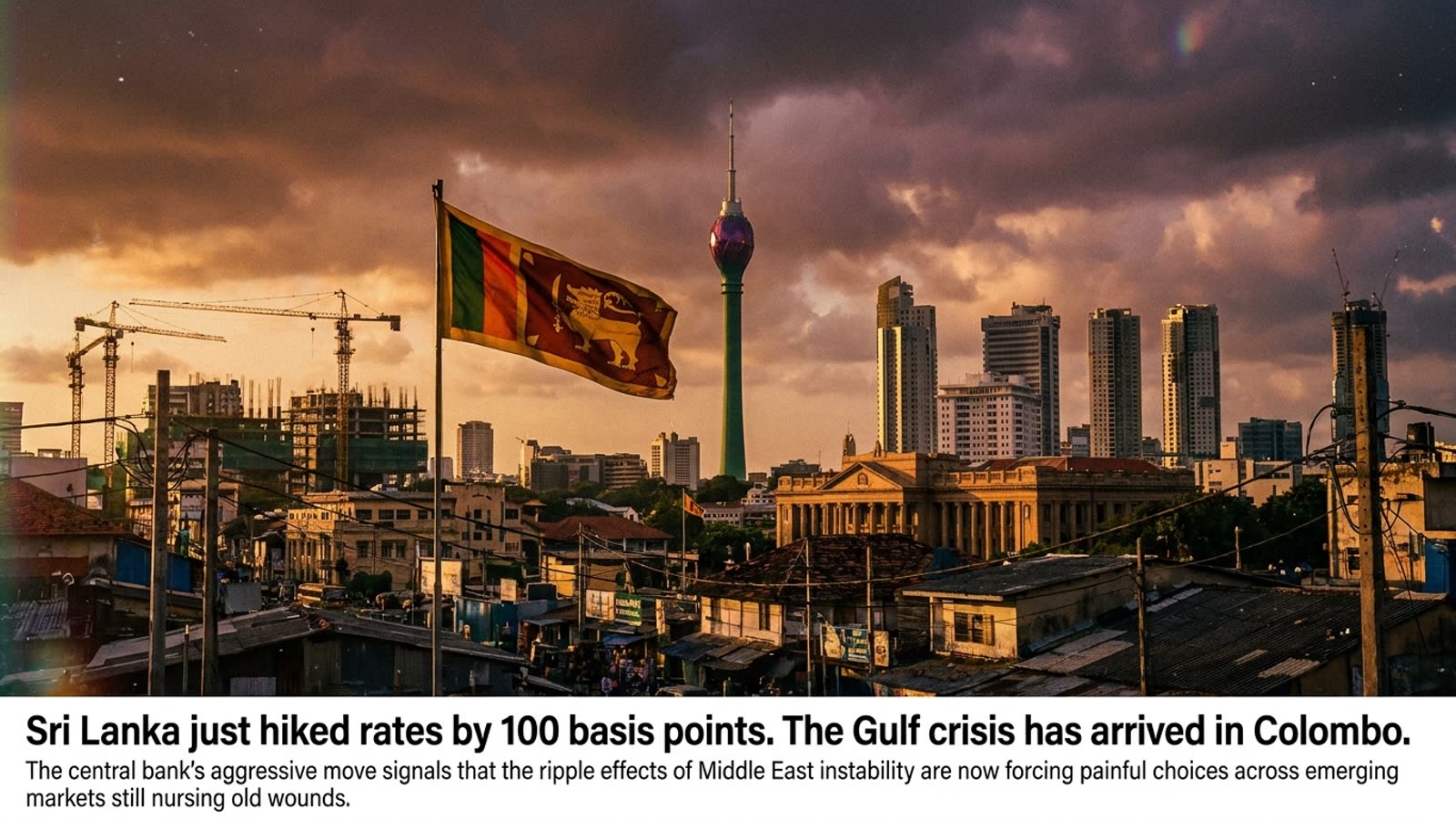
Sri Lanka's central bank delivered a shock on Monday, raising its benchmark rate by a full percentage point in a single session — the kind of emergency maneuver that screams vulnerability rather than confidence. The official rationale cited inflationary pressures stemming from the Gulf crisis, but the subtext is starker: an economy that barely crawled out of its 2022 collapse is now being stress-tested by forces entirely beyond its control.
The timing is brutal. Just as Sri Lanka was beginning to stabilize after its sovereign default and IMF bailout, the disruptions emanating from the Strait of Hormuz have sent fuel costs climbing and the rupee sliding. For an island nation that imports nearly all its energy, the arithmetic is unforgiving. Higher oil means wider current account deficits, which means currency pressure, which means imported inflation — the classic emerging-market doom loop that rate hikes are meant to arrest before it spirals.
The 100-basis-point signal
Central banks rarely move in such large increments unless they feel they're losing control of the narrative. A quarter-point hike signals vigilance; a full point signals alarm. The Central Bank of Sri Lanka is essentially telling markets: we see the problem, we're not behind the curve, and we're willing to accept the growth cost to defend the currency. Whether markets believe that credibility play is another matter. Sri Lanka's foreign reserves remain thin, and its debt restructuring with bondholders is still being implemented. There's not much cushion.
Emerging markets on notice
Sri Lanka is the canary, not the coalmine. Across South Asia and beyond, central bankers are running the same spreadsheets — modeling what sustained energy price volatility does to their inflation targets, their fiscal balances, their political stability. Pakistan, Egypt, and Turkey all carry similar vulnerabilities: heavy import dependence, fragile currencies, populations already squeezed by years of inflation. If the Gulf situation doesn't resolve quickly, expect more emergency meetings and more uncomfortable rate decisions.
The irony is that global markets have been relatively sanguine about the broader economic fallout from Middle East tensions, pricing in a resolution before real damage accumulates. Sri Lanka's move is a reminder that for smaller, more exposed economies, the damage doesn't wait for headlines to settle.
Our take
This is what contagion looks like in slow motion. Sri Lanka's 100-basis-point jolt won't make front pages in New York or London, but it should. The country's fragility makes it an early-warning system for how energy shocks transmit through the global economy's weaker links. When a nation that defaulted three years ago has to slam on the monetary brakes because of events in the Persian Gulf, it's a useful corrective to the complacency that often settles over developed-market trading floors. The Gulf crisis isn't just about oil futures — it's about the policy space that disappears for countries that can't afford to wait and see.