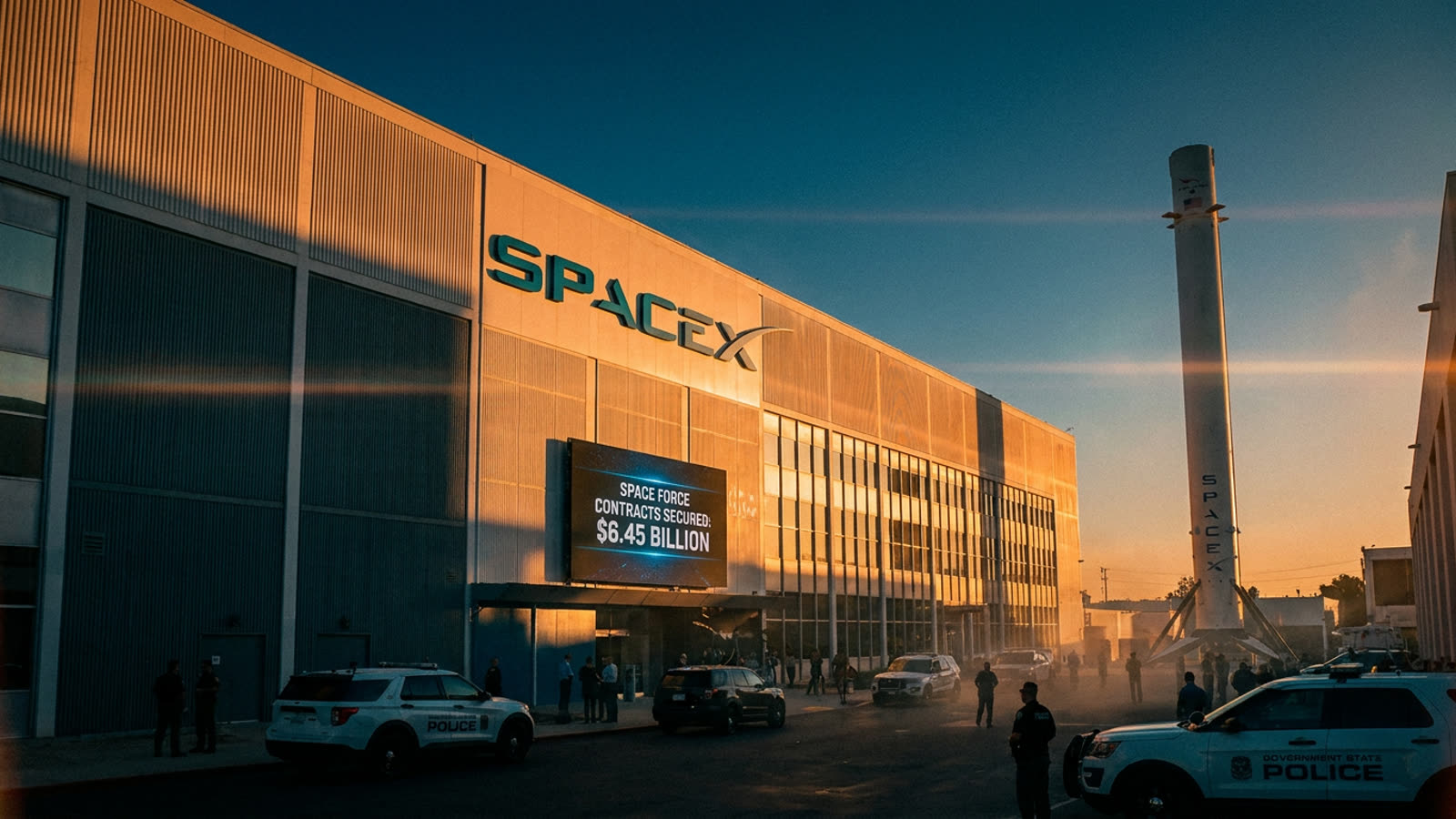
The timing is not coincidental. SpaceX has secured $6.45 billion in Space Force contracts just as the company prepares for what would be the most anticipated initial public offering since Facebook. The defense windfall does more than pad the balance sheet—it fundamentally reframes the investment thesis for a company that has spent two decades blurring the line between private ambition and public mission.
The contracts, announced this week, cover launch services, satellite deployment, and what the Pentagon describes as "responsive space capabilities." In practical terms, SpaceX has become the default infrastructure provider for American military space operations, a position that would have seemed fantastical when Elon Musk founded the company in 2002 with the stated goal of making humanity multiplanetary.
The defense moat
What makes this award significant is not the dollar figure alone—though $6.45 billion is substantial—but the strategic lock-in it represents. SpaceX now handles the majority of national security space launches, a market that competitors like United Launch Alliance and Blue Origin have struggled to penetrate at scale. The Falcon 9's reusability economics have created a pricing advantage that the Pentagon, despite its institutional preference for supplier diversity, cannot ignore.
For prospective IPO investors, the government revenue stream solves a persistent valuation puzzle. SpaceX's commercial businesses—Starlink satellite internet and launch services for private customers—generate impressive revenue but face questions about long-term margin sustainability. Defense contracts, by contrast, offer predictable cash flows with built-in inflation adjustments and multi-year visibility. The company is effectively presenting Wall Street with a hybrid: venture-style growth potential backstopped by utility-style government revenue.
The IPO calculus
SpaceX has reportedly been valued at roughly $350 billion in secondary market transactions, making it the most valuable private company in the world. An IPO would need to justify that valuation to public market investors who tend to be more skeptical than late-stage venture capitalists. The Space Force contracts provide crucial ammunition.
The defense relationship also carries political insurance. In an era of intensifying scrutiny over Musk's various enterprises and his proximity to the Trump administration, SpaceX's role as an indispensable national security asset creates a protective buffer. No administration—regardless of party—can afford to antagonize a company that launches spy satellites and resupplies the International Space Station.
Our take
SpaceX has executed a masterful two-decade arbitrage: use government contracts to fund the development of reusable rockets, then use those rockets to dominate both government and commercial markets. The IPO, when it comes, will not be selling a rocket company. It will be selling a toll road to space that the American government has no choice but to use. That is a very different, and far more valuable, proposition.