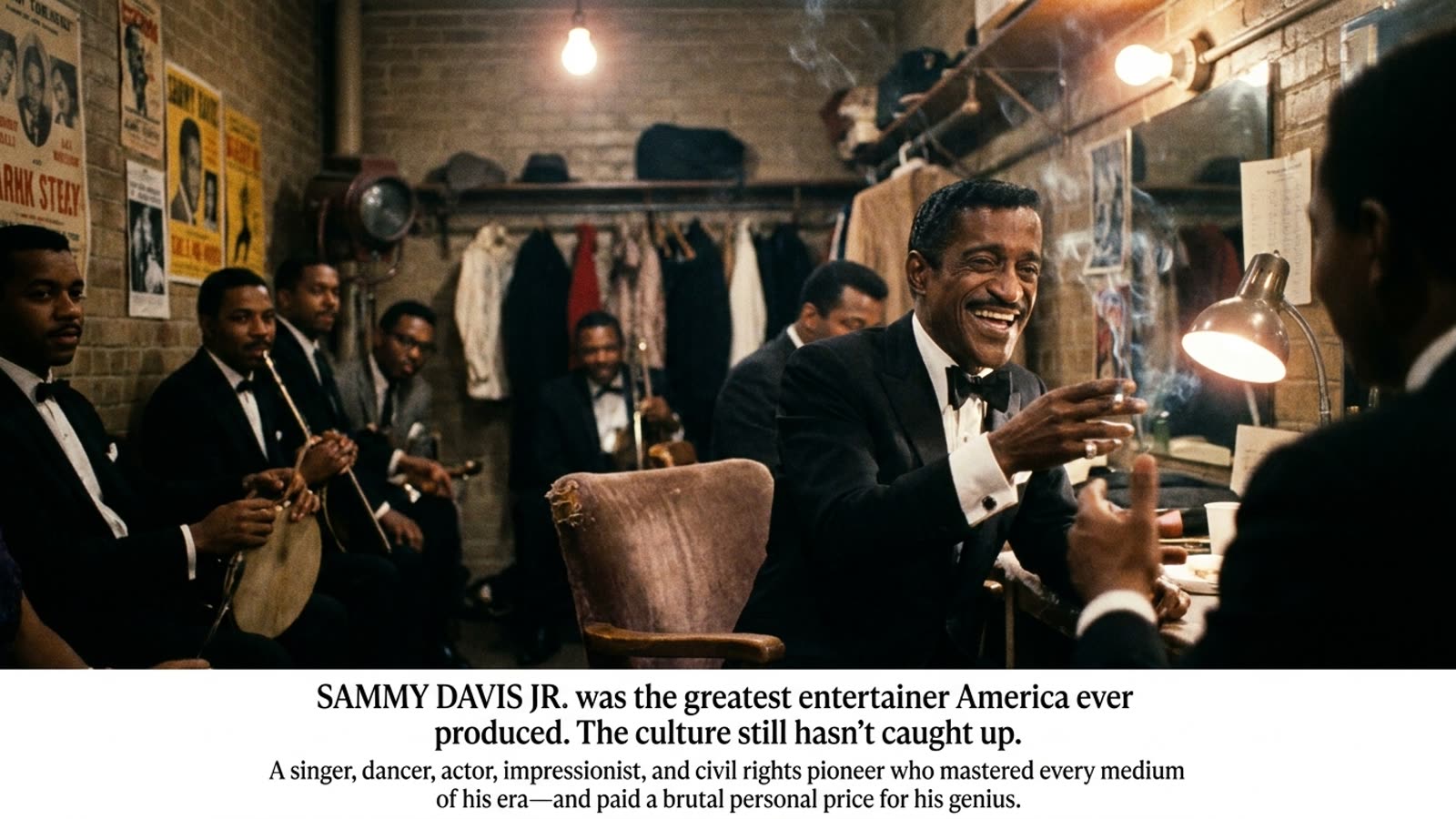
There is no contemporary equivalent to Sammy Davis Jr., and there likely never will be. The very concept of the "total entertainer"—someone who could headline a Broadway musical, anchor a hit television variety show, record platinum albums, star in Hollywood films, and perform stand-up comedy at the highest level—has been atomized by specialization. Davis did all of it, often simultaneously, while navigating American racism with a combination of defiance and accommodation that still generates controversy decades after his death.
The numbers alone are staggering. He recorded more than fifty studio albums. He appeared in over twenty films. He starred on Broadway in Mr. Wonderful and Golden Boy. He hosted his own television variety series and became a fixture on talk shows from the 1950s through the 1980s. And beneath all of it was a tap-dancing virtuosity that Fred Astaire himself acknowledged as superior to his own.
The Rat Pack paradox
Davis's membership in the Rat Pack alongside Frank Sinatra, Dean Martin, Peter Lawford, and Joey Bishop represented both his greatest triumph and most uncomfortable compromise. He was, by most accounts, the most talented performer in the group—a fact his colleagues readily admitted. Yet the dynamics of mid-century American racism meant he often played the subordinate, absorbing racial jokes that read as deeply painful in retrospect, staying in segregated hotels while his white colleagues enjoyed the main resorts.
The arrangement was transactional in ways that remain difficult to assess. Sinatra, whatever his motivations, used his considerable power to desegregate Las Vegas venues, refusing to perform at establishments that wouldn't serve Davis. The friendship was genuine but asymmetrical, and Davis's navigation of it revealed a survival intelligence that his critics have sometimes mistaken for weakness.
The price of assimilation
Davis's 1960 marriage to Swedish actress May Britt generated death threats and cost him a role at John F. Kennedy's inaugural celebration—the new president's team deemed an interracial couple too controversial. His 1972 embrace of Richard Nixon at the Republican National Convention alienated much of the Black community and remains his most debated public act. Was it political naïveté, a desperate bid for mainstream acceptance, or something more calculated?
The simplest explanation may be the most accurate: Davis wanted, with almost pathological intensity, to be loved by everyone. This need—likely rooted in a childhood spent performing in vaudeville from age three, with no formal education and little stability—drove both his extraordinary work ethic and his most questionable decisions.
Our take
The contemporary tendency is to flatten historical figures into heroes or villains, but Davis resists such treatment. He was a Black, Jewish, one-eyed performer who became one of the most famous entertainers on Earth through sheer, almost supernatural talent—and who made compromises along the way that he himself later regretted. The talent, however, was never in question. Watch footage of him performing "Mr. Bojangles" or trading impressions with Johnny Carson, and you're seeing someone operating at a level of skill that simply doesn't exist in the current entertainment landscape. We have specialists now. Davis was the last of the generalists, and the culture is poorer for the loss.