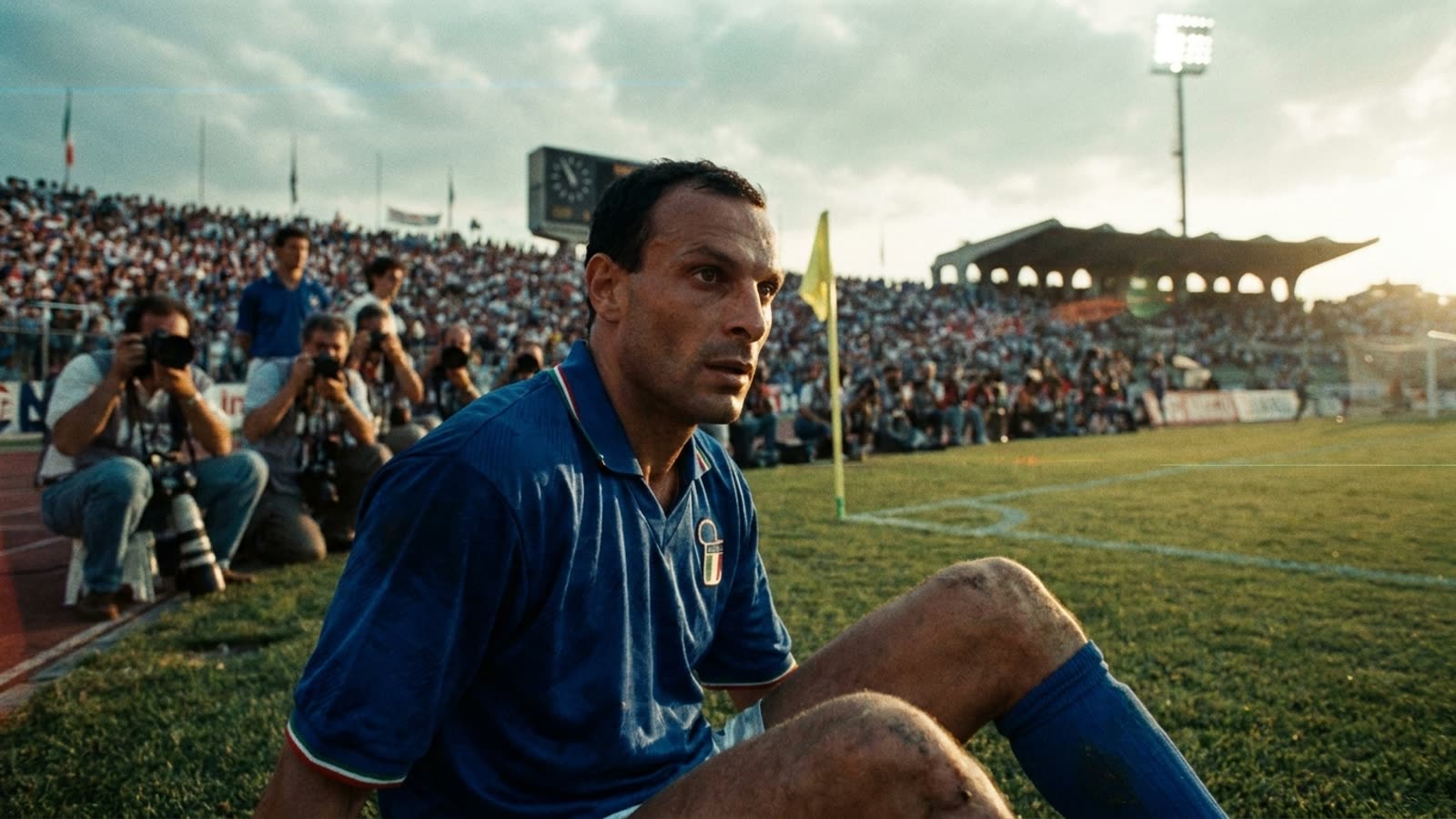
The enduring image is those eyes—wide, bulging, almost terrified by his own success. Salvatore Schillaci did not celebrate goals so much as react to them with bewildered ecstasy, as if he himself could not believe what was happening. In the summer of 1990, neither could anyone else.
Schillaci arrived at Italia '90 as the twenty-fifth man on Azeglio Vicini's roster, a contingency plan from Serie B who had spent most of his career in Sicilian football's lower reaches. He left as the tournament's leading scorer, a national obsession, and proof that the World Cup, more than any other competition, manufactures mythology from improbability.
The provincial route to Rome
Schillaci's path to the Stadio Olimpico traced the geography of Italian football's margins. Born in Palermo's working-class Cep district, he played for Messina in Serie B before Juventus took a modest gamble on him in 1989. He scored fifteen goals in his first Serie A season—respectable, but hardly the CV of a World Cup savior. Vicini included him almost reluctantly, preferring the established credentials of Gianluca Vialli and Roberto Baggio.
Then came the opening match against Austria. Italy labored, the crowd grew restless, and Vicini sent Schillaci on as a substitute. Within minutes, he headed home the winner. The pattern would repeat itself with eerie consistency: Schillaci entering matches, Schillaci finding the net, Schillaci sprinting toward the corner flag with that expression of startled rapture.
A tournament's emotional architecture
What made Schillaci's run so captivating was its alignment with Italy's collective mood. The country was hosting its second World Cup, desperate to improve on the disappointment of 1982's early-round exit on home soil four decades prior. The Azzurri needed a hero who felt earned rather than inherited, someone whose success seemed to surprise even himself.
Schillaci delivered six goals in seven matches, including strikes against Czechoslovakia, Uruguay, and the Republic of Ireland. Each felt like a minor miracle. His technique was workmanlike, his movement intelligent but not exceptional. What he possessed was an almost supernatural ability to be in precisely the right place when the ball arrived, combined with a finisher's cold nerve that his wild-eyed celebrations belied.
The semifinal and after
The dream ended, as Italian World Cup dreams so often do, in a penalty shootout. Argentina prevailed in Naples, and Schillaci's tournament concluded with a consolation goal against England in the third-place match. He collected the Golden Boot and the Golden Ball for best player, awards that testified to his extraordinary month but also marked its limits. Schillaci would never again reach these heights.
His subsequent career traced a melancholy arc: diminishing returns at Juventus and Inter, a final chapter in Japan's nascent J-League. By the time he retired, the 1990 World Cup felt less like a launching pad than an anomaly, a moment when circumstance and form aligned so perfectly they could never be replicated.
Our take
Schillaci's legacy is not about sustained excellence but about what the World Cup uniquely offers: the compression of an entire career's worth of meaning into a single month. He was not Italy's most talented striker of that era, nor even its most important. But he was its most necessary one at precisely the right moment, and football remembers necessity as fondly as genius. Those eyes, forever frozen in disbelief, captured something true about sport's capacity to elevate the unlikely. For one Roman summer, Totò Schillaci was the most famous footballer on earth, and the fact that this seems impossible in retrospect is exactly the point.