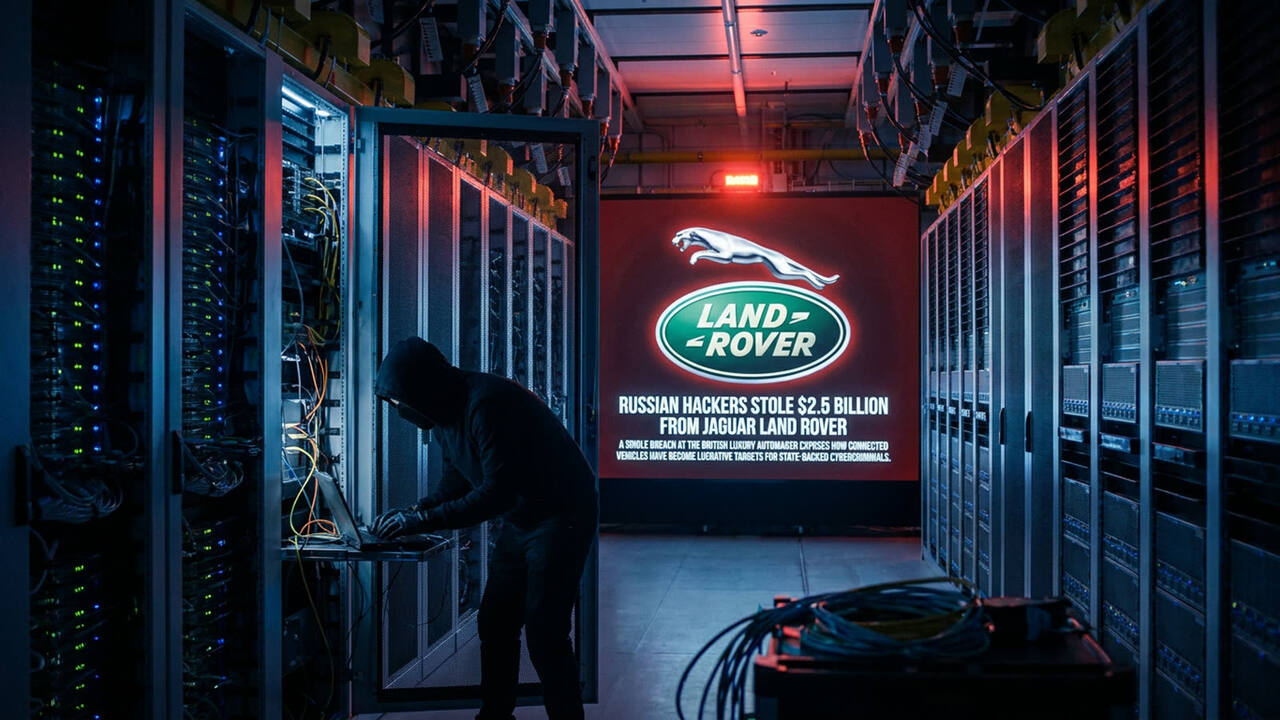
The automotive industry has spent the past decade racing to stuff cars full of software, sensors, and connectivity features. It has spent considerably less time thinking about what happens when hostile actors decide those digital systems are worth exploiting. Now comes the bill: Russian hackers have reportedly extracted $2.5 billion from Jaguar Land Rover in what appears to be one of the largest single-target cyberattacks in automotive history.
The breach, attributed to a Russian state-linked hacking group, reportedly compromised JLR's internal financial systems, supply chain management infrastructure, and proprietary vehicle development data. The scale suggests this was not opportunistic ransomware but a sustained, sophisticated campaign—the kind of patient, well-resourced intrusion that Western intelligence agencies have been warning about for years.
Why automakers are uniquely vulnerable
Modern vehicles are rolling data centers. A typical luxury car now contains over 100 million lines of code—more than a Boeing 787. These systems manage everything from engine timing to customer payment information to real-time location tracking. Yet automotive cybersecurity budgets remain a fraction of what banks or tech companies spend, and the industry's culture still treats software as an afterthought to mechanical engineering.
JLR's predicament is particularly acute. The company, owned by India's Tata Motors, has been navigating a difficult transition to electric vehicles while managing legacy systems built in an era when "connected car" meant satellite radio. The attack reportedly exploited vulnerabilities in supplier interfaces—the sprawling network of third-party vendors that provide everything from infotainment chips to seat motors. This supply chain complexity is an industry-wide weakness, not a JLR-specific failing.
The geopolitical dimension
Russian cyber operations have increasingly targeted Western industrial infrastructure since the invasion of Ukraine, and automotive manufacturing sits squarely in the crosshairs. Vehicle production data, supplier relationships, and financial flows all have intelligence value. The $2.5 billion figure—if accurate—suggests the hackers achieved deep access to payment systems, possibly including fraudulent wire transfers or extortion payments that JLR has not publicly acknowledged.
British and American authorities are reportedly investigating, though attribution in cyber operations remains contested. What is clear is that the attack fits a pattern: state-backed groups using criminal techniques to generate revenue while simultaneously gathering industrial intelligence.
Our take
The automotive industry's cybersecurity reckoning was always coming; the only question was which company would become the cautionary tale. JLR now holds that distinction, and the $2.5 billion figure—roughly equivalent to the company's entire annual R&D budget—should concentrate minds across the sector. Every automaker rushing to add over-the-air updates, subscription services, and autonomous features is simultaneously expanding its attack surface. The companies that survive the next decade will be those that treat cybersecurity as a core engineering discipline rather than an IT cost center. The rest will learn, expensively, that hackers find connected cars just as appealing as consumers do.