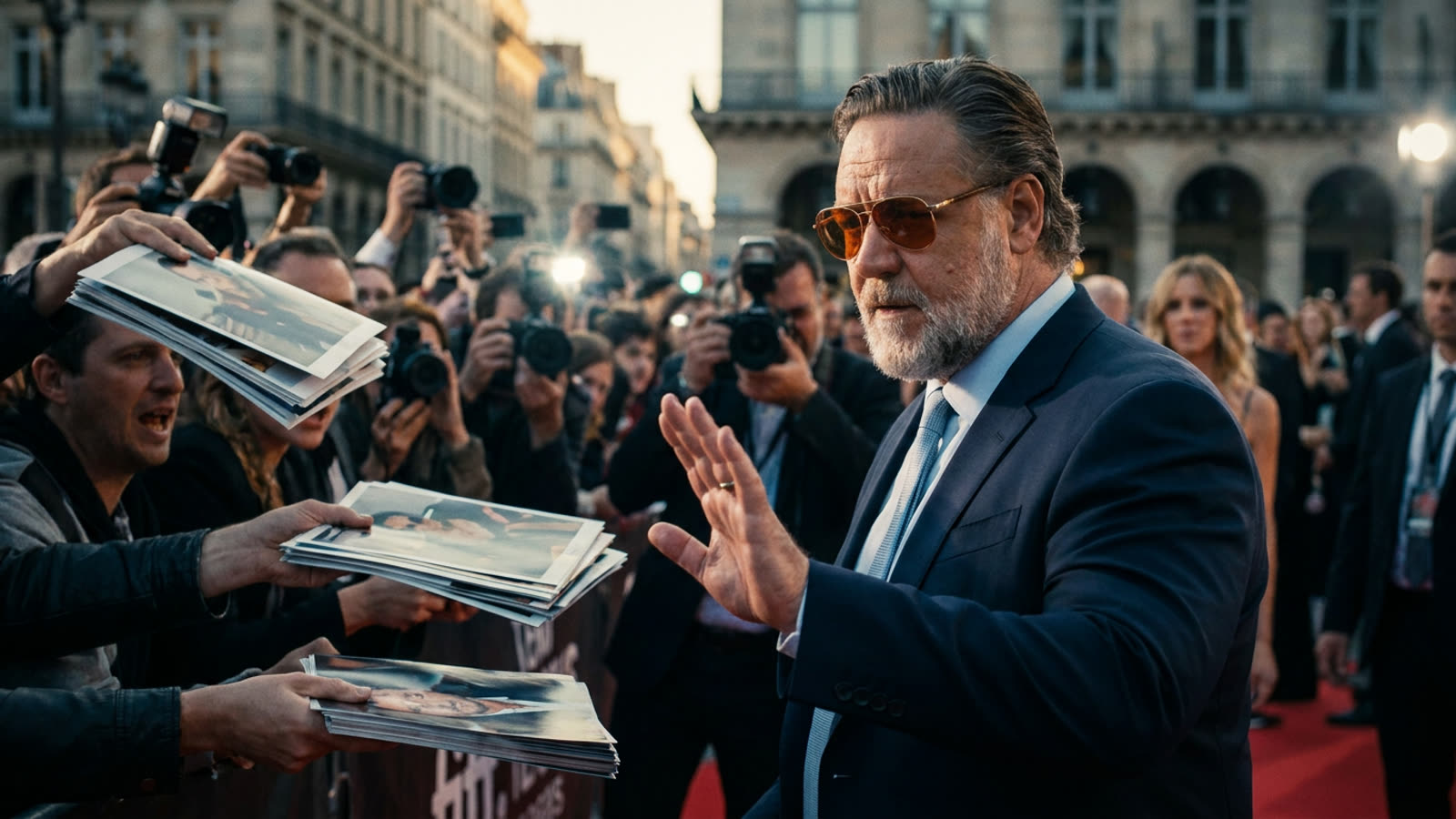
Russell Crowe has never been mistaken for a pushover. The actor who once hurled a telephone at a hotel concierge and whose on-set intensity is Hollywood legend has, in recent years, cultivated a warmer public persona—affable on talk shows, generous with fans on social media, seemingly at peace with his place in the cultural firmament. So when Crowe felt compelled to issue a public warning to autograph seekers camped outside his Paris hotel this week, it suggested something more systemic than a star having a bad day.
The message, delivered with characteristic directness, asked the assembled hunters to "behave" or face consequences. No physical threats, no security summoned—just a 62-year-old man drawing a boundary that apparently needed drawing.
The professional autograph industrial complex
What Crowe encountered in Paris bears little resemblance to the fan culture of previous generations. The people waiting outside celebrity hotels in major cities are increasingly not fans at all but professional resellers running what amounts to a small commodities trading operation. A signed Crowe photograph fetches $150-300 on authentication sites; multiply that by a dozen signatures obtained during a single hotel departure, and the economics become clear.
These operators travel circuits—Cannes during the festival, Paris during fashion weeks, Los Angeles year-round—treating celebrity proximity as inventory acquisition. They know flight schedules, hotel preferences, restaurant reservations. The line between dedicated collector and low-grade stalker has blurred into irrelevance.
Why celebrities are pushing back now
Crowe is hardly alone in his frustration. The past eighteen months have seen a notable shift in how A-listers handle autograph culture, with several high-profile actors declining to sign anything outside controlled environments. The calculation has changed: social media means any terse interaction becomes content, any boundary-setting becomes "celebrity behaving badly," any refusal becomes evidence of ingratitude.
Yet the alternative—endless compliance with professional extractors—creates its own problems. Authentication services have made unsigned items nearly worthless for resale, which means the pressure on celebrities to sign has intensified precisely as their patience has worn thin.
Our take
Crowe's Paris moment is minor as celebrity news goes, but it illuminates something worth noting: the parasocial economy has matured into something genuinely parasitic. The people he addressed weren't seeking connection or even a brush with fame—they were working a shift. That Crowe, of all people, chose measured words over confrontation suggests even he recognizes the futility of fighting a business model. The autograph hunters will be back tomorrow. The only question is whether celebrities will keep showing up to meet them.