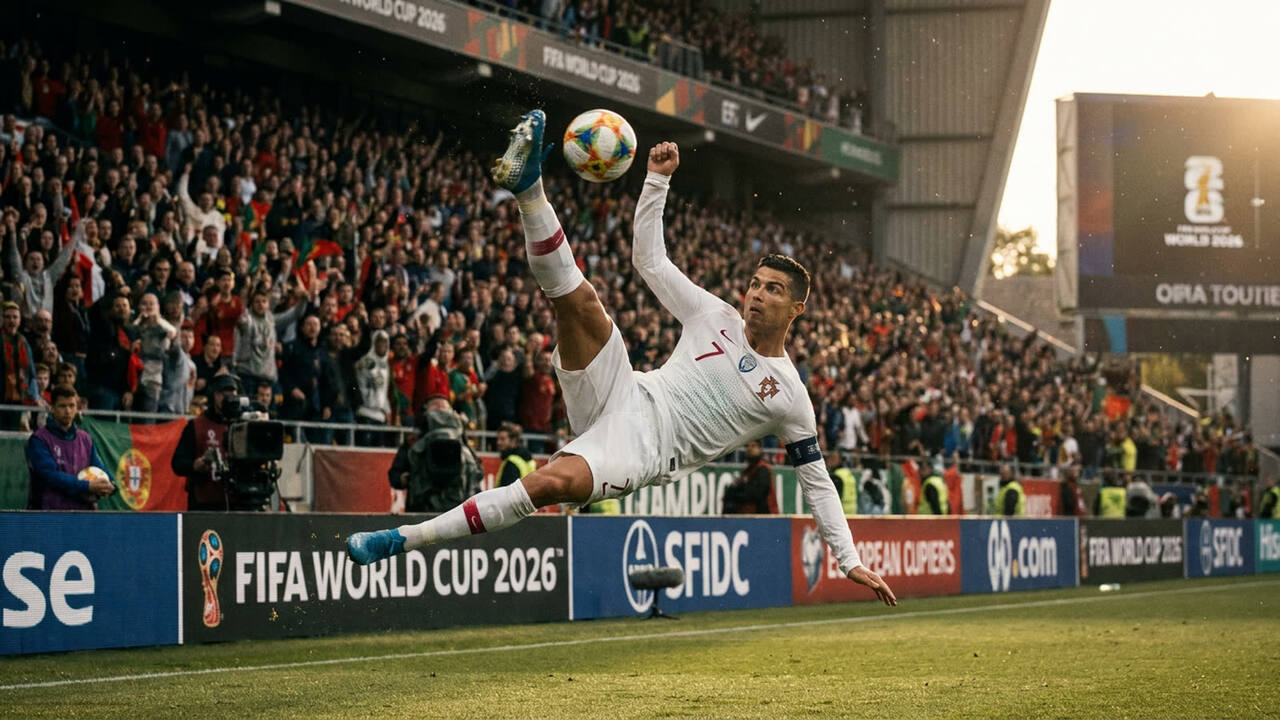
The 2026 World Cup was supposed to belong to a new generation. Instead, we are watching Cristiano Ronaldo bend the tournament's narrative around himself one more time.
At 41, the Portuguese forward is the oldest outfield player at this expanded 48-team tournament, a relic from an era when the competition featured half as many nations. His body has slowed. His club career wound through Saudi Arabia's lucrative but obscure Pro League. Yet here he is, starting for Portugal, demanding the ball in dangerous areas, and commanding the attention of a global audience that cannot quite look away.
The physics of decline
Ronaldo's numbers tell a story of diminishing returns. His sprint speed has dropped measurably since his Real Madrid peak. His conversion rate on chances has declined. Portugal's coaching staff has quietly restructured the attack to reduce his defensive responsibilities, essentially building a system that accommodates a player who can no longer press for 90 minutes.
But statistics miss something essential about Ronaldo's presence. He remains a gravitational force — defenders shade toward him even when younger, faster teammates occupy better positions. Whether this helps or hinders Portugal is genuinely unclear. What is undeniable is that no other player at this tournament commands equivalent attention simply by standing in the penalty area.
The Messi parallel
The other ageing colossus, Lionel Messi, arrived at this World Cup as a defending champion with nothing left to prove. Ronaldo's situation is different: he has never won this trophy, and at 41, this is almost certainly his last chance. The asymmetry between them — Messi's 2022 triumph versus Ronaldo's continued pursuit — has become football's defining narrative of the 2020s.
Ronaldo's response has been characteristically defiant. He has spoken openly about wanting to score in this tournament, about proving doubters wrong, about legacy. The hunger is admirable. Whether it serves Portugal's collective interests is another question entirely.
Our take
Ronaldo's final World Cup is compelling precisely because it refuses to be a graceful exit. He is not here to wave goodbye; he is here to win. The tension between his individual ambition and Portugal's tactical needs will define their tournament. It may end in tears or triumph, but it will not end quietly — and that, perhaps, is the most Ronaldo outcome imaginable.