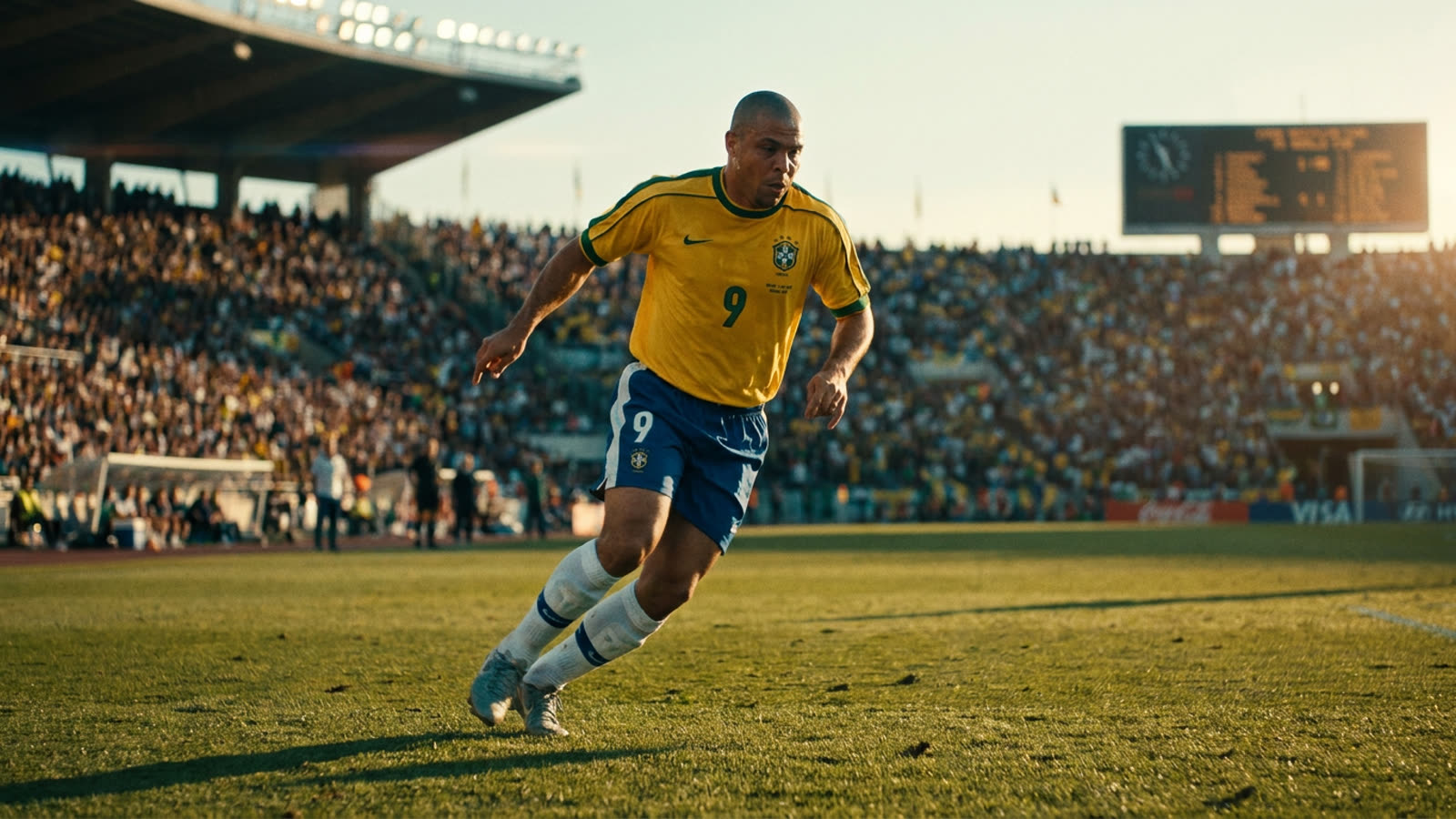
There is a particular kind of football genius that announces itself not through elegance but through impossibility. Pelé had grace, Maradona had cunning, Messi has geometry. Ronaldo Luís Nazário de Lima had something else entirely: he moved through defenses the way light moves through water, bending where it should not bend, arriving where he could not possibly arrive.
The footage still startles. Watch him against Compostela in 1996, collecting the ball near the halfway line, then simply deciding that five defenders were a suggestion rather than an obstacle. Or against Valencia that same season, when he received a pass with his back to goal, turned, and accelerated past three men before they had processed that he had started moving. The ball stayed glued to his foot at speeds that should have sent it spinning into the stands.
The body that betrayed its own brilliance
Ronaldo's career divides neatly into two eras: before the knee injuries and after. The first Ronaldo, the one who terrorised Serie A and won consecutive FIFA World Player of the Year awards before turning twenty-two, was perhaps the most complete striker the sport has produced. He combined the low center of gravity of a winger with the finishing instinct of a pure number nine and the upper-body strength of a defender. Goalkeepers described facing him as confronting a mathematical paradox—he was simultaneously too fast to contain and too powerful to dispossess.
Then came the ruptures. The patella tendon gave way in November 1999, then again in April 2000. The Ronaldo who returned was heavier, more cautious, stripped of the explosive acceleration that had made him supernatural. He was still excellent—the 2002 World Cup proved that conclusively—but he was no longer extraterrestrial.
What the numbers cannot capture
Statistically, Ronaldo's career looks impressive but not transcendent: roughly 350 goals across club and country, two World Cups, a pair of Ballon d'Ors. The numbers fail to convey the experience of watching him. Other great players make the difficult look easy; Ronaldo made the impossible look inevitable. His signature move—a step-over executed at full sprint, followed by an acceleration that left defenders leaning the wrong way—was not technically complex. It was simply performed at a velocity that human reaction times could not accommodate.
The tragedy is one of truncation. We saw perhaps four full seasons of peak Ronaldo before his body revolted. Messi and Cristiano Ronaldo have had two decades at the summit; the original Ronaldo had a handful of years. The brevity makes the memories sharper, more precious, tinged with the particular melancholy of potential unrealised.
Our take
Football history will always wonder what Ronaldo might have achieved with functioning knees. But perhaps scarcity is its own kind of legacy. The players we debate endlessly are often those who gave us just enough brilliance to imagine infinity. Ronaldo gave us four years of footage that still looks fake, a World Cup redemption arc for the ages, and the permanent suspicion that we witnessed something the sport was not quite designed to contain. That is enough. That is more than enough.