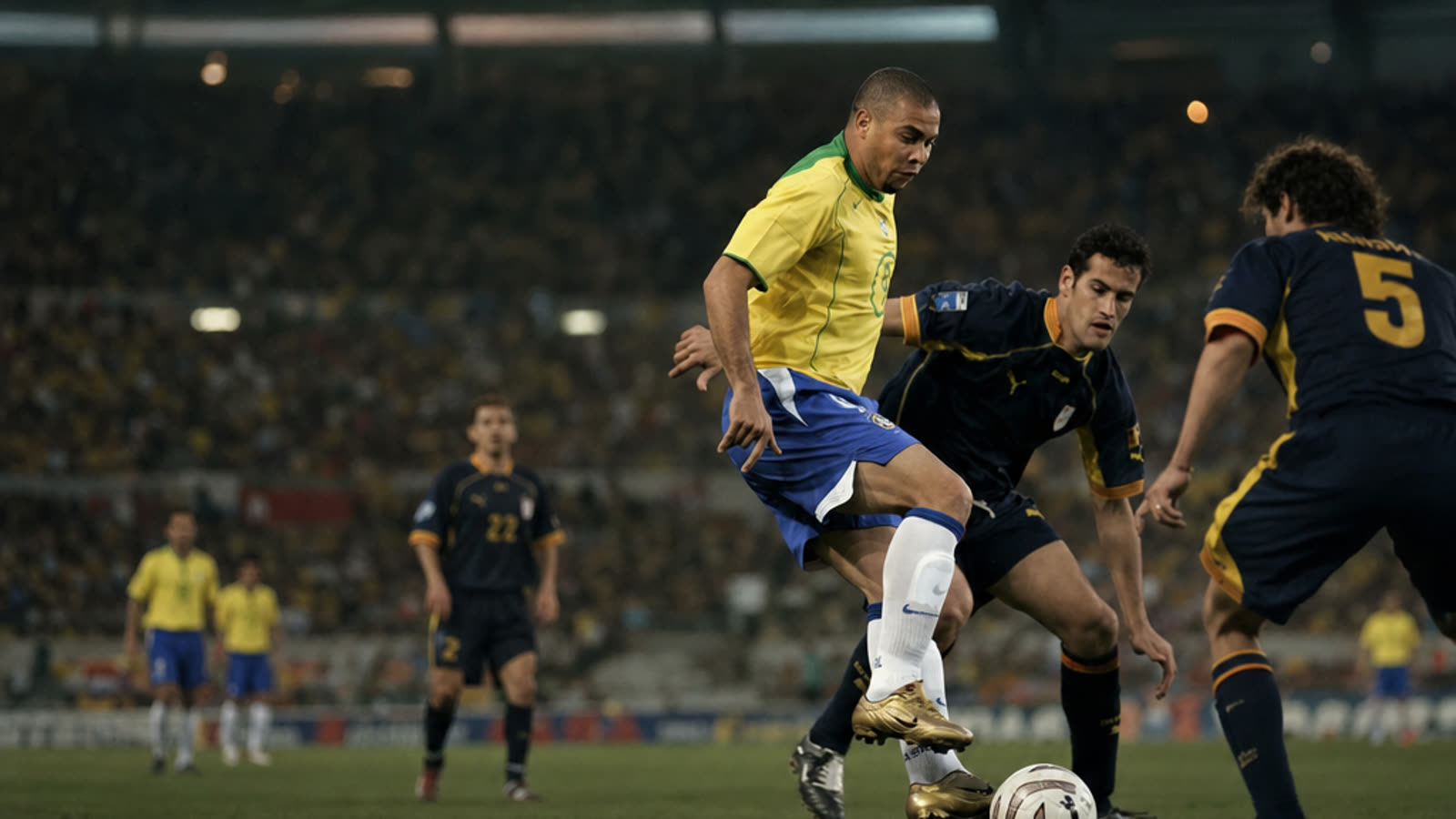
There is a particular cruelty reserved for athletes whose bodies betray their genius. Ronaldo Luís Nazário de Lima—O Fenômeno—possessed physical gifts so absurd that defenders often looked like they were moving through different temporal planes. Then his knees exploded, repeatedly, and football was left to argue forever about what might have been.
The debate over the greatest striker in history typically involves sustained excellence: Pelé's longevity, Gerd Müller's relentless efficiency, or the statistical dominance of more recent finishers. Ronaldo's case rests on something harder to quantify—the sheer impossibility of what he did when healthy. At his peak with Barcelona and Inter Milan in the mid-to-late 1990s, he combined sprinter's acceleration with a center-forward's finishing and a playmaker's vision. Defenders couldn't foul him because he was past them before they could react.
The body as betrayal
The first major rupture came in November 1999: a partial tear of his right patellar tendon during an Inter match. The second, more devastating injury occurred in April 2000, when he attempted a comeback and the same tendon ruptured completely on live television. He was twenty-three years old. The footage remains difficult to watch—Ronaldo collapsing without contact, his career as a physical marvel effectively over.
What followed was a different kind of greatness. The Ronaldo who returned for the 2002 World Cup was slower, heavier, and somehow still unstoppable. He scored eight goals in that tournament, including both in the final against Germany, winning his second World Cup and the Golden Boot. But this was compensation, not continuation. The player who terrified Serie A defenses with his combination of power and delicacy was gone. In his place stood a brilliant but diminished version, a great goalscorer rather than an athletic phenomenon.
The impossible counterfactual
Football history is littered with injury casualties, but Ronaldo's case haunts differently because of what we actually witnessed. This wasn't potential cut short before it could flower—we saw the full bloom, briefly, before it was torn away. Those who watched him at Barcelona in 1996-97, scoring forty-seven goals in forty-nine games while still a teenager, saw something unprecedented. The question isn't whether he would have been the greatest; it's by how much.
The modern game's obsession with statistics and sustained performance makes Ronaldo's abbreviated prime harder to contextualize. He won two Ballon d'Or awards and three FIFA World Player of the Year titles, yet his peak lasted perhaps four full seasons. Compare this to the decade-plus dominance of Lionel Messi or Cristiano Ronaldo (no relation), and the numbers seem modest. But numbers miss the point. Ronaldo at his best didn't just beat defenders—he made the sport look like it had been designed around his specific capabilities.
Our take
The greatest-ever arguments are ultimately unanswerable, which is precisely why they persist. But Ronaldo Nazário offers something more interesting than a definitive ranking: he represents the sport's reminder that genius is borrowed, not owned. His knees didn't just end a career trajectory; they created football's most compelling ghost story. Every generation will have to take the word of those who watched him that yes, there really was a player who moved like that, and no, we'll never see the full version of what he might have become.