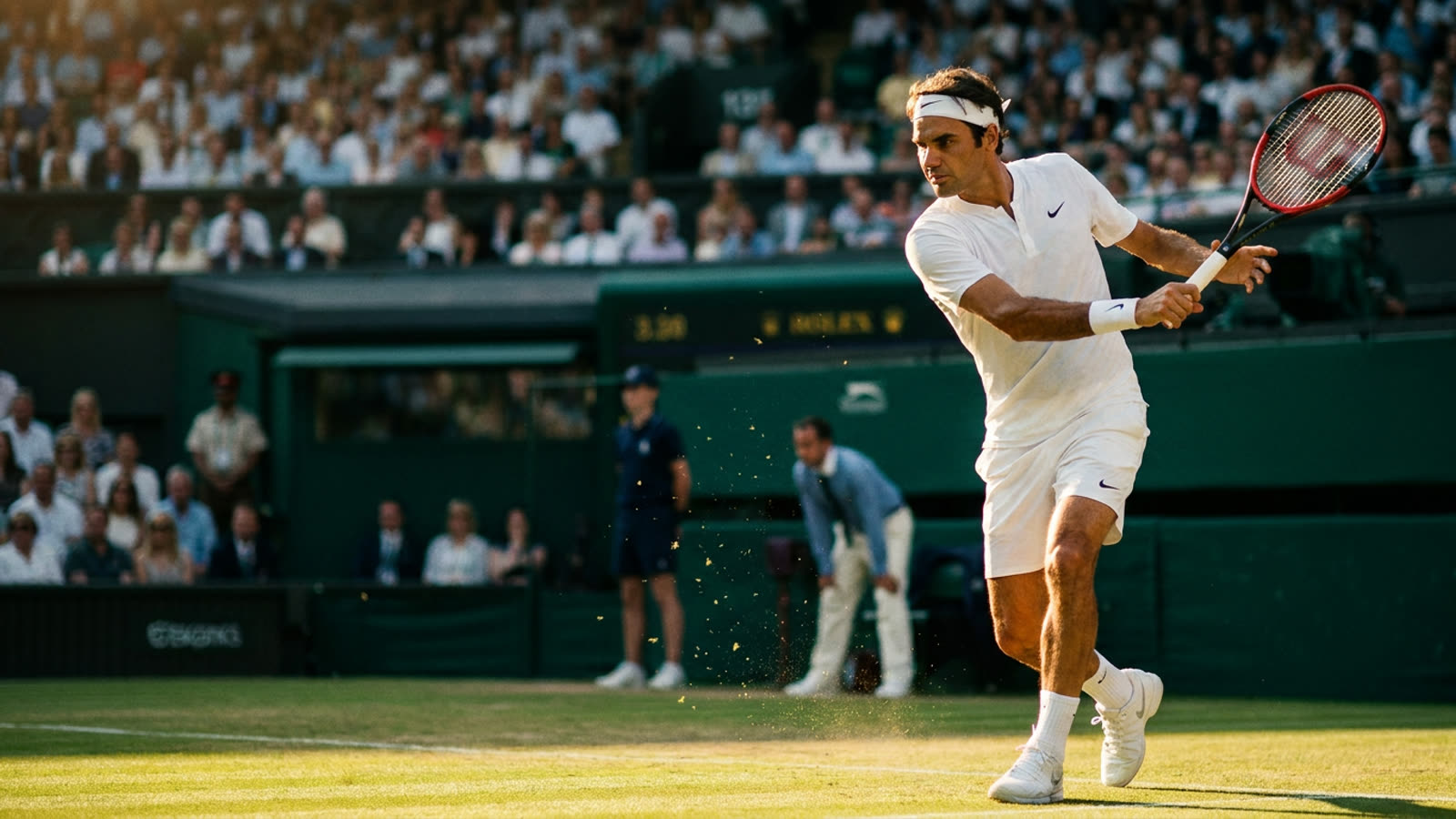
Tennis has always struggled with the question of whether it is a sport or an art form. Roger Federer's career suggested the answer was yes.
The numbers are extraordinary—twenty Grand Slam singles titles, 310 weeks at world number one, a record that stood for over a decade before being surpassed—but they miss something essential about what Federer represented. He was not merely successful. He was aesthetically singular, a player whose movement and shot-making seemed to operate according to different physical laws than those governing his opponents. Where Rafael Nadal's game was constructed from visible effort and Novak Djokovic's from preternatural flexibility, Federer's appeared to require nothing at all. The ball simply went where it was supposed to go, as if by mutual agreement.
The architecture of ease
This effortlessness was, of course, an illusion—the product of biomechanics so refined that the work became invisible. Federer's one-handed backhand, the shot that defined him more than any other, required timing measured in milliseconds and a kinetic chain that coaches still study. His service motion was a model of efficiency, generating pace without the violent torque that shortened other careers. But the technical excellence was always in service of something larger: the idea that sport at its highest level should look like play.
This philosophy put Federer at odds with the direction tennis was traveling. The modern game rewards grinding, the willingness to absorb punishment and extend rallies until the opponent cracks. Federer's response was to end points before they could become wars of attrition, to hit winners from positions where others would have been content with neutral balls. It was a high-wire act that became more precarious as his reflexes slowed, but he never abandoned it. The alternative—becoming a different kind of player—was apparently unthinkable.
The Nadal problem
No discussion of Federer is complete without acknowledging Rafael Nadal, whose left-handed topspin was specifically designed, whether by accident or intention, to exploit Federer's backhand. Their rivalry was asymmetric: Federer was the favorite everywhere except on clay, where Nadal was essentially unbeatable, and in the moments that mattered most, Nadal's physical intensity often overwhelmed Federer's elegance. The 2008 Wimbledon final, widely considered the greatest tennis match ever played, ended with Federer losing in near-darkness, his game finally unable to solve the puzzle Nadal posed.
That loss, more than any victory, revealed something important about Federer. He was not invincible, and he knew it. The tears that followed major defeats were genuine, the frustration of a perfectionist confronting the limits of perfection. But he kept returning, kept playing the same beautiful, risky tennis, kept refusing to grind. There was stubbornness in the elegance.
Our take
Federer's retirement left tennis with champions who are objectively his equals or superiors by certain metrics, but none who offer quite the same thing. His gift was making excellence look like the natural order rather than the product of suffering, and in doing so, he reminded audiences why they watch sport in the first place. Not just to see who wins, but to see what humans can become when they master something completely. The scoreboard was never really the point.