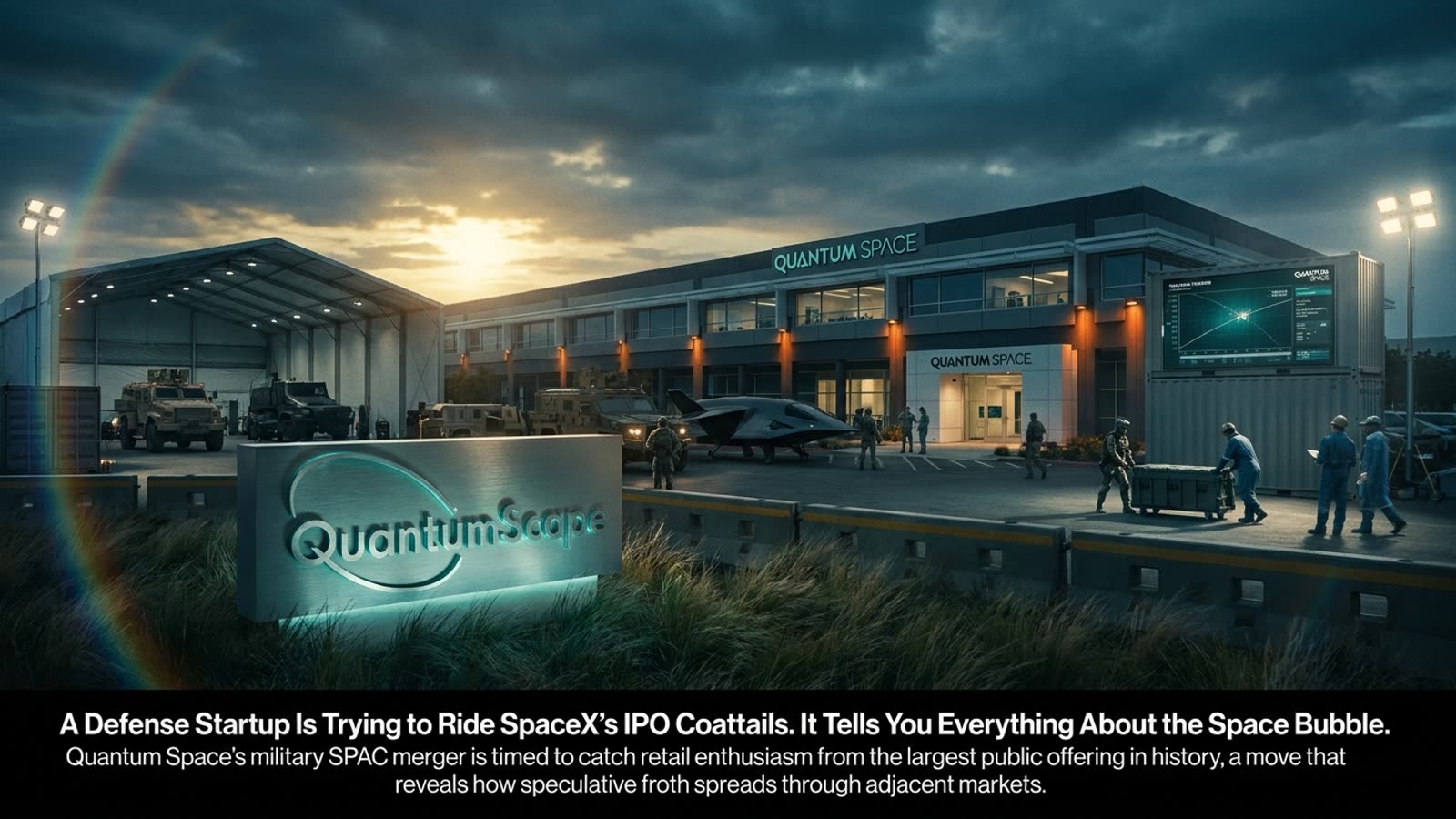
When SpaceX prices the largest IPO ever recorded, the ripples don't stay confined to one stock. They slosh into every corner of the aerospace sector, lifting vessels of wildly varying seaworthiness. Quantum Space, a Maryland-based company building satellite-servicing technology for the Pentagon, has chosen this precise moment to finalize a SPAC merger that will take it public—a decision that is either shrewd opportunism or a warning flare about market conditions, depending on your appetite for risk.
The timing is not coincidental. Quantum Space's management has been explicit: they want public-market exposure while investor enthusiasm for space assets is at a cyclical peak. The SpaceX offering, which raised approximately $75 billion at $135 per share, has created a gravitational field that pulls capital toward anything with "space" in the pitch deck. Quantum Space is positioning itself squarely in that orbit.
The SPAC Calculus
SPACs—special-purpose acquisition companies—were the darlings of 2020 and 2021, then became punchlines after a wave of post-merger collapses. Virgin Orbit went bankrupt. Astra's stock fell more than 95 percent from its peak. Yet the structure persists because it offers something traditional IPOs cannot: speed, certainty of price, and the ability to make forward-looking projections that SEC rules prohibit in conventional prospectuses. For a defense contractor with contracts but limited revenue, that last feature is particularly attractive.
Quantum Space's pitch centers on its Rogue spacecraft platform, designed to service, inspect, and reposition satellites in cislunar space—the region between Earth and the Moon that the Pentagon considers strategically vital. The company has secured contracts with the Air Force Research Laboratory and NASA, but its commercial revenue remains modest. A SPAC lets it tell a story about future cash flows that a traditional S-1 filing would not permit.
Why Defense Space Is Different
The bull case for Quantum Space rests on a genuine shift in military doctrine. The Pentagon now treats space as a contested warfighting domain, and satellite servicing is central to resilience. If an adversary can disable a reconnaissance satellite, the ability to repair or relocate it becomes a strategic asset. Quantum Space is one of several startups—including Astroscale and Orbit Fab—racing to build that capability.
The bear case is simpler: defense procurement is slow, lumpy, and subject to political whims. A change in administration or a budget sequester can vaporize projected revenue. And unlike SpaceX, which has a proven launch business generating billions in annual revenue, Quantum Space is still in the demonstration phase. Investors buying the SPAC are betting on contracts that have not yet been signed.
Our take
Quantum Space may well succeed—its technology addresses a real need, and its Pentagon relationships are genuine. But the decision to go public via SPAC, timed to coincide with SpaceX's record offering, is a tell. It suggests management believes this is a window, not a floor. When the largest IPO in history creates a rising tide, some boats float higher than their hulls deserve. Investors would be wise to check for leaks before climbing aboard.