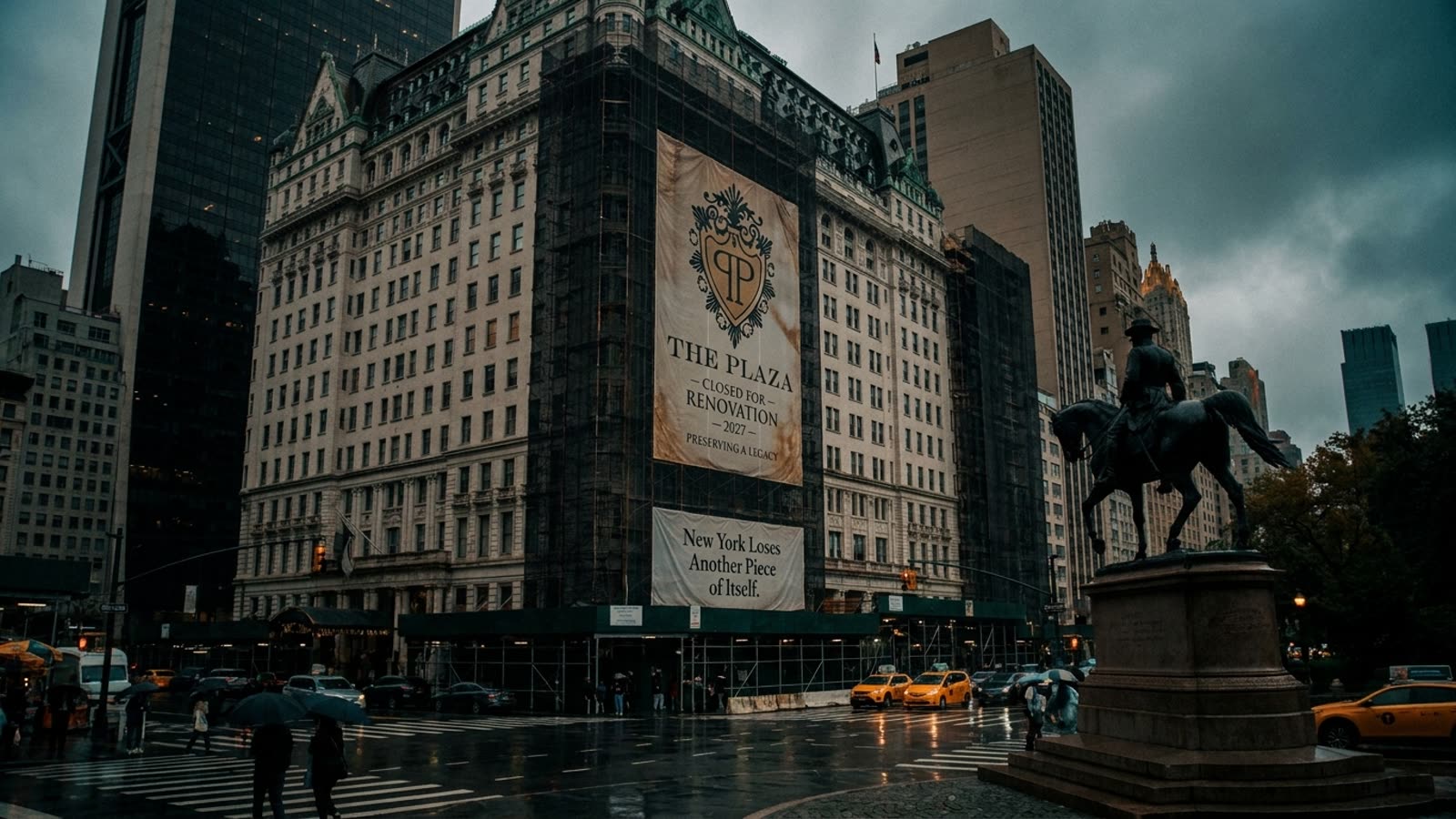
There is a particular kind of New York grief reserved for places that close not because they failed, but because they succeeded too well at becoming irreplaceable. The Plaza Hotel, which will shut its doors in 2027 for at least four years of renovation, belongs to this category — a building so thoroughly woven into the city's mythology that its temporary absence will feel like a small death.
The hotel opened in 1907 at Fifth Avenue and Central Park South, and has spent the intervening century accumulating the kind of cultural sediment that cannot be manufactured. Eloise lived there, in Kay Thompson's imagination and then in the world's. Kevin McCallister charged room service there in Home Alone 2. The Beatles held court there. So did Truman Capote, F. Scott Fitzgerald, and approximately every person who has ever wanted to feel, for a night, like the version of themselves that deserves a view of the park.
The renovation question
The ownership group, a partnership between Katara Hospitality and a Saudi investment fund, has been characteristically vague about what four years and an undisclosed sum will actually produce. The building requires significant infrastructure work — that much is clear from city filings. But the deeper question is whether the Plaza that reopens will bear any meaningful resemblance to the one that closes.
Grand hotels face an impossible calculus in the 2020s. The travelers who can afford them increasingly expect the frictionless anonymity of Aman or the performative minimalism of boutique properties. The Plaza's appeal has always been the opposite: maximalist, specific, unapologetically itself. Gilt and marble and the faint suggestion that you might run into someone interesting in the Palm Court.
What closures cost
New York has watched this happen before. The Waldorf-Astoria closed in 2017 for what was supposed to be a three-year renovation; it remains shuttered nearly a decade later, its reopening perpetually imminent. The Pierre survived its own renovation scare. The St. Regis endures. But the Plaza occupies different territory — it is less a hotel than a municipal landmark that happens to rent rooms.
The staff, several hundred strong, will be dispersed. Some will be offered positions at other properties; most will simply join the city's hospitality workforce in waiting. The Oak Room, already converted to retail space years ago, will presumably remain whatever it becomes next. The residential condominiums that occupy the upper floors will continue their separate existence, their owners unbothered by the construction below.
Our take
Four years is long enough for a city to forget what it had. The Plaza will reopen eventually, probably with better plumbing and worse charm, and tourists will still take photographs on the steps. But something will have been lost in the interval — not the building, which will survive, but the continuity that made it matter. New York is a city that runs on the fiction that certain places are permanent. Every closure is a small confession that they are not.