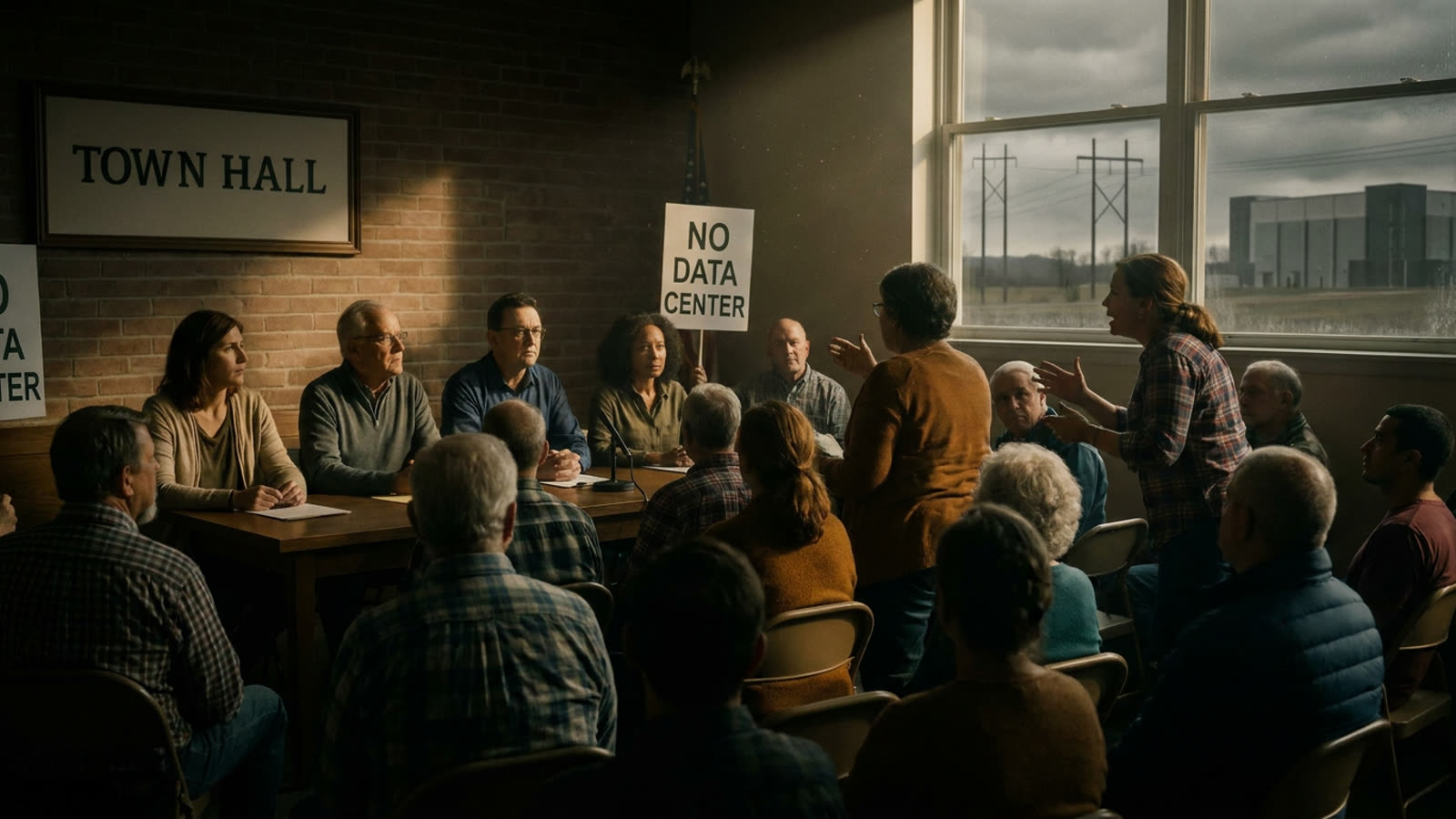
The residents of rural Pennsylvania did not sign up to become the cooling system for artificial intelligence. But that is increasingly what they are being asked to do, and at a town hall meeting this week, they made clear they have had enough.
The gathering, which drew hundreds of locals to voice opposition to proposed data center developments, represents a new phase in the AI infrastructure debate. For years, the conversation about compute capacity has been conducted in the abstract language of kilowatts and market cap. Now it is being translated into the concrete grievances of people watching their electricity bills climb while tech companies negotiate sweetheart deals for the power their facilities will consume.
The arithmetic of resentment
Data centers are extraordinarily thirsty for electricity. A single large facility can draw as much power as a small city, and the AI boom has only intensified demand. Training and running large language models requires orders of magnitude more compute than traditional cloud services, which means the facilities being proposed today are far larger than those built even five years ago.
For communities that host them, the calculus is rarely favorable. Data centers create few permanent jobs—a facility that consumes as much electricity as fifty thousand homes might employ a few dozen technicians. The tax revenues they generate often fall short of the infrastructure costs they impose. And when power grids strain under the load, it is residential customers who face rate increases and reliability concerns.
Pennsylvania's grid, already stressed by the retirement of coal plants and the slow pace of renewable buildout, is particularly vulnerable. The state sits in the PJM Interconnection, the largest wholesale electricity market in North America, where data center demand has become a dominant factor in capacity planning.
The NIMBY problem goes national
What happened in Pennsylvania is not an isolated incident. Similar confrontations have erupted in Virginia's Loudoun County, long the data center capital of the world, where residents have pushed back against further expansion. In Oregon, communities near the Columbia River have fought proposals that would tap hydroelectric power. And as we reported earlier this month, Lake Tahoe residents are watching their utility provider redirect resources to serve Nevada data centers.
The pattern is consistent: tech companies seek out regions with cheap power, favorable tax treatment, and permissive zoning. Local officials, eager for development, approve projects without fully accounting for their downstream effects. And residents, who discover too late what is being built in their backyards, organize in opposition.
The AI industry's response has been to emphasize its investments in renewable energy and efficiency improvements. But these commitments ring hollow to communities that see their grids strained today, not in some carbon-neutral future. The gap between corporate sustainability reports and lived experience is becoming a political liability.
Our take
The town hall in Pennsylvania will not stop the data center boom. The economics are too compelling, the demand too insatiable. But it may force a reckoning with how the costs of AI infrastructure are distributed. For too long, the tech industry has treated electricity as an externality—someone else's problem to solve, someone else's grid to maintain. The communities now pushing back are demanding a seat at the table, and they are learning that collective action at the local level can accomplish what federal policy has not. The AI revolution will be built somewhere. The question is whether the people who live there will have any say in the matter.