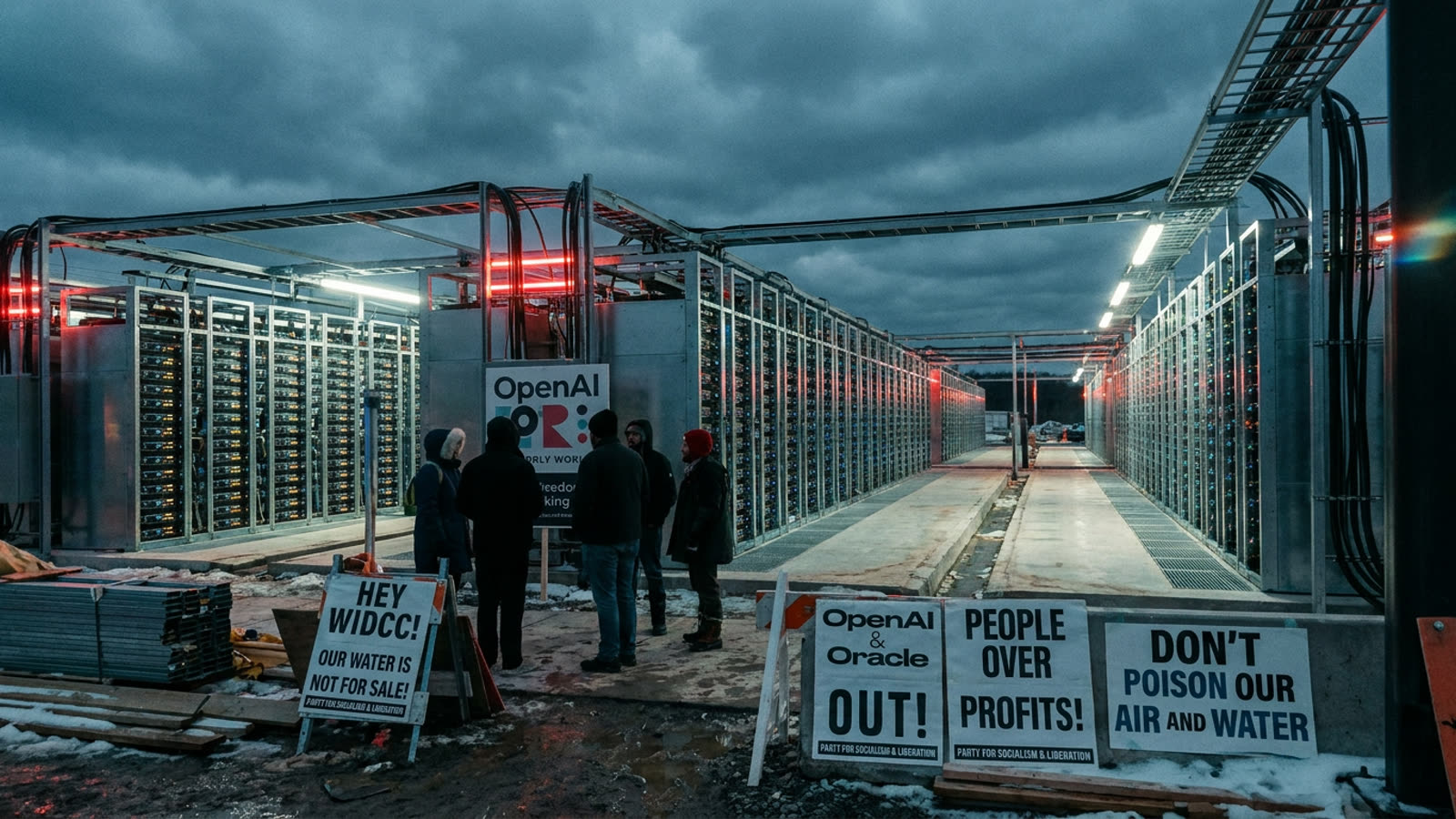
The residents of Northampton County, Pennsylvania, did not come to their town hall meeting last week to discuss artificial intelligence. They came to discuss noise, water tables, and electricity bills—the tangible consequences of an industry that prefers to speak in abstractions like "compute" and "inference."
What they got was a masterclass in the gap between Silicon Valley's grand ambitions and the granular realities of American infrastructure politics. The meeting, which stretched past four hours, featured farmers worried about aquifer depletion, retirees alarmed by projected noise levels, and local officials struggling to explain why their zoning codes never anticipated facilities that consume as much power as small cities.
The arithmetic of AI's appetite
The numbers driving the backlash are staggering. A single hyperscale data center can consume 100 megawatts of electricity—enough to power roughly 80,000 homes. The cooling systems required to prevent servers from melting draw millions of gallons of water daily. And the facilities run around the clock, every day of the year, generating a low hum that residents describe as maddening in its constancy.
Pennsylvania has become a prime target for data center developers precisely because of what made it an industrial powerhouse a century ago: abundant water, relatively cheap electricity, and proximity to East Coast population centers. The state has approved or is considering more than a dozen major facilities, with several clustered in the Lehigh Valley region that once anchored the American steel industry.
When "jobs" isn't enough
The developers' pitch—economic development, construction jobs, tax revenue—is meeting increasingly sophisticated opposition. Residents at the Northampton meeting arrived armed with studies on groundwater impact, noise ordinance comparisons from other jurisdictions, and pointed questions about the actual number of permanent jobs these facilities create (typically fewer than fifty for a billion-dollar installation).
The dynamic mirrors conflicts playing out from Virginia to Arizona, but Pennsylvania's version carries particular symbolic weight. These are communities that watched manufacturing disappear, were promised various forms of economic renaissance, and have learned to interrogate the fine print. They are not opposed to technology; they are opposed to bearing its costs while its benefits flow elsewhere.
Our take
The AI industry has spent three years telling anyone who would listen that it will transform civilization. It has spent considerably less time explaining who will supply the water, absorb the noise, and upgrade the transmission lines. Pennsylvania's angry farmers and skeptical township supervisors are not Luddites—they are the first serious check on an industry that assumed infinite expansion was simply a matter of writing checks. The backlash will not stop data centers from being built, but it will make them more expensive, slower to approve, and subject to conditions their developers never anticipated. That is probably healthy. An industry building the future should be able to explain itself to the present.