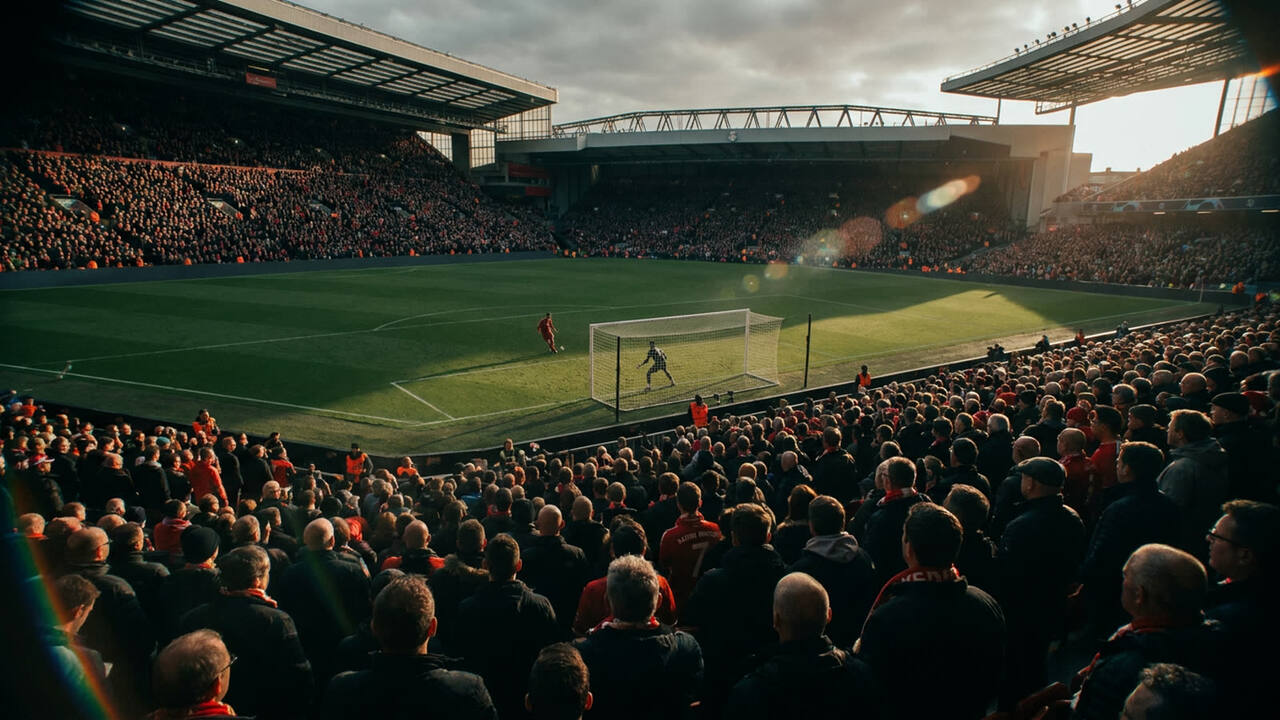
No sporting event compresses more psychological drama into less time than the penalty shootout. Eleven meters of grass, a ball, a goalkeeper, and the weight of an entire nation's expectations pressing down on a single pair of shoulders. In those seconds between the referee's whistle and the striker's approach, we witness something rare: elite athletes stripped of their technical advantages, reduced to a binary test of nerve.
The shootout is often dismissed as a lottery, a coin flip dressed up in sporting clothes. This is both true and completely wrong. Yes, chance plays a role—a goalkeeper guessing correctly, a ball catching an imperfection in the turf. But the accumulated evidence from decades of World Cup shootouts reveals patterns that expose the lie of pure randomness.
The architecture of pressure
England's historical struggles from the spot have become so notorious they constitute a national trauma. Between 1990 and 2012, the Three Lions lost six consecutive shootouts in major tournaments. German players, by contrast, seemed almost bored by the exercise, converting with mechanical efficiency. The difference was not genetic, nor was it purely technical. It was environmental.
German football culture treated penalties as a skill to be drilled, demystified, made mundane through repetition. English football treated them as a test of character—something you either had or didn't. One approach produced players who walked to the spot with a routine; the other produced players who walked to the spot with a prayer.
Research into penalty-taking has revealed counterintuitive truths. Goalkeepers dive left or right on roughly 94% of attempts, yet staying in the center would yield better results—the middle of the goal is struck about a third of the time. But goalkeepers dive anyway, because the social cost of standing still and watching a ball sail past is psychologically unbearable. Action, even futile action, feels better than inaction.
The long walk and its demons
The most devastating penalties are not the ones saved but the ones missed entirely. Roberto Baggio's shot over the crossbar in 1994 remains seared into Italian memory not because a goalkeeper made a brilliant play, but because one of the most gifted players of his generation simply failed to execute a basic task. The pressure didn't beat Baggio through external interference; it beat him from within.
Sports psychologists have identified a phenomenon called "ironic process theory"—the harder you try not to think about something, the more likely you are to think about it. Tell yourself not to hit the ball over the bar, and suddenly the bar becomes all you can see. The players who succeed are those who can occupy their minds with process rather than outcome, who can make the walk from the center circle to the penalty spot feel like a walk to training rather than an execution.
Our take
The penalty shootout persists because it is unbearable, and the unbearable is irresistible. FIFA has floated alternatives over the years—golden goals, silver goals, extended extra time—but none capture the public imagination like the shootout's brutal clarity. We say we hate it, that it's unfair, that it reduces the beautiful game to something crude. But we never look away. In those twelve yards, we see ourselves: capable of greatness, vulnerable to collapse, never quite sure which version will show up when it matters most.