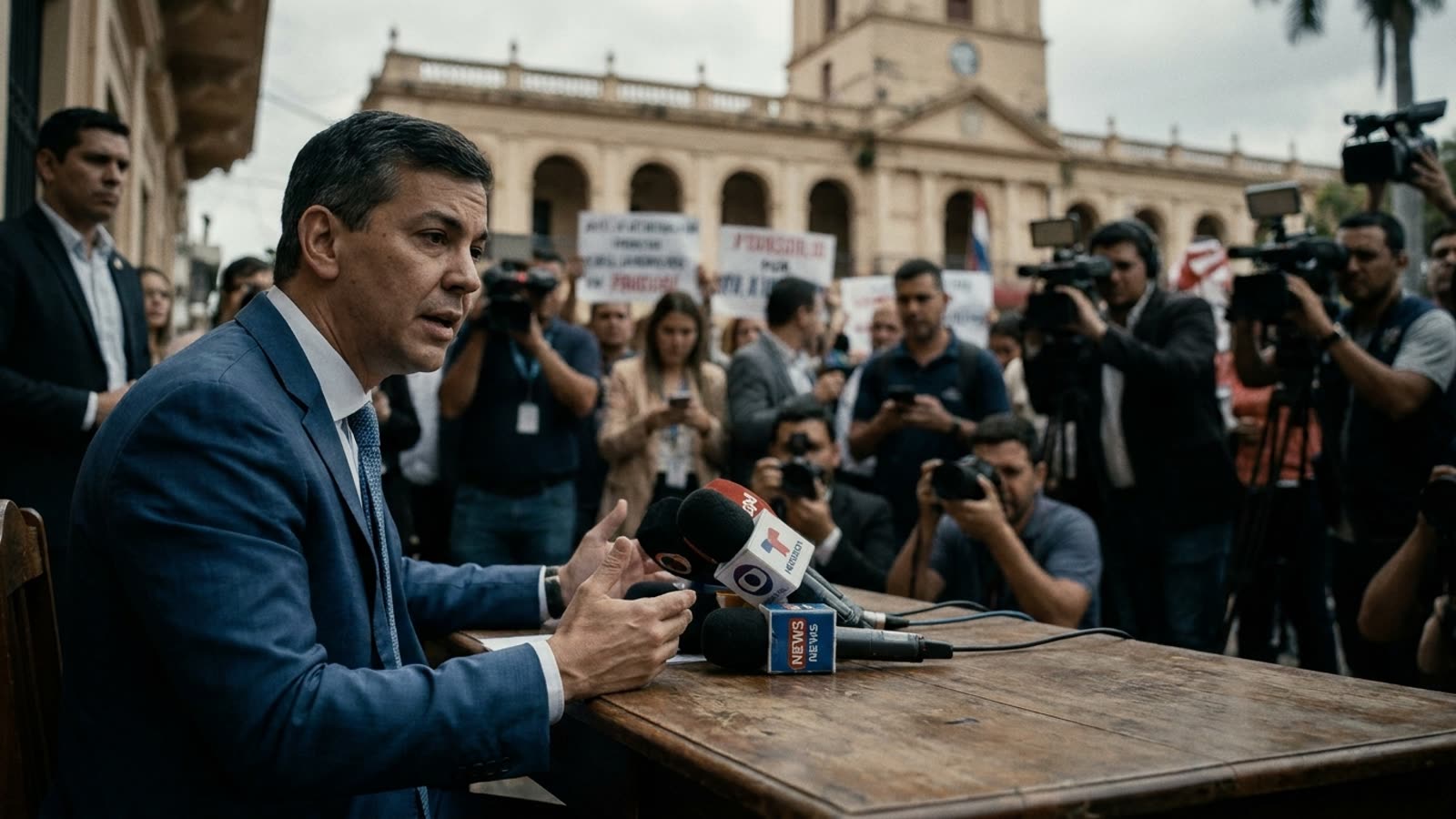
A sitting president resigning over a bank failure he personally enabled is the kind of clean narrative that rarely survives contact with Latin American politics. Yet here is Santiago Peña, Paraguay's market-friendly technocrat, stepping down Thursday after Ueno Bank's collapse froze the savings of an estimated two million Paraguayans—roughly a quarter of the country's population.
The timeline is damning. Peña's administration authorized Ueno to dramatically expand its retail deposit base in early 2025, overruling central bank concerns about the institution's thin capital buffers and opaque ownership structure. Within eighteen months, the bank had quintupled its deposit book. When liquidity dried up last week, there was no cushion. The government's initial response—a partial guarantee scheme that would have made depositors whole over five years—sparked protests that turned Asunción's central plaza into a permanent encampment.
The regulatory failure
Paraguay's banking supervision, never robust, had been further weakened by Peña's deregulatory agenda. His finance minister, a former Ueno consultant, pushed through rules that allowed smaller banks to hold riskier assets with minimal disclosure. The central bank governor who objected was replaced in March 2025. What followed was predictable to everyone except, apparently, the people in charge: a mid-tier lender with political connections leveraged itself into systemic importance, then collapsed when its loan book soured.
The parallels to historical banking crises—from the American S&L debacle to Iceland's 2008 implosion—are uncomfortable. In each case, captured regulators blessed expansion they should have blocked. Paraguay's twist is the speed of political consequence: Peña lasted eight days from the freeze announcement to his resignation letter.
What comes next
Vice President Pedro Alliana, a Colorado Party stalwart with closer ties to the agricultural establishment than to Asunción's financial sector, assumes the presidency. His immediate challenge is deciding whether to nationalize Ueno's assets or let foreign creditors—primarily Brazilian and Argentine banks—pick over the carcass. Either path risks capital flight from a country that spent a decade courting foreign investment.
The broader question is whether Paraguay's democratic institutions can process this shock without sliding into the authoritarian temptations that have claimed neighbors. Peña's resignation, for all its ignominy, is actually a hopeful sign: the system forced accountability faster than most observers expected.
Our take
Peña's fall is less a story about one man's hubris than about the persistent fantasy that emerging markets can skip the boring work of institution-building. Paraguay wanted to be a regional financial hub. It got the deposits without the supervision, the growth without the guardrails. The depositors now queuing outside shuttered Ueno branches are paying for that ambition. At least their president paid something too.