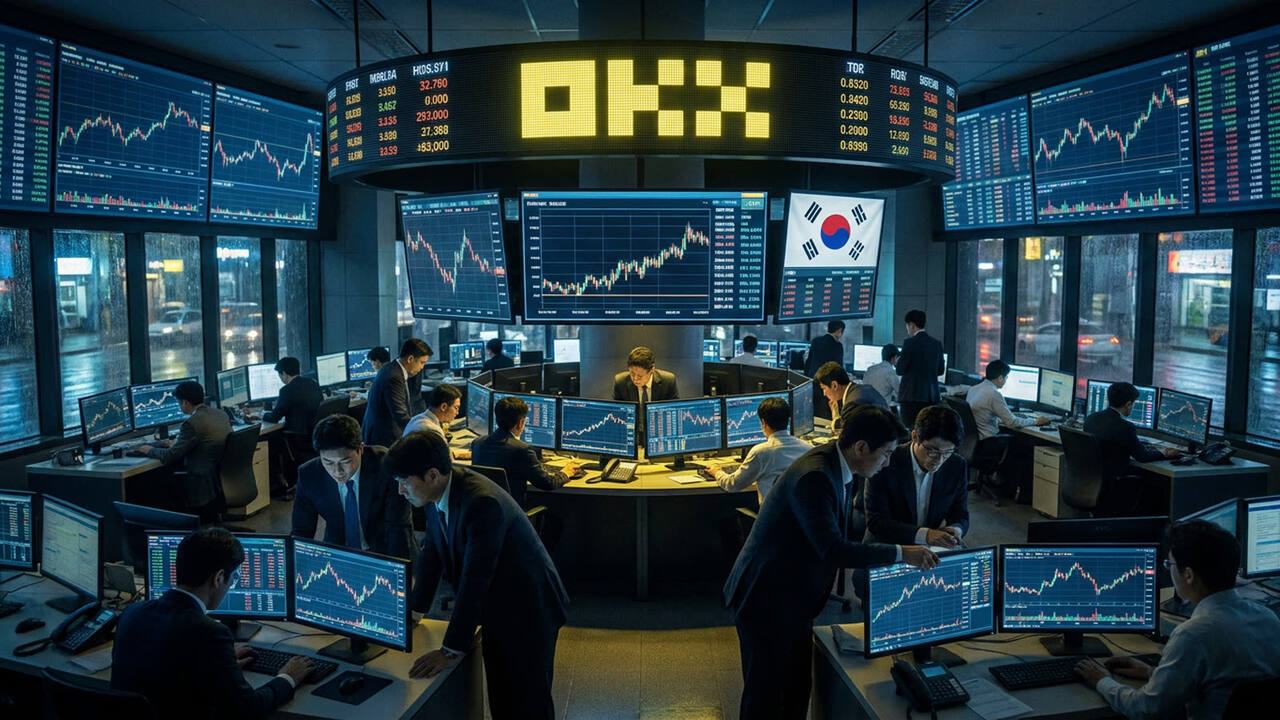
Exchange tokens are the closest thing crypto has to equity in a profitable business, and OKB is making the case better than most.
The native token of OKX, one of the world's largest cryptocurrency exchanges by trading volume, is trading around $80.67—up more than 62 percent over the past year while much of the altcoin market has cratered. Cardano is down 73 percent. Sui has lost nearly 75 percent. Avalanche has shed 64 percent. OKB, meanwhile, has compounded quietly, rewarding holders who bet on exchange fundamentals rather than narrative cycles.
The utility moat
OKB's value proposition is straightforward: hold the token and receive trading fee discounts, priority access to token launches, and yield opportunities through OKX's Earn products. The exchange also conducts regular buybacks and burns, reducing supply in a manner that would make any traditional corporate treasurer nod approvingly. This isn't DeFi yield farming with its recursive leverage and impermanent loss—it's a loyalty program with tokenized economics.
OKX has also avoided the regulatory catastrophes that have hobbled competitors. While Binance paid a $4.3 billion settlement and saw its founder step down, and FTX collapsed entirely, OKX has maintained a lower profile and kept its institutional relationships intact. The exchange has expanded aggressively into compliant markets, launching regulated entities in Singapore, Australia, and the UAE. Each new license adds legitimacy to the underlying business—and by extension, to OKB.
The exchange token thesis
Exchange tokens occupy an unusual position in the crypto taxonomy. They are not securities in the traditional sense, yet they derive value from the profitability of a centralized business. They offer no governance rights, no dividends, no legal claim on assets. And yet, for holders, they function like a synthetic equity stake with extra steps.
The model works when the exchange is profitable, growing, and disciplined about tokenomics. OKX appears to check all three boxes. The exchange has consistently ranked in the top three globally by derivatives volume, a high-margin business that generates substantial fee revenue. Its token burns have removed hundreds of millions of dollars worth of OKB from circulation over the years. And unlike some competitors, OKX has not diluted holders with endless token unlocks or insider sales.
The risks remain real
Exchange tokens are also uniquely exposed to platform risk. A regulatory crackdown, a hack, or a management scandal could vaporize OKB's value overnight—there is no balance sheet to liquidate, no legal recourse for token holders. The FTX implosion demonstrated that even tokens backed by seemingly thriving exchanges can go to zero when the underlying business turns out to be a fraud. OKB holders are betting that OKX is what it appears to be: a well-run exchange with genuine revenue.
There is also concentration risk. OKX is a private company with limited transparency. Holders must trust that reported volumes are real, that reserves are adequate, and that management is acting in good faith. These are not unreasonable assumptions for a major exchange, but they are assumptions nonetheless.
Our take
OKB's outperformance is a quiet rebuke to the crypto market's obsession with narrative over substance. While traders chase memecoins and AI tokens, exchange tokens like OKB demonstrate that boring fundamentals still matter. The token is not exciting. It will not make anyone rich overnight. But in a market littered with broken promises and abandoned protocols, a token that does exactly what it claims to do—and rises accordingly—is worth noticing. Sometimes the best trade is owning a piece of the house.