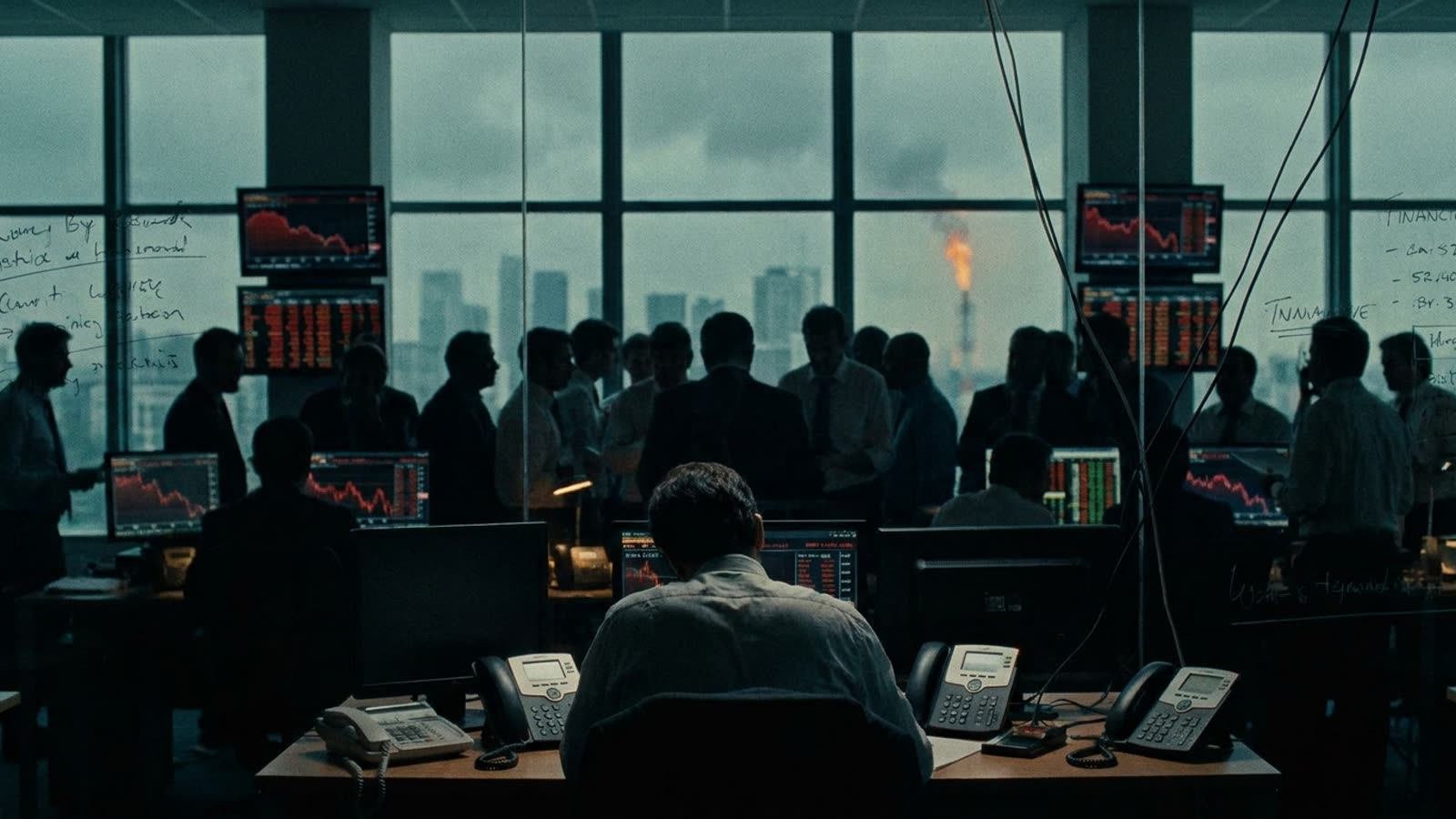
The fragile equilibrium that markets had constructed around the Iran-Israel conflict shattered overnight. Tehran's retaliatory strikes on Israeli territory—and Jerusalem's swift response—sent Brent crude surging past $95 a barrel and triggered a cascade of selling across Asian equity markets, with Seoul's Kospi suffering its worst session in eighteen months.
This is not merely a one-day risk-off event. It is the market's belated acknowledgment that the conflict, now grinding past its hundredth day, has entered a more dangerous phase—one where the probability distribution of outcomes has shifted decisively toward escalation rather than containment.
The oil calculus
Crude's jump of more than three percent in early Asian trading reflects something more durable than headline-driven panic. Traders are now pricing in meaningful disruption risk to Gulf shipping lanes and, more critically, the possibility that Iranian production itself could become a target. The Strait of Hormuz, through which roughly a fifth of global oil consumption passes daily, has returned to the center of energy-market anxiety for the first time since the Tanker Wars of the 1980s.
The timing is particularly awkward. OPEC+ had just announced plans to boost production in August, a move designed to ease prices and placate Western governments ahead of a fraught American election season. Those barrels now look less like supply relief and more like a hedge against potential outages. The cartel's spare capacity, concentrated overwhelmingly in Saudi Arabia and the UAE, has become the market's insurance policy—and insurance is never cheap.
Asian equities take the hit
South Korea's market bore the brunt of the selling, a reflection of the country's acute sensitivity to energy prices and its substantial exposure to global trade flows. The Kospi's plunge dragged regional benchmarks lower, with Hong Kong and Tokyo both opening sharply down before finding tentative footing.
The pattern is familiar from previous geopolitical shocks: export-dependent economies with thin energy margins suffer first and hardest. What is different this time is the backdrop. Asian markets were already contending with a resurgent dollar—now at two-month highs on renewed Fed hawkishness—and persistent concerns about Chinese demand. The Iran-Israel escalation arrives not as an isolated shock but as an accelerant poured on existing anxieties.
The Fed's uncomfortable position
Central bankers in Washington are watching the oil charts with undisguised concern. A sustained move in crude above $100 would complicate the Federal Reserve's already delicate inflation calculus, potentially forcing officials to maintain restrictive policy even as growth softens. The soft landing that Chair Powell has been carefully engineering requires stable energy prices; geopolitical supply shocks are not in the playbook.
Market pricing for a July rate hike has ticked higher in recent sessions, and the combination of dollar strength and oil-driven inflation expectations could push those odds further. The irony is acute: a conflict that began as a regional security crisis may end up determining whether American mortgage rates fall this year.
Our take
Markets spent much of the spring pretending that a contained conflict was the base case. That complacency is now being repriced in real time, and the adjustment is unlikely to be smooth. The strikes exchanged overnight may or may not presage a wider war, but they have already accomplished something significant: they have reminded investors that geopolitical risk is not a tail event to be modeled and forgotten, but a live variable that can move asset prices faster than any earnings report or economic indicator. Summer 2026 just got considerably more interesting—and considerably more expensive.