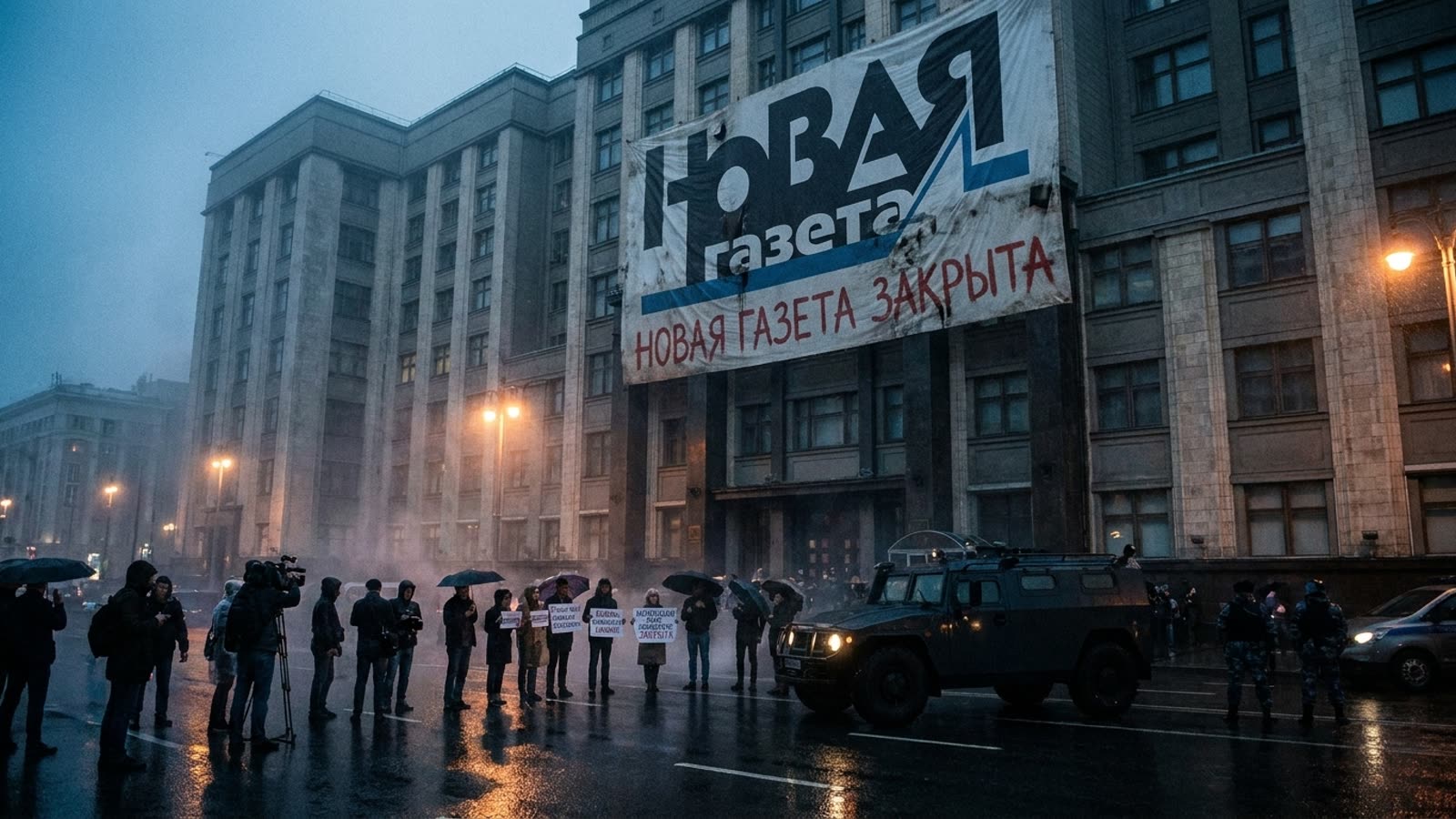
The announcement came without fanfare but with unmistakable finality: Novaya Gazeta, the newspaper that outlasted the Soviet collapse, the Chechen wars, and the murders of six of its journalists, will cease publication. "They killed us," the staff wrote in their statement, declining to soften the accusation with euphemism.
For thirty-three years, Novaya Gazeta operated as living proof that independent journalism could exist in Russia—not comfortably, not safely, but stubbornly. Its co-founder, Dmitry Muratov, accepted the Nobel Peace Prize in 2021 with the paper still publishing. That the outlet survived another five years after that international spotlight says something about its resilience. That it could not survive indefinitely says more about the system it was resisting.
The long suffocation
The Kremlin did not shutter Novaya Gazeta with a single dramatic raid. Instead, the paper died by a thousand bureaucratic cuts: foreign agent designations, advertising bans, distribution restrictions, and endless litigation. Staff members faced individual prosecutions. Sources dried up as the risks of speaking to journalists became career-ending or worse. The model was not censorship as the twentieth century understood it, but something more insidious—a regulatory environment designed to make independent journalism economically and legally impossible.
This approach has proven devastatingly effective across Russian media. TV Rain, Echo of Moscow, Meduza—each faced variations of the same playbook. What made Novaya Gazeta's persistence remarkable was its institutional memory. Reporters who had covered Anna Politkovskaya's assassination in 2006 were still filing stories two decades later, maintaining investigative standards that embarrassed the state-controlled press.
What the closure signals
The timing is not incidental. With the war in Ukraine grinding through its fifth year and domestic dissent increasingly criminalized, the Kremlin appears to have concluded that even symbolic opposition is intolerable. Novaya Gazeta's readership had dwindled, its influence circumscribed, but its mere existence represented an alternative narrative. That alternative is now officially extinguished.
For the journalists themselves, the options are familiar: exile, silence, or prison. Several senior staff members had already relocated to European capitals, attempting to continue reporting from abroad. Whether the institutional identity of Novaya Gazeta can survive in diaspora remains uncertain. History suggests that exile publications rarely regain their domestic influence.
Our take
There is a temptation to frame Novaya Gazeta's closure as a tragedy, which it is, or as a surprise, which it is not. The paper's staff understood better than anyone that they were operating on borrowed time. What deserves emphasis is not the ending but the duration—three decades of journalism produced under conditions that would have broken most institutions within months. The Kremlin wanted Novaya Gazeta dead for years. The fact that it took this long to accomplish is the paper's final, defiant achievement.