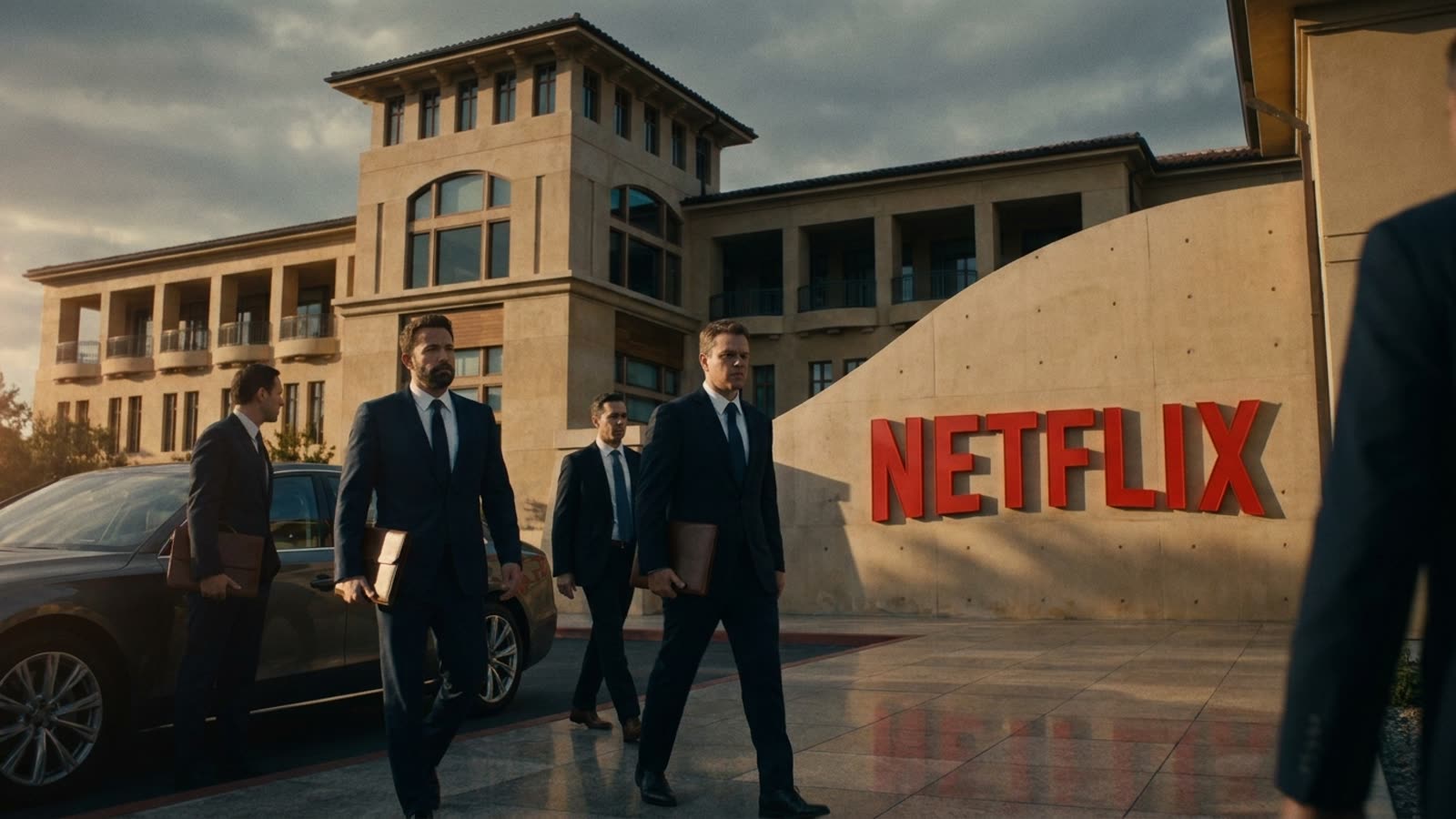
The streaming economy has operated on a simple, brutal premise for nearly a decade: creators get paid upfront, platforms keep the data, and nobody outside the C-suite knows whether a show was a hit or a write-off. Netflix built an empire on that asymmetry. Now a crack has appeared in the wall.
Artists Equity, the production company founded by Ben Affleck and Matt Damon in 2022, has negotiated a performance bonus for the cast and crew of The Rip, their upcoming Netflix thriller. The terms remain undisclosed, but the structure itself is the news. Netflix does not do back-end deals. Or rather, it didn't.
Why Netflix's Model Worked (For Netflix)
Traditional Hollywood compensation was built on transparency, however imperfect. Box office receipts were public. Nielsen ratings were published. Residuals flowed from syndication, home video, and international sales—all trackable, all auditable. Talent could negotiate points on profits because profits could be verified, or at least litigated.
Streaming obliterated that. Netflix famously guards its viewership data like a state secret, releasing only selective metrics designed for press releases rather than royalty statements. The company argued that its model benefited creators through higher upfront fees, eliminating the uncertainty of back-end participation. What it really eliminated was leverage. If you can't prove a show performed well, you can't demand to share in that performance.
The Artists Equity Playbook
Affleck and Damon founded Artists Equity with an explicit mandate to restructure how talent gets paid. The company's model routes a portion of its own producer fees into pools for below-the-line workers—crew members who traditionally see none of a project's upside. Air, their 2023 film about Nike's pursuit of Michael Jordan, tested the approach with Amazon. The Rip extends it to Netflix, and crucially, to a performance-based trigger rather than just profit-sharing from the production side.
The negotiation reportedly took months. Netflix's resistance was predictable; the streamer has spent years fending off demands for viewership transparency from guilds, agents, and regulators alike. That Artists Equity extracted even a limited concession suggests the leverage calculus is shifting. A-list producers with theatrical options can walk away from streaming deals. Netflix, facing slowing subscriber growth and renewed competition, increasingly cannot afford to let them.
What It Doesn't Change (Yet)
One deal does not make a precedent. Netflix can frame this as a one-off accommodation for marquee talent, not a template for future negotiations. The company's standard contracts will remain opaque. The vast majority of creators—showrunners without Oscar-winning partners, writers without production shingles, actors without box-office track records—will continue to operate in the dark.
But leverage is contagious. The guilds secured streaming residual improvements in the 2023 strikes; this deal shows that individual production entities can push further. If The Rip performs well by whatever internal metrics Netflix uses, and if the bonus actually pays out, the next negotiation gets easier. And the one after that.
Our take
Netflix built a business on the principle that information is power and sharing it is weakness. Artists Equity just proved that principle has a price. The bonus itself may be modest; the symbolism is not. Hollywood's streaming transition was sold as a rising tide for creators. A decade in, the creators are finally asking to see the tide charts.