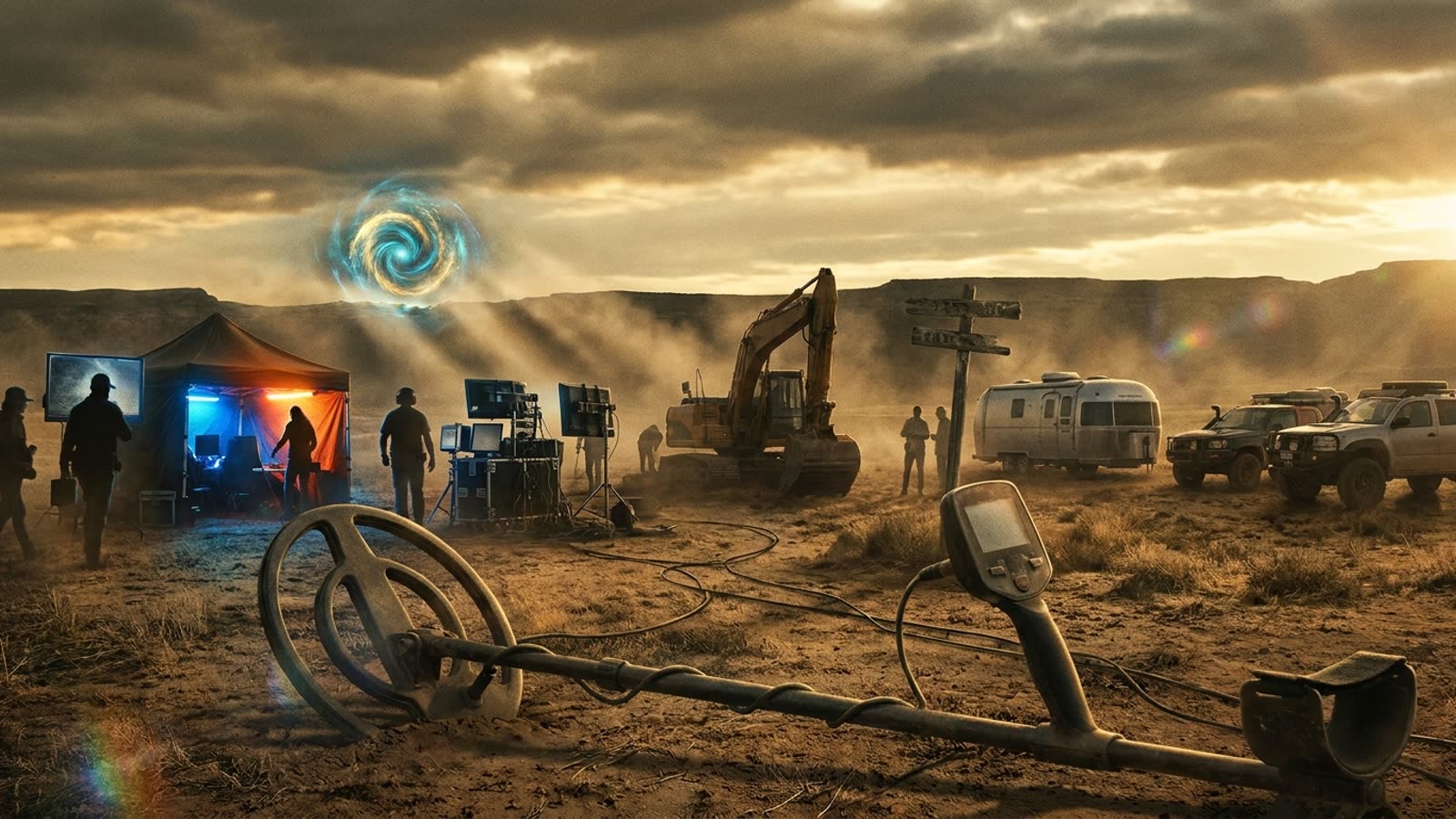
The premise would be rejected as too implausible for scripted television: a family in Utah believes their 160-acre property sits atop both Aztec gold and a portal to another dimension, and they've convinced a major cable network to document their excavations. Yet here we are, with Discovery's "Mystery at Blind Frog Ranch" entering another season of men in hard hats staring meaningfully at holes in the ground while ominous music suggests imminent revelation.
The show represents something genuinely fascinating about where reality television has arrived in 2026—not as a mirror of actual life, but as a delivery mechanism for the aesthetics of mystery without any obligation to solve one.
The treasure-hunting industrial complex
Blind Frog Ranch exists in a crowded field. The History Channel's "The Curse of Oak Island" has run for over a decade on the promise that Canadian brothers will eventually find something more significant than old coins. "Expedition Unknown" sends Josh Gates to locations where treasure definitely isn't. The formula is identical across all of them: tease discovery, delay discovery, end season, repeat.
What distinguishes Blind Frog Ranch is the shamelessness of its supernatural overlay. The Olmstead family doesn't merely believe there's gold beneath their property—they've incorporated claims of strange lights, unexplained phenomena, and dimensional anomalies into their pitch. It's "Oak Island" meets "Ancient Aliens," a synergy that says something uncomfortable about what networks believe their audiences want.
The economics of perpetual mystery
These shows persist because they're cheap to produce and reliable in ratings. A small crew, a remote location, and participants willing to dig holes on camera costs a fraction of scripted programming. The genius is structural: resolution would end the series, so resolution never comes. Each episode ends with a cliffhanger that the next episode studiously avoids resolving.
Viewers understand this contract implicitly. Nobody watching Blind Frog Ranch genuinely expects the Olmsteads to unearth Aztec gold or stumble through a portal. The pleasure is in the ritual—the ground-penetrating radar, the "expert" consultations, the dramatic pauses before commercial breaks. It's professional wrestling for people who'd never watch professional wrestling.
Our take
There's no treasure at Blind Frog Ranch, just as there's no treasure at Oak Island, just as every locked safe opened on reality television contains disappointment. The shows know this, the networks know this, and increasingly the audience knows this. What we're watching isn't treasure hunting—it's a meditation on the American appetite for the possibility of sudden wealth, dressed up with night-vision cameras and portentous narration. As entertainment, it's oddly soothing. As a cultural document, it's quietly devastating.