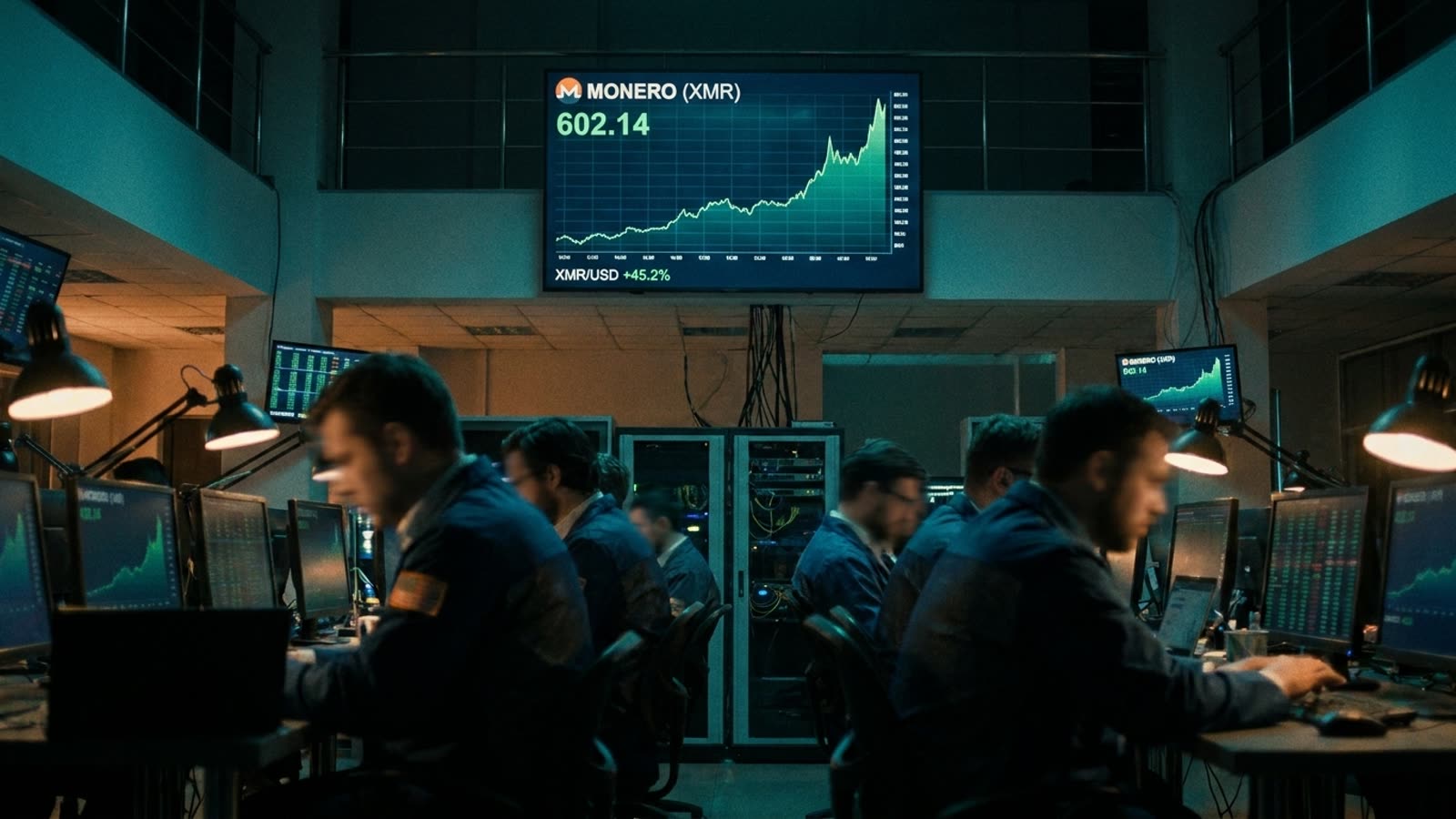
The cryptocurrency that governments most want to kill refuses to die. Monero, the privacy-focused digital asset that obscures sender, receiver, and transaction amounts by default, has climbed past $600 for the first time in nearly five years, capping a 75 percent gain over the past twelve months that has unfolded with remarkably little fanfare.
The rally is not about memecoins or ETF flows or institutional adoption playbooks. It is about something more elemental: a growing cohort of users who have concluded that financial privacy is not a feature but a necessity, and that transparent blockchains like Bitcoin and Ethereum have become surveillance tools as much as liberation technologies.
The transparency trap
Bitcoin's public ledger was once celebrated as a breakthrough in accountability. Every transaction, permanently visible, theoretically incorruptible. But that transparency has become a liability for users who discover, often too late, that blockchain analytics firms like Chainalysis and Elliptic can trace their entire financial history with a few clicks. Employers, insurers, landlords, and law enforcement now routinely purchase this data. The result is a chilling effect: Bitcoin holders who once believed they were transacting pseudonymously now understand they were simply building a permanent, searchable record of their economic lives.
Monero's ring signatures, stealth addresses, and confidential transactions offer the opposite architecture. No observer can determine how much XMR a wallet holds or where funds originated. This makes it genuinely useful for dissidents, journalists, and anyone living under an authoritarian regime—but also, critics note, for ransomware operators and sanctions evaders.
Regulatory pressure as catalyst
Paradoxically, the crackdown on privacy coins has accelerated Monero's appeal. Major exchanges including Binance, Kraken, and Coinbase have delisted XMR in multiple jurisdictions over the past two years, responding to pressure from regulators who view untraceable assets as inherently suspicious. The delistings have made acquisition harder but not impossible; decentralised exchanges and peer-to-peer platforms have absorbed the volume. And the regulatory hostility has functioned as a perverse endorsement: if governments are this determined to suppress it, the reasoning goes, it must actually work.
The asset's market capitalisation remains modest by crypto standards—roughly $11 billion, a fraction of Bitcoin's trillion-dollar valuation—but its user base is disproportionately committed. Monero is not bought for speculation; it is bought for use. That distinction matters in a market where most tokens exist primarily as vehicles for greater-fool trading.
Our take
Monero's resurgence is uncomfortable for an industry that has spent the past three years courting institutional legitimacy through compliance and transparency. But it is also a reminder that the original cypherpunk vision—money that cannot be surveilled, seized, or censored—never went away. It simply went underground, waiting for the moment when enough people decided that the cost of financial visibility had become too high. That moment, evidently, has arrived.