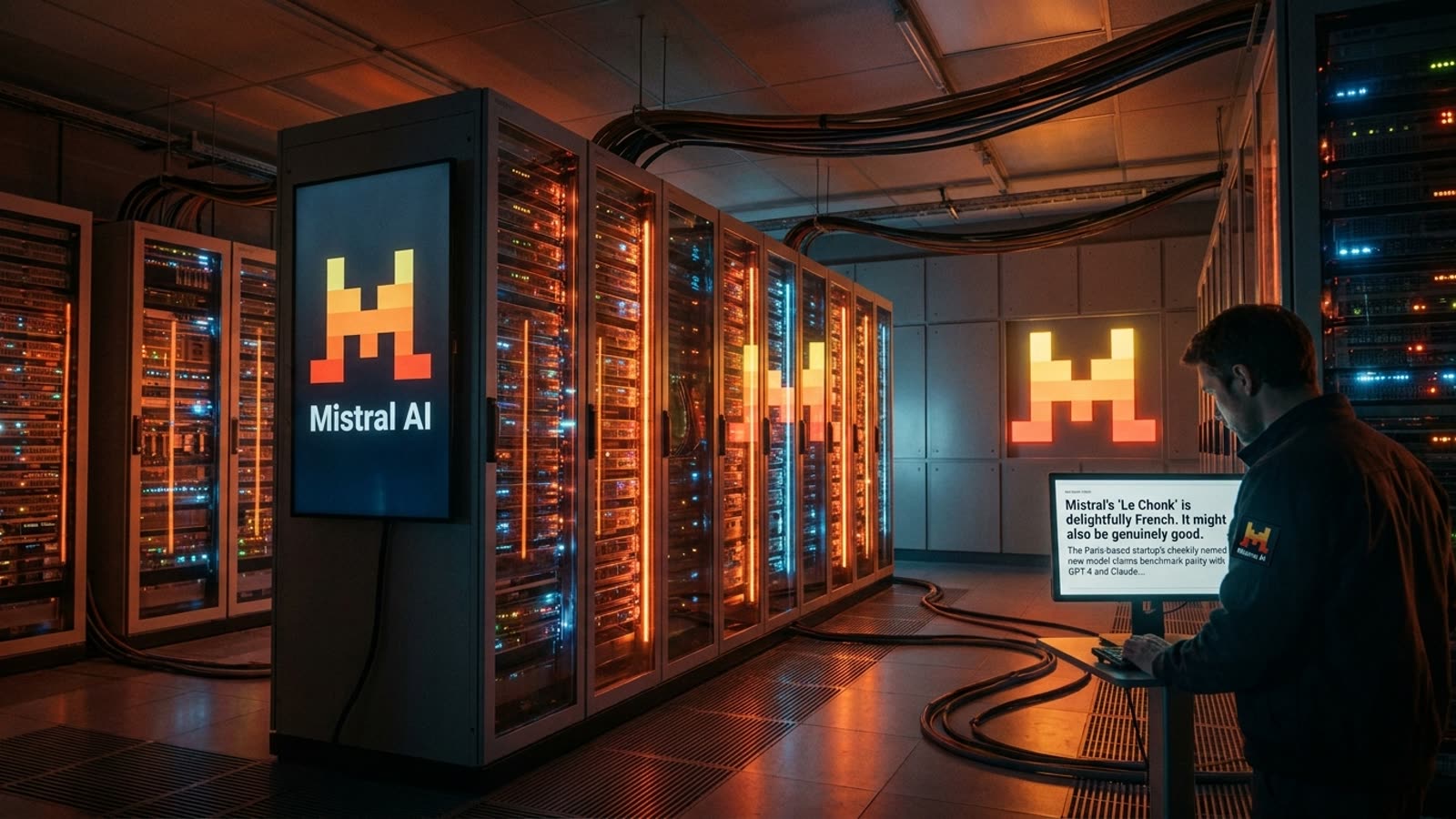
Mistral AI has unveiled what it calls its most capable model yet, and in characteristic fashion, the Paris-based startup has given it a name that sounds like a Michelin-starred cheese course: Le Chonk. The branding is playful, but the ambition is not. Mistral claims Le Chonk matches or exceeds the performance of OpenAI's GPT-4 and Anthropic's Claude 3.5 Sonnet across major benchmarks, a boast that, if validated by independent testing, would mark a genuine inflection point for European AI.
The benchmark question
Mistral has historically punched above its weight. Its earlier Mixtral models demonstrated that a scrappy team with deep technical pedigree—several founders came from Meta's AI research division—could produce competitive open-weight models at a fraction of the cost. Le Chonk, however, represents a shift: this is not an open-weight release but a proprietary flagship, suggesting Mistral is now playing the same commercial game as its American rivals. The company says Le Chonk excels at reasoning, code generation, and multilingual tasks, with particular strength in French and German—a nod to its EU roots and a potential wedge for enterprise contracts on the continent.
Benchmarks, of course, are only part of the story. Real-world performance, latency, and cost-per-token will determine whether Le Chonk can dent the market share of incumbents who have spent billions on inference infrastructure.
Europe's AI sovereignty bet
Mistral has become something of a mascot for European tech ambitions. The company raised over €1 billion in its most recent funding round, with backing from sovereign wealth funds and strategic investors who see it as a hedge against American dominance. The EU's AI Act, which imposes stricter compliance requirements on high-risk systems, could theoretically advantage a European player that understands the regulatory terrain. Whether that advantage translates into enterprise adoption remains to be seen; most Fortune 500 AI deployments still run through Microsoft Azure or Google Cloud, both of which default to their own models.
Le Chonk's release also arrives at a moment when the AI industry is grappling with commoditization. If frontier models are converging in capability, differentiation may come down to price, trust, and ecosystem lock-in—areas where Mistral's independence could be either a strength or a vulnerability.
Our take
Mistral naming its flagship model after an affectionate term for an overweight cat is the kind of move that either signals supreme confidence or a certain Gallic indifference to American marketing conventions. Probably both. The more interesting question is whether Le Chonk can convert benchmark bragging rights into actual market share before the next GPT iteration arrives. Europe needs a credible AI champion, and Mistral is the closest thing it has. But being close is not the same as winning, and the runway for catching up is getting shorter by the quarter.