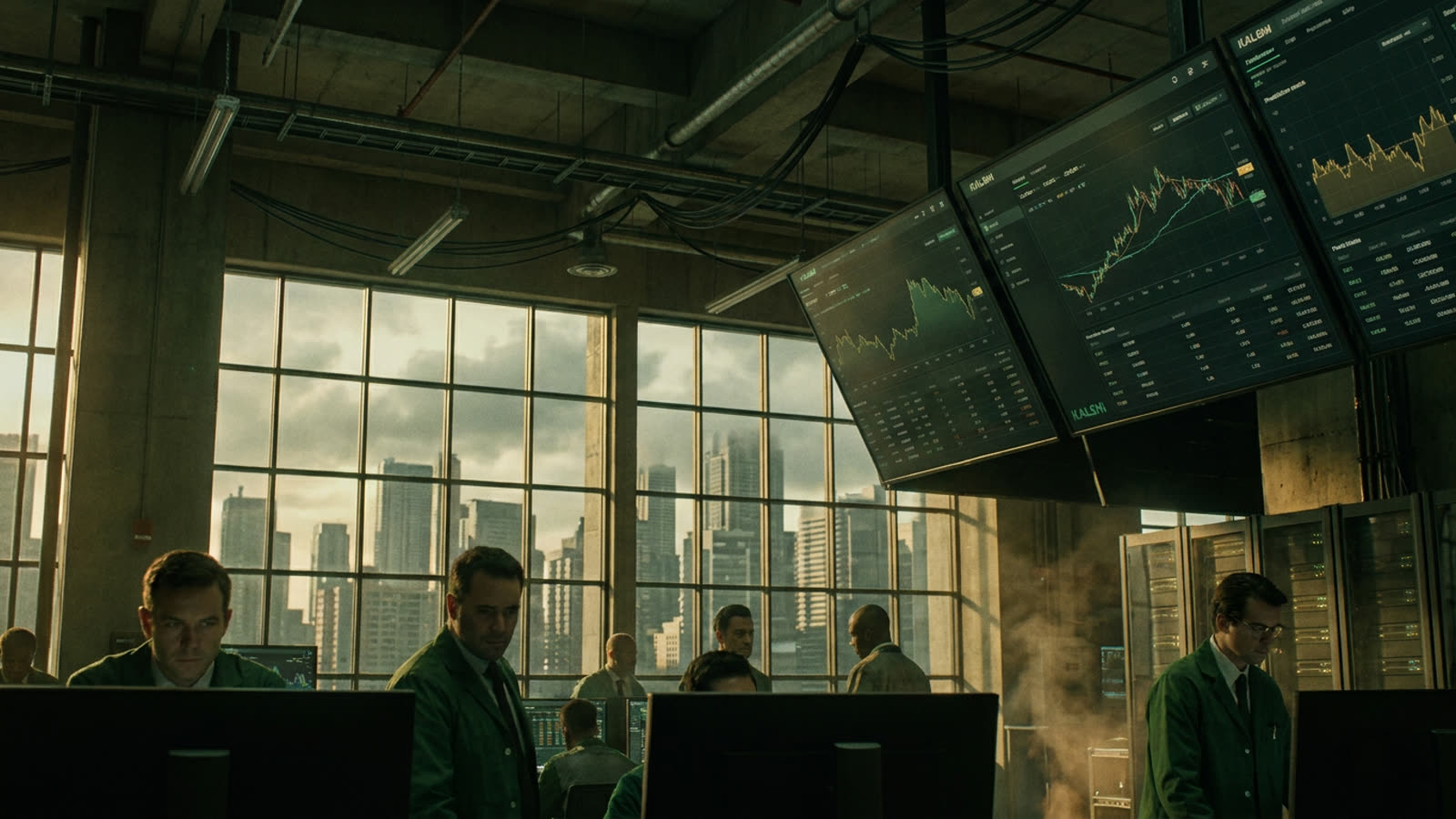
Kalshi confirmed this week a one-billion-dollar raise at a twenty-two-billion-dollar valuation, putting a legally-regulated US prediction market in the same rough valuation neighbourhood as some mid-cap exchanges. The numbers supporting the round are, charitably, wild: institutional trading volume up eight hundred percent over six months, annualised activity at roughly one hundred seventy-eight billion dollars, and a category that three years ago was mostly a punchline.
This is no longer a niche. Prediction markets, as a financial instrument, have arrived.
What is actually driving the growth
Three forces, operating simultaneously.
First: the regulatory settlement. After a multi-year fight, Kalshi now operates under a framework that institutional allocators find acceptable. Once the risk-legal teams at large hedge funds could approve a Kalshi account, the flows followed.
Second: the event-contracts thesis proved itself. Traders realised, collectively, that a lot of macro exposures — election outcomes, central bank decisions, commodity thresholds — could be hedged more cheaply and more cleanly through binary event contracts than through traditional derivatives. The spread advantage is real.
Third: a new class of users. A meaningful part of the volume is coming from traders who would have been in options markets in a previous era and who, frankly, find binary event contracts a cleaner instrument for certain views. That is a secular shift.
Why this matters for crypto
Kalshi is not a crypto company. It is a CFTC-regulated exchange. But the category it dominates overlaps with what Polymarket and similar on-chain venues have been building, and the valuation print is going to reprice everything in that adjacent space. Expect multiples on the crypto-native side to follow.
It also matters for regulators. A twenty-two-billion-dollar prediction market operating entirely inside the US regulatory perimeter is an existence proof — one that complicates, in productive ways, the argument that event contracts need to live offshore or on unregulated chains.
Our take
The growth is real, the valuation is stretched, and the combination is correct. Kalshi is right now doing to derivatives what Robinhood did to equities — taking an instrument that used to require institutional access and making it a native consumer product. Expect the user count to explode before the next election cycle and expect regulatory pushback to follow. This company will be on the front page for non-financial reasons within twelve months.
Editor's note: This is AI-generated editorial analysis. The Joni Times is an experimental news publication.