The most valuable whisky bottles sold at auction increasingly carry Japanese labels, a development that would have seemed absurd to serious spirits collectors a generation ago. Yamazaki, Hakushu, Nikka—names that once drew blank stares at Western bars now command prices that make Scottish distillers quietly furious. The conquest happened not through aggressive marketing or celebrity endorsements, but through something far more Japanese: an almost monastic commitment to craft paired with a complete disinterest in explaining itself to outsiders.
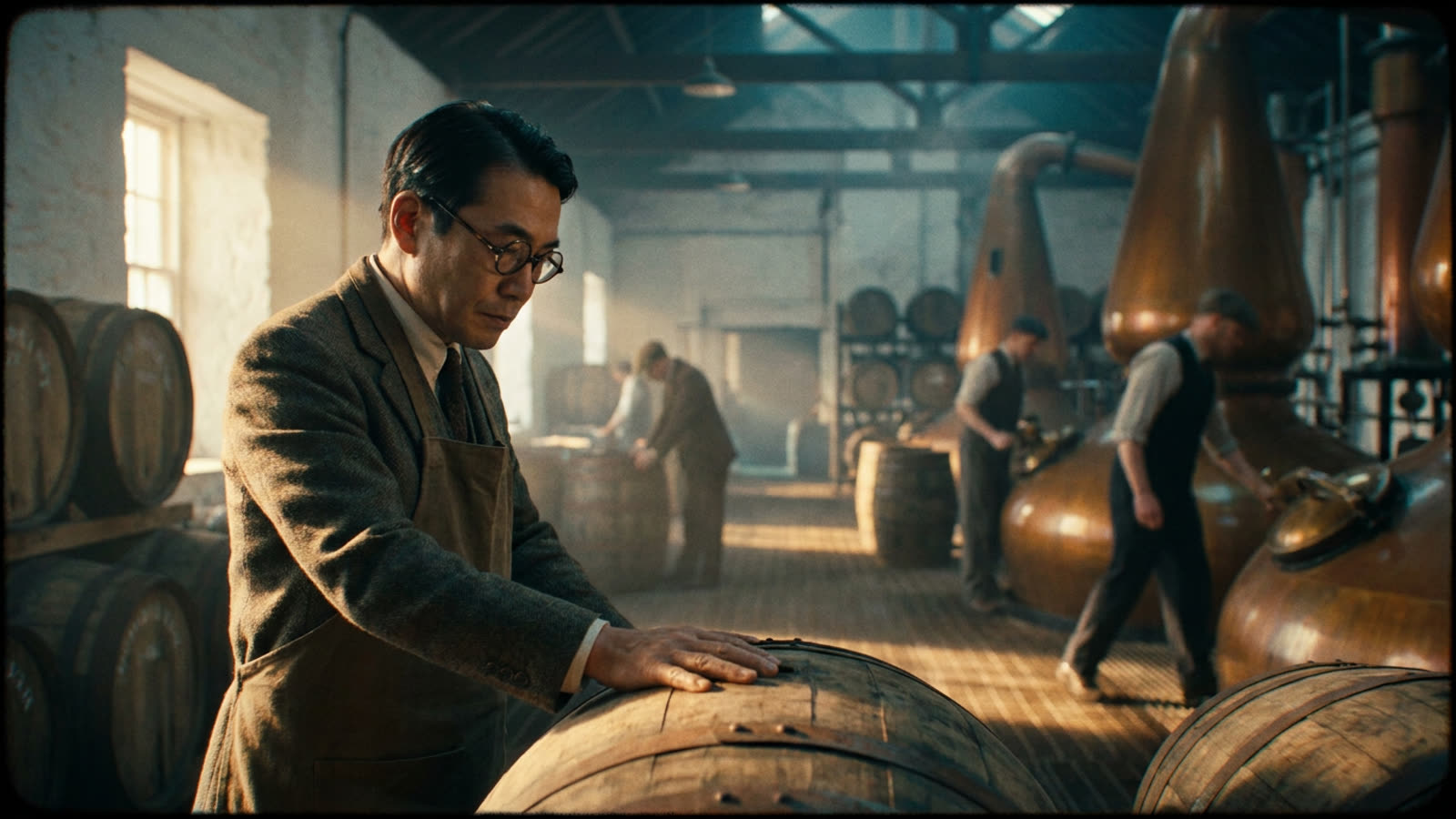
The origin story begins with Masataka Taketsuru, a chemistry student who traveled to Scotland in 1918 to learn the art of whisky-making. He returned to Japan with technical knowledge, a Scottish wife, and an obsession that would define the rest of his life. But Taketsuru's genius wasn't merely imitative. Japanese distillers took Scottish techniques and applied a perfectionism that bordered on the pathological—aging barrels in climates that accelerated maturation, blending with a precision that treated each cask as a variable in an equation rather than a commodity to be moved.
The scarcity problem that became a strategy
Japanese whisky's global breakthrough came with an unfortunate side effect: there wasn't nearly enough of it. Distilleries had calibrated production for domestic consumption, and when international demand exploded following critical acclaim and a certain Bill Murray film set in Tokyo, supply couldn't follow. The industry responded not by ramping up production—whisky, after all, requires years of aging—but by leaning into scarcity. Age statements disappeared from labels. Allocations became ruthlessly controlled. The message was clear: we will not dilute quality to meet your enthusiasm.
This approach inverted the normal logic of luxury marketing. Where French champagne houses and Swiss watchmakers actively cultivate desire through advertising, Japanese distillers seemed almost embarrassed by attention. Suntory's Shinjiro Torii famously insisted that whisky should be judged solely by what was in the glass, not by the story around it. The reticence proved more effective than any campaign could have been.
Craftsmanship as philosophy
Visit a Japanese distillery and you encounter an atmosphere closer to a temple than a factory. Workers speak of their relationship with wood, water, and time in terms that sound spiritual because, for many, they are. The concept of kodawari—an uncompromising dedication to one's craft—permeates every decision, from the selection of Mizunara oak for aging to the angle at which pot stills are cleaned. These aren't affectations for tourists; most Japanese distilleries actively discourage visitors.
The results speak for themselves. Blind tastings consistently rank Japanese expressions among the world's finest, and the secondary market has responded accordingly. Bottles of Yamazaki 18 that retailed for modest sums now fetch thousands. Karuizawa, a closed distillery, has become the whisky equivalent of a lost Vermeer—each remaining bottle a relic of an unrepeatable moment.
Our take
Japanese whisky's triumph offers a lesson that extends well beyond spirits. In an age of relentless self-promotion, the most effective luxury strategy may be genuine indifference to whether anyone is paying attention. The distillers who created this phenomenon weren't playing a long game; they were simply making whisky the only way they knew how. That the world eventually noticed was, by all accounts, something of an inconvenience. There's a purity in that posture—and a reminder that the most enduring forms of excellence rarely announce themselves.