The kissaten has no loyalty program, no oat milk, and absolutely no interest in your laptop. These Japanese coffee houses—dark-paneled, often smoky, furnished with velvet chairs that have absorbed decades of quiet contemplation—represent everything the modern café industry has systematically eliminated. And yet they endure, not as museum pieces but as functioning businesses, attracting a new generation of devotees who have discovered that inefficiency, properly deployed, is its own luxury.
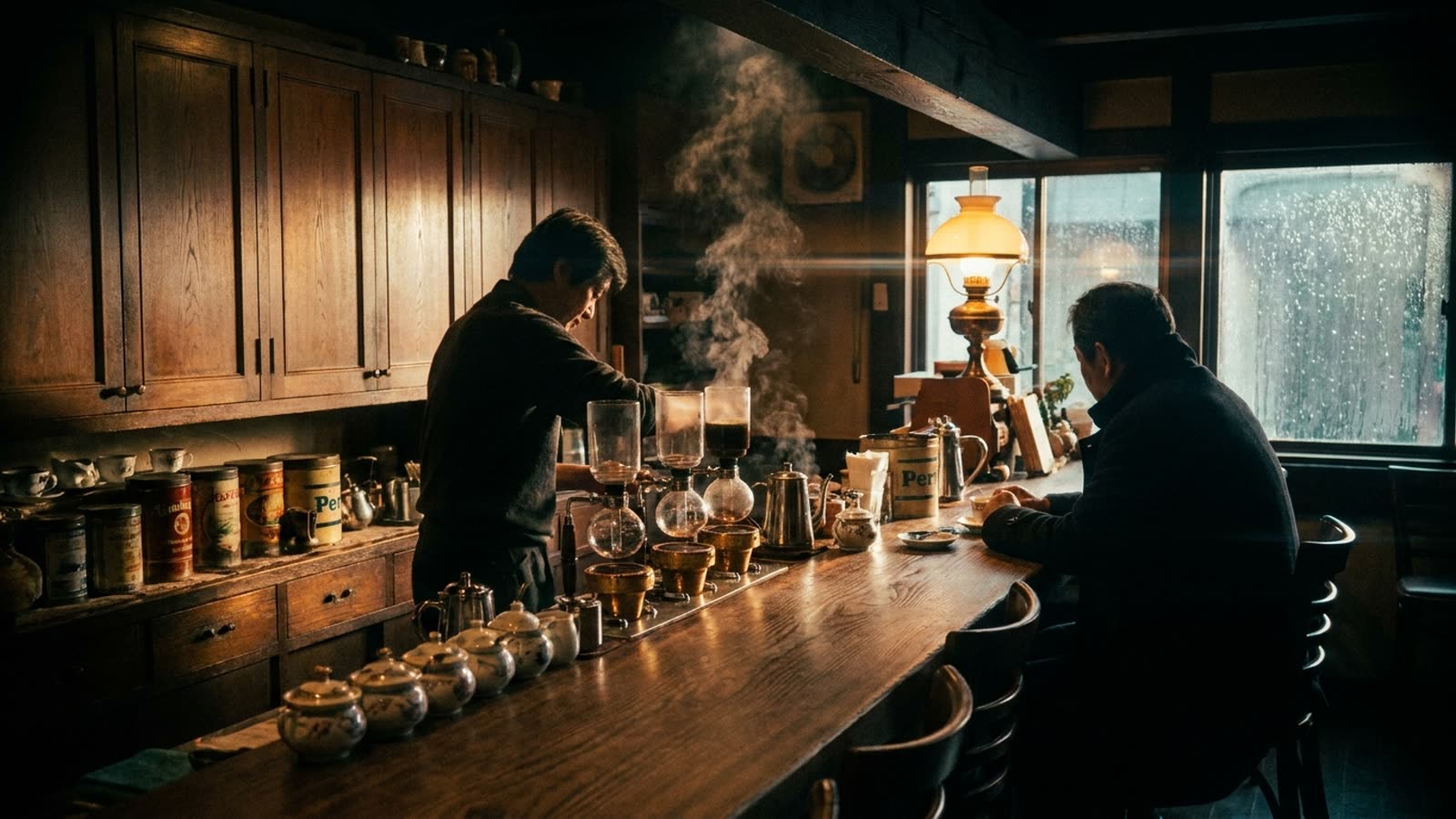
The word itself tells you what you need to know: kissaten translates roughly to "tea-drinking shop," though coffee has dominated since the postwar years when American GIs introduced the habit. What distinguishes a kissaten from a café is harder to articulate but immediately apparent upon entry. The lighting is low, often amber. The coffee arrives in a china cup, hand-dripped by an elderly proprietor who learned the technique from someone who learned it from someone else. The menu features items like Napolitan spaghetti and thick-cut toast with butter. Time moves differently here, which is precisely the point.
The economics of anachronism
By any rational business metric, the kissaten should have vanished. The model requires skilled labor, premium real estate in urban centers, and a per-customer revenue that cannot compete with high-turnover chains. During Japan's economic bubble of the late 1980s, the country had more than 150,000 kissaten. That number has contracted dramatically, yet the survivors have achieved something remarkable: they have become destinations rather than conveniences. Foreign visitors now seek them out the way previous generations sought temples. Japanese professionals in their twenties and thirties, raised on Starbucks and Doutor, have begun treating kissaten visits as a form of secular meditation.
The proprietors themselves are often the attraction. Many are in their seventies or eighties, having spent entire careers perfecting a single pour-over technique or roast profile. They represent a relationship to craft that feels almost confrontational in its rejection of scale. You cannot franchise a kissaten because the kissaten is, in some essential way, its owner.
What the algorithm cannot replicate
The kissaten's unlikely persistence illuminates a broader cultural hunger. The modern café has been optimized for throughput, for remote work, for the seamless integration of commerce and productivity. The kissaten offers the opposite: a space designed for presence rather than output, where checking your phone feels like a violation of an unspoken contract. The coffee is excellent but not the point. The point is the permission to simply sit, to watch the proprietor work, to exist temporarily outside the logic of efficiency.
This is not nostalgia, or not only nostalgia. It is a practical response to the exhaustion of perpetual connectivity. The kissaten asks nothing of you except that you drink your coffee slowly and perhaps order a second cup. In a world that has monetized every spare moment, that absence of demand has become genuinely radical.
Our take
The kissaten's survival is a quiet rebuke to the tech industry's assumption that convenience is the supreme value. Some experiences improve when friction is removed; others are constituted by friction. The hand-dripped coffee that takes seven minutes to prepare tastes different from the pod coffee that takes thirty seconds, not because of chemistry but because of attention. The kissaten has discovered, perhaps accidentally, that scarcity of time is the one resource that cannot be disrupted. When everything is fast, slowness becomes the luxury.