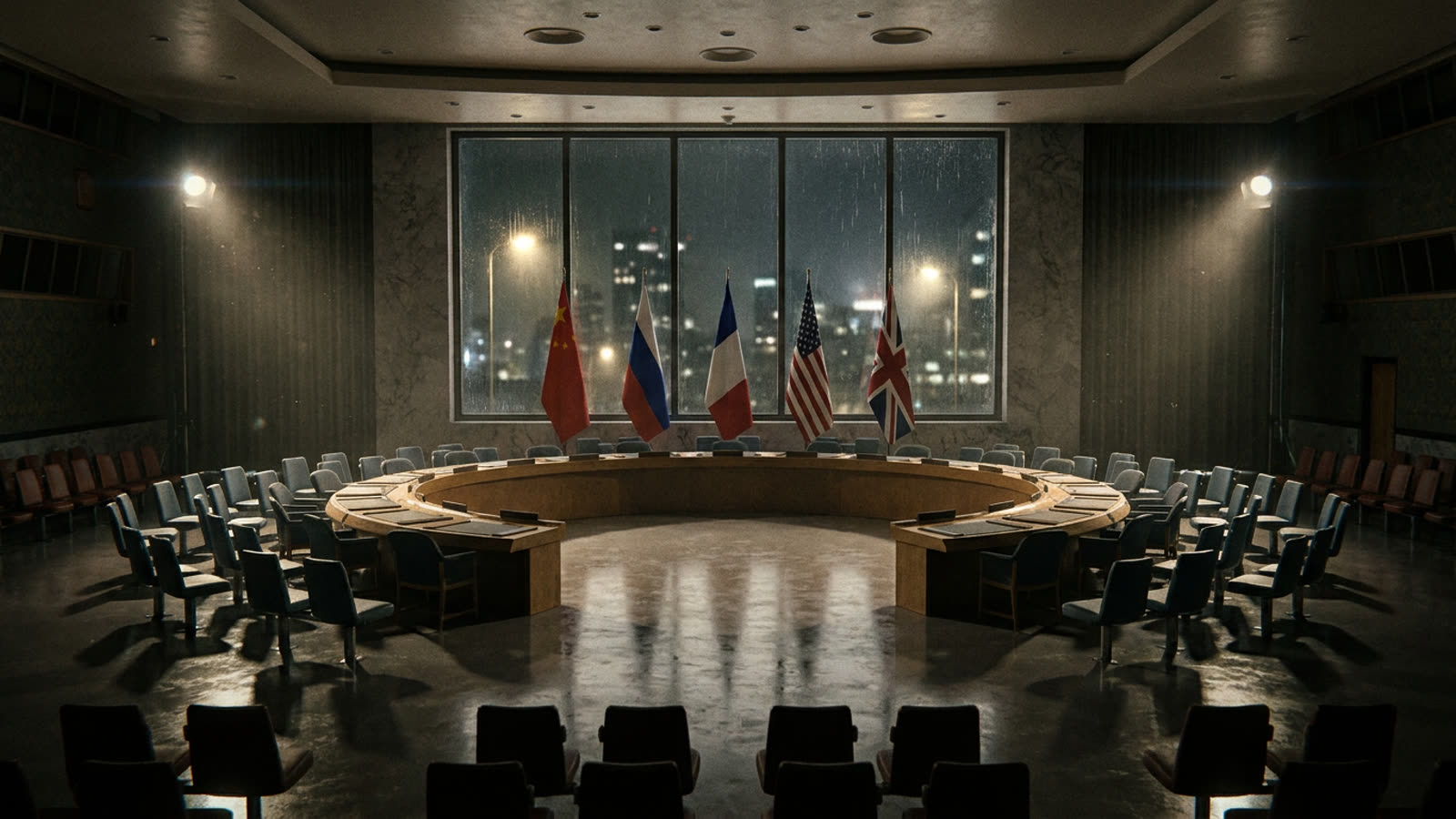
The most powerful word in international diplomacy is not spoken; it is withheld. When a permanent member of the United Nations Security Council raises its hand to veto a resolution, it does not merely block a vote—it erases the possibility of collective action, rendering the world's premier body for maintaining peace into a theater of choreographed impotence.
This is not a bug in the system. It is the system. The veto exists precisely because the nations that designed it refused to submit themselves to any authority they could not control. Understanding this paradox is essential to understanding why the UN can condemn atrocities it cannot stop, why wars rage while diplomats debate, and why the architecture of global governance remains frozen in the strategic anxieties of 1945.
The Yalta bargain
The veto emerged from the Yalta Conference, where Franklin Roosevelt, Winston Churchill, and Joseph Stalin sketched the postwar order while the war still raged. The Americans wanted an organization that could act; the Soviets wanted one that could never act against them. The compromise was elegant and cynical: a Security Council with enforcement powers, but one where the United States, Soviet Union, United Kingdom, France, and China could each unilaterally block any substantive resolution.
The logic was coldly pragmatic. The League of Nations had failed partly because great powers either refused to join or simply ignored its rulings. The UN's founders reasoned that an organization the major powers would actually participate in—even one structurally incapable of restraining them—was better than a principled body they would abandon. The veto was the price of admission.
The arithmetic of paralysis
Russia has cast more vetoes than any other permanent member, frequently to shield itself or allies from censure. The United States has deployed its veto most often to protect Israel from resolutions it considers one-sided. China, historically more sparing, has grown increasingly willing to use the mechanism to block actions it views as interference in sovereign affairs. Britain and France veto rarely now, their imperial afterlives having faded into alignment with broader Western positions.
The mere threat of a veto shapes outcomes before votes occur. Resolutions are drafted, watered down, and sometimes abandoned entirely based on anticipated objections. The formal veto count understates the mechanism's influence; it functions as a gravitational field, bending all diplomacy toward what the permanent five will tolerate.
Reform's impossible math
Proposals to reform or abolish the veto have circulated for decades. Some suggest expanding the permanent membership to include powers like India, Brazil, Germany, or Japan. Others advocate limiting veto use in cases of mass atrocity. A few idealists call for eliminating it entirely.
All such proposals face the same insurmountable obstacle: amending the UN Charter requires ratification by two-thirds of member states, including all five permanent members. The nations with vetoes must agree to diminish their own power. They have shown no inclination to do so. The veto protects itself.
Our take
The Security Council veto is neither an accident of history nor a correctable flaw—it is the honest architecture of a world where powerful states refuse to be bound by rules they do not write. Criticizing the UN for failing to stop wars between or involving major powers misunderstands its purpose; it was never designed to do so. The veto exists because its holders preferred a weak institution they controlled to a strong one they did not. Until that calculus changes—until great powers conclude that submitting to collective restraint serves their interests better than unilateral freedom—the veto will remain what it has always been: the sound of sovereignty trumping solidarity.