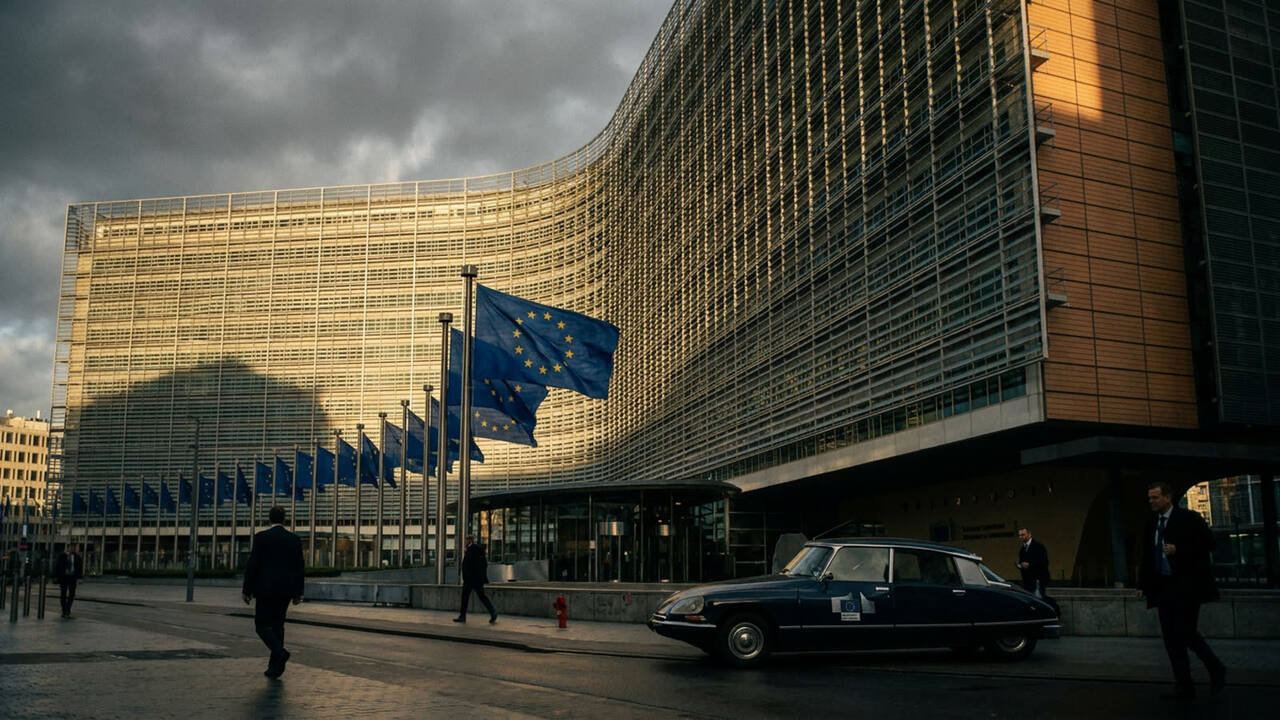
The European Commission is not a government, not quite a civil service, and definitely not a parliament—yet it functions as all three simultaneously while answering to none of the usual democratic checks. This institutional chimera, headquartered in Brussels' Berlaymont building, drafts nearly all EU legislation, enforces competition law against the world's largest corporations, negotiates trade deals on behalf of 450 million people, and operates with a budget larger than most nation-states. Understanding how it actually works is essential to understanding modern Europe.
The Commission's power derives from a peculiar constitutional quirk: it holds a near-monopoly on legislative initiative within the EU. The European Parliament, despite its democratic mandate, cannot propose laws—it can only amend or reject what the Commission puts forward. The Council of Ministers, representing member states, faces the same constraint. This means twenty-seven Commissioners, one from each member state but theoretically serving European rather than national interests, control the policy agenda for an entire continent.
The College of Commissioners
Each Commissioner oversees a portfolio—competition, trade, agriculture, digital affairs—and commands a Directorate-General, the permanent bureaucracy that does the actual drafting. These DGs employ roughly 32,000 officials, a workforce smaller than many municipal governments yet responsible for regulations affecting everything from pesticide residues to smartphone chargers. The Commission President, currently the most powerful unelected official in European politics, assigns portfolios and can reshuffle them at will, creating internal hierarchies that shift with each five-year term.
Commissioners are nominated by member states but must survive confirmation hearings before the European Parliament—a process that has grown increasingly contentious. Several nominees have been rejected or withdrawn under pressure, giving Parliament its primary leverage over an institution it otherwise cannot control. Once confirmed, Commissioners take an oath to serve European interests exclusively, though the fiction that a French Commissioner forgets Paris's preferences strains credulity.
The Art of the Directive
Legislation emerges through a labyrinthine process called the ordinary legislative procedure. The Commission proposes; Parliament and Council amend through multiple readings; trilogue negotiations between all three institutions hammer out compromises in closed sessions. A directive, once adopted, must be transposed into national law by each member state—a process that introduces further variation and delay. A regulation, by contrast, applies directly and uniformly.
The real power often lies in delegated and implementing acts, technical measures the Commission can adopt without full legislative procedure. These ostensibly minor adjustments—setting chemical thresholds, defining product categories—accumulate into vast regulatory authority exercised far from public scrutiny. When the Commission banned certain single-use plastics or mandated USB-C charging ports, it was exercising this accumulated technocratic discretion.
Our take
The Commission represents a genuinely novel experiment in supranational governance, and its legitimacy problem is real but overstated. Democratic accountability flows through multiple channels—Parliament confirmation, Council oversight, national governments that appoint Commissioners, courts that review decisions. The more honest critique is that this diffuse accountability lets everyone blame Brussels while no one takes responsibility. The Commission's power is less a democratic deficit than a democratic diffusion, which may be worse.