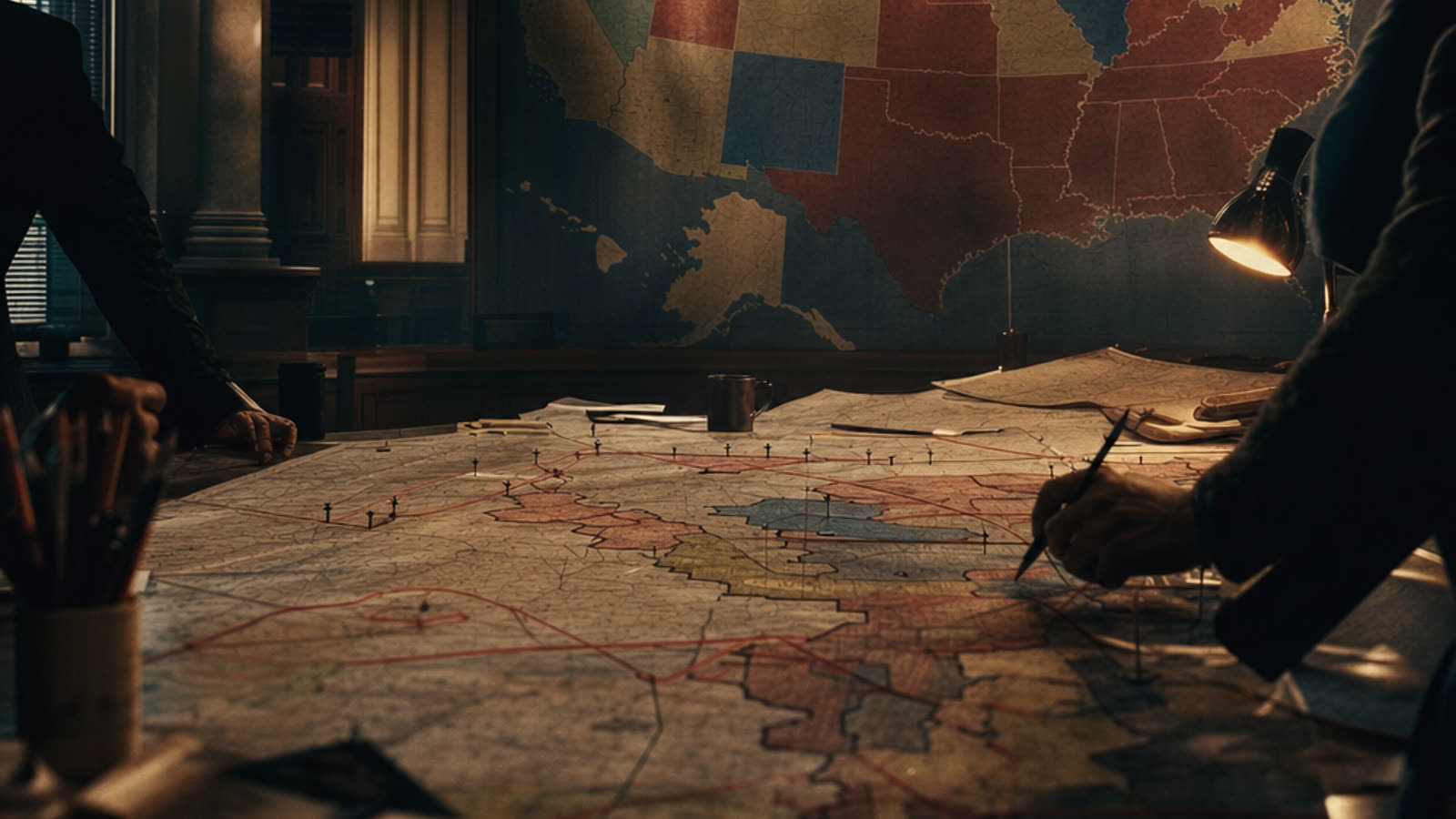
The most consequential political decisions in American democracy often happen in windowless conference rooms, surrounded by laptops running sophisticated mapping software, where state legislators and their consultants draw the lines that will determine who governs for the next ten years.
This is redistricting, the decennial ritual mandated by the Constitution's requirement that House seats be apportioned according to population. In theory, it's a neutral administrative task. In practice, it's become the most effective tool for incumbent protection and partisan advantage in modern politics—one that operates largely outside public attention until the damage is already locked in.
The mechanics of manipulation
Gerrymandering—named for Massachusetts Governor Elbridge Gerry, whose 1812 state senate map included a district shaped like a salamander—relies on two basic techniques. "Packing" concentrates opposition voters into a few districts they'll win overwhelmingly, wasting their surplus votes. "Cracking" spreads them thinly across many districts where they'll reliably lose. Modern mapping software can execute these strategies with surgical precision, analyzing voter files, demographic data, and past election results down to the individual household.
The results are districts that snake through cities, split neighborhoods, and sometimes connect two population centers by nothing more than a highway median. North Carolina's former 12th District stretched 120 miles along Interstate 85, in some places no wider than the road itself. Maryland's 3rd District was once described by a federal judge as resembling "a broken-winged pterodactyl, lying prostrate across the state."
Why courts struggle to stop it
The Supreme Court has long held that racial gerrymandering violates the Constitution, but partisan gerrymandering presents a thornier problem. In Rucho v. Common Cause, the Court ruled that federal courts cannot adjudicate partisan gerrymandering claims, calling them "political questions" beyond judicial reach. Chief Justice Roberts acknowledged that excessive partisanship in districting is "incompatible with democratic principles," but concluded that no manageable standard exists for courts to apply.
This leaves reform efforts to state courts interpreting state constitutions, ballot initiatives establishing independent redistricting commissions, or the faint hope that legislators might voluntarily surrender their map-drawing power. Some states have moved toward independent commissions—California, Arizona, and Michigan among them—but the majority still leave the fox in charge of the henhouse.
Our take
The genius of gerrymandering is its invisibility. Voters experience its effects—uncompetitive elections, polarized representatives, a sense that their votes don't matter—without connecting them to lines drawn years earlier in rooms they never saw. It's democracy's original sin of self-dealing, committed fresh every decade. Until redistricting becomes boring enough to be left to genuinely nonpartisan bodies, American elections will continue to be won before a single ballot is cast.