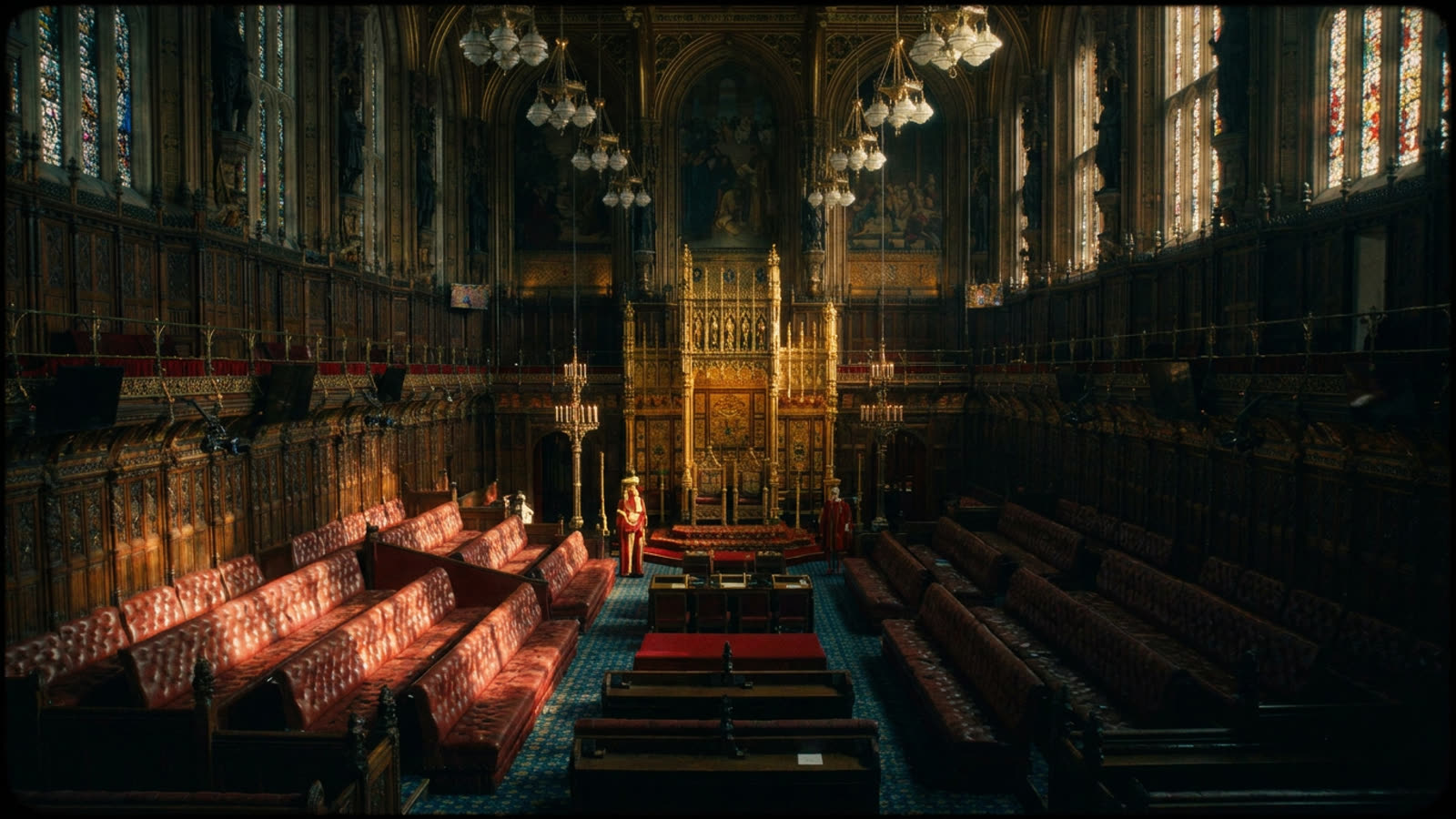
The House of Lords should not exist. An unelected legislative chamber stuffed with hereditary aristocrats, political appointees, and Anglican bishops belongs in a constitutional museum, not in the parliament of a modern democracy. Yet there it sits in Westminster, reviewing legislation, occasionally blocking government bills, and somehow commanding enough legitimacy to survive every reform attempt thrown at it. The Lords endures not despite its absurdity but partly because of it—its very strangeness creates a political equilibrium that no proposed alternative has managed to replicate.
The chamber's composition defies tidy explanation. Since the House of Lords Act 1999 ejected most hereditary peers, the body has comprised mainly life peers appointed by successive prime ministers, plus 26 Church of England bishops (the "Lords Spiritual") and 92 remaining hereditary peers elected by their own kind whenever one dies. No other Western legislature features clergy sitting by constitutional right or aristocrats chosen through internal balloting. The result is a house of roughly 800 members—larger than the European Parliament—with no fixed term, no constituency, and no democratic mandate whatsoever.
The Salisbury convention and soft power
What prevents this unelected mass from simply vetoing everything the Commons passes? The answer lies in constitutional convention rather than law. The Salisbury-Addison convention, established after Labour's landslide victory in 1945, holds that the Lords will not block legislation promised in the governing party's election manifesto. This gentleman's agreement has no legal force; peers simply observe it because violating it would trigger a constitutional crisis they would lose. The Lords can delay, amend, and send bills back for reconsideration, but on manifesto commitments they ultimately yield. This self-imposed restraint is precisely what keeps abolition off the table—a chamber that cannot ultimately defy the elected house poses no existential threat to democracy.
The Lords' real influence operates through revision rather than rejection. Government bills arrive from the Commons riddled with drafting errors, unintended consequences, and hasty compromises. The Lords' committee system—populated by retired judges, former cabinet ministers, and genuine subject-matter experts—catches problems that the Commons' partisan warfare often misses. Ministers frequently accept Lords amendments because they improve legislation, not because they fear defeat. This technocratic function gives the chamber a legitimacy that pure democratic theory cannot explain.
Why every reform proposal collapses
British politicians have promised Lords reform for over a century. The Parliament Act 1911 was explicitly described as a temporary measure pending proper democratization. Yet every serious reform effort has foundered on the same dilemma: a fully elected upper house would claim democratic legitimacy equal to the Commons, creating American-style gridlock between co-equal chambers. A partially elected house satisfies no one. And abolition would remove a useful revising function without obvious replacement. The Lords persists because every alternative creates worse problems than the status quo.
Prime ministers also discover that appointment power is too valuable to surrender. The ability to reward loyal supporters, retired MPs, and major donors with lifetime peerages represents patronage of medieval proportions dressed in modern clothes. Tony Blair, who removed most hereditary peers, appointed more life peers than any predecessor. The chamber he reformed became more dependent on prime ministerial favor, not less.
Our take
The House of Lords is constitutional dark matter—invisible to democratic theory yet exerting gravitational pull on how Britain actually governs. Its survival teaches an uncomfortable lesson: institutions need not be legitimate in principle to be functional in practice. The Lords works because everyone involved understands its limits and respects conventions that exist nowhere in writing. That fragility is also its protection. Any attempt to rationalize the chamber risks destroying the delicate equilibrium that lets an unelected body coexist with democratic government. The Lords will likely outlast most of its critics, not because Britain loves aristocracy but because no one has found a better way to revise legislation without creating a second power center. Sometimes the strangest arrangements are the most stable.