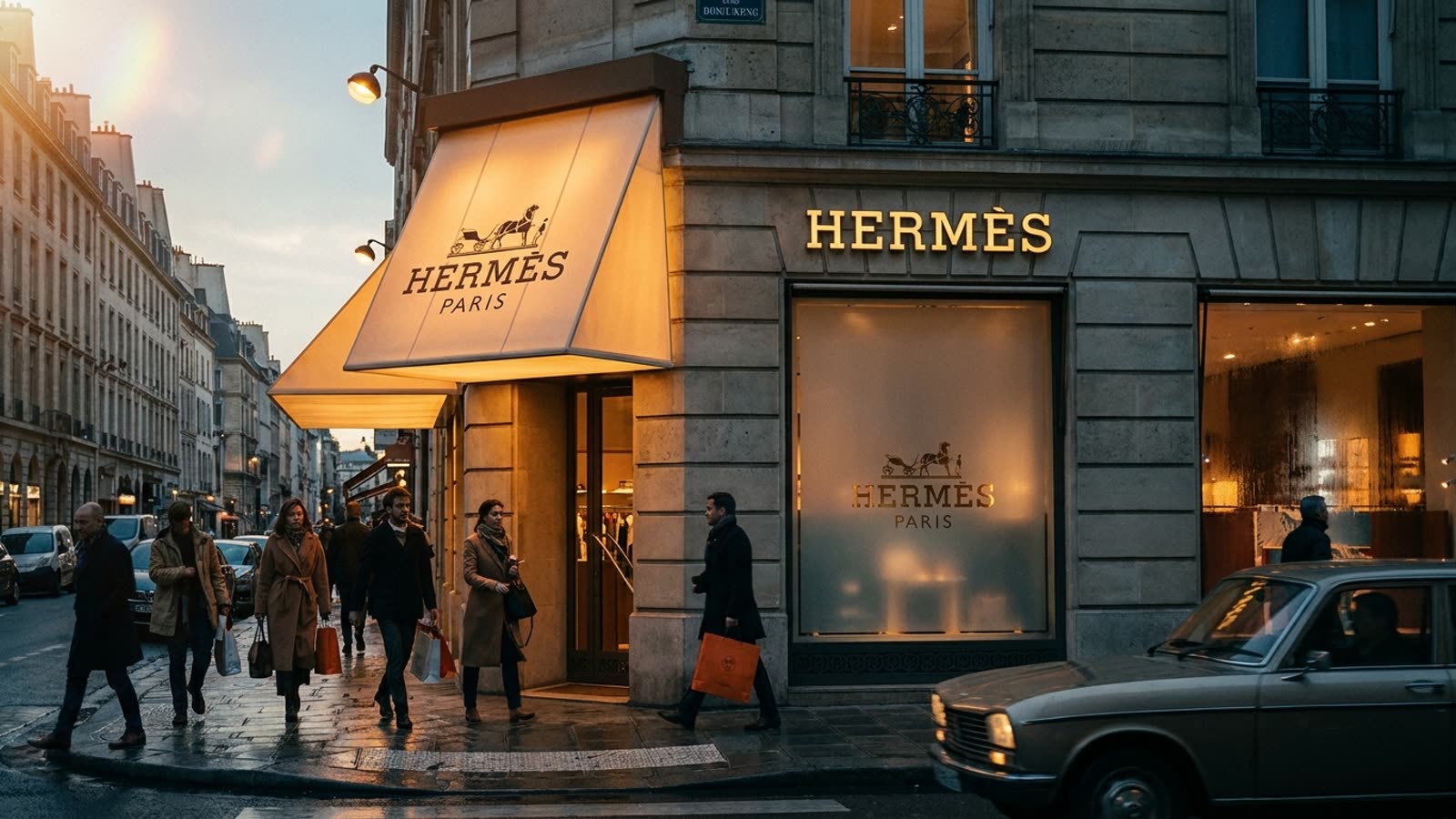
The waiting list for a Birkin bag doesn't exist. This fact, widely misunderstood by luxury aspirants worldwide, is the key to understanding how Hermès has created what may be the perfect luxury good: an object that becomes more desirable the harder it is to obtain, and more valuable the moment you walk out of the store with it.
The accidental icon
The origin story is almost too perfect. In 1984, Jane Birkin sat next to Hermès chief executive Jean-Louis Dumas on a flight from Paris to London. When her overstuffed straw bag spilled its contents across the cabin floor, she complained about the impossibility of finding a leather weekend bag she liked. Dumas sketched a design on an airsickness bag. The resulting handbag would become a cultural phenomenon that transcends fashion.
What began as a practical solution to a storage problem has evolved into something far stranger: a handbag that can cost anywhere from five figures to several hundred thousand dollars, depending on the leather and hardware, yet consistently outperforms the S&P 500 as an investment vehicle. Auction houses now have dedicated Hermès departments. There are Birkin bag indices tracking appreciation rates.
The game theory of desire
Hermès doesn't maintain a waiting list because that would be too straightforward, too democratic. Instead, they've created something more psychologically complex: a system where your ability to purchase a Birkin depends on your "relationship" with the brand and your sales associate. It's a dance of unspoken rules, strategic purchases of scarves and jewelry, and careful cultivation of your profile as a client.
This opacity serves multiple functions. It allows Hermès to control distribution absolutely while maintaining the fiction that anyone could, theoretically, walk in and buy one. It creates a secondary market where bags routinely sell for multiples of their retail price. Most importantly, it transforms the purchase from a transaction into an achievement.
The company produces only a limited number of Birkins each year – the exact figure is a closely guarded secret, but estimates suggest around 12,000 globally. Each bag is handmade by a single craftsperson over 18 to 24 hours. This genuine scarcity, combined with artificial scarcity through selective distribution, creates a perfect storm of desire.
The ultimate Veblen good
In economics, a Veblen good is one for which demand increases as price increases, violating the basic law of demand. The Birkin is perhaps the purest example of this phenomenon in the modern economy. Its value lies not in its utility – there are thousands of handbags that carry items just as effectively – but in its ability to signal.
What it signals has evolved over the decades. Initially, it marked membership in a certain European social set. Today, particularly in Asia and the Middle East, it functions as a store of value, a business card, and a family heirloom simultaneously. The bags are increasingly purchased as investments, stored in climate-controlled conditions, and treated more like art than accessories.
Our take
The Birkin bag represents late capitalism's masterstroke: convincing consumers that the difficulty of purchasing something enhances rather than diminishes its value. Hermès has effectively gamified luxury consumption, turning their stores into casinos where the chips are silk scarves and the jackpot is the right to spend a year's salary on a handbag. It's absurd, it's brilliant, and it's working perfectly. The Birkin will outlive us all, not because it's particularly well-made (though it is), but because Hermès understands something fundamental about human psychology: we always want most what we cannot have.