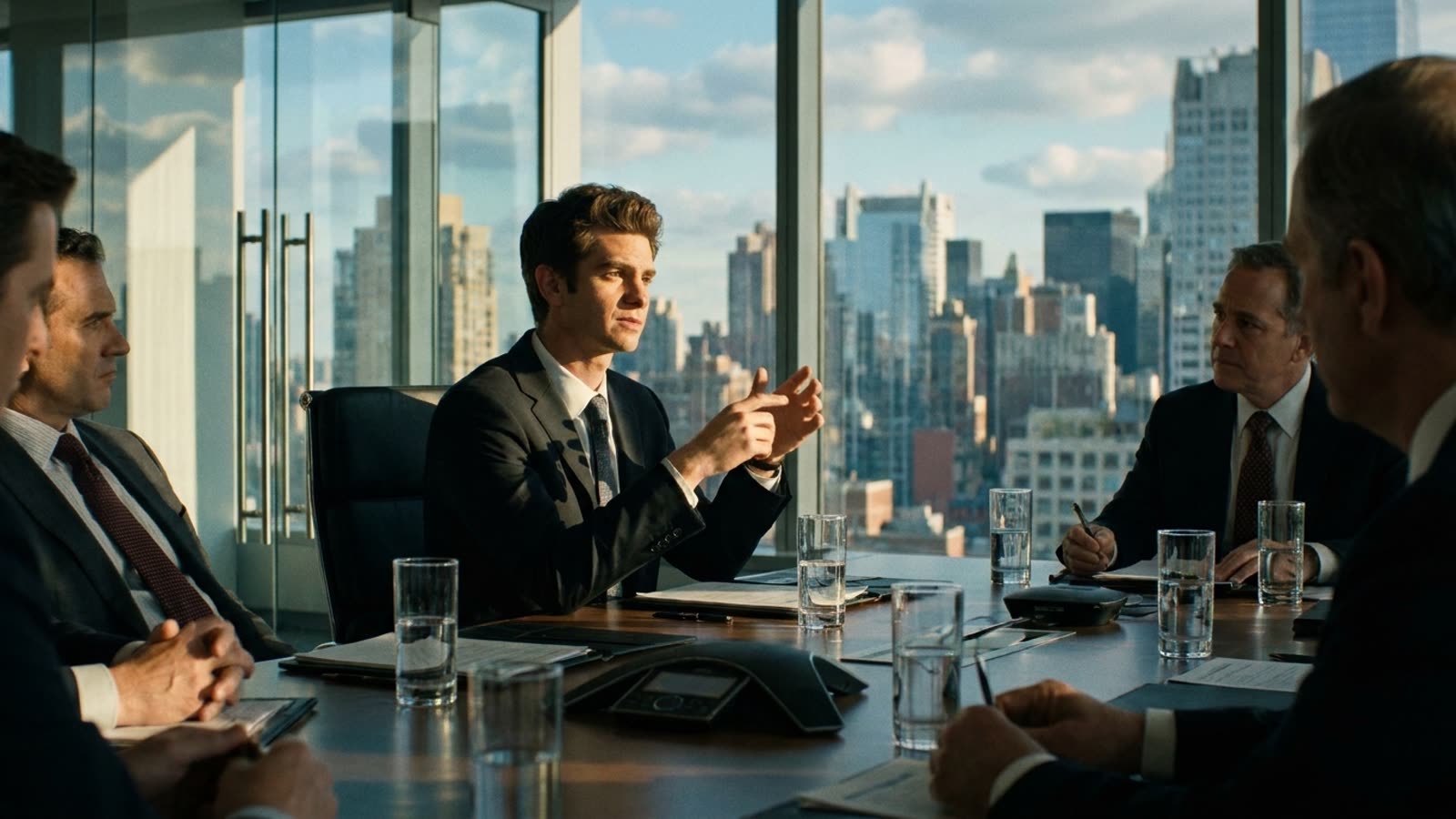
There is something deliciously meta about an actor preparing to portray a man whose company builds machines designed to simulate human interaction, only to discover that his subject may have simulated an interaction with him.
Andrew Garfield, who is filming the OpenAI biopic Artificial, told interviewers this week that he has "never had any interaction" with Sam Altman, the company's chief executive and the man he is embodying on screen. The statement directly contradicts Altman's own recent claim that the two exchanged a friendly wave during production. "I was very confused by that," Garfield said, with the kind of measured bewilderment that suggests he has thought about this more than once.
The non-wave heard round the industry
The discrepancy is minor in substance but rich in subtext. Altman, who has spent the past several years cultivating an image as Silicon Valley's most affable disruptor, apparently told people he and Garfield had shared a moment of mutual acknowledgment. Garfield, known for his method intensity and a certain allergy to Hollywood phoniness, is now on record saying it never happened. One of them is mistaken. One of them is misremembering. Or one of them is doing something else entirely.
For the production, the timing is awkward. Biopics of living subjects are delicate creatures, requiring a balance between journalistic credibility and narrative license. When the subject and the star cannot agree on whether they have ever made eye contact, that balance becomes harder to strike. Studios prefer their talent and their real-life inspirations to appear, if not collaborative, at least cordial. A public "he said, he said" about a wave is not cordial.
Why it matters beyond the gossip
Garfield's insistence on the record is notable because he did not have to say anything. He could have smiled, nodded, confirmed the wave, and moved on. Instead, he chose precision over diplomacy, a move that will either endear him to audiences who value authenticity or complicate his relationship with Altman's considerable publicity apparatus. OpenAI is not merely a tech company; it is a cultural phenomenon with a communications operation to match. Garfield has, perhaps knowingly, picked a small fight with a large machine.
The incident also raises the evergreen question of how biopics of tech founders should be made. Altman is not Steve Jobs, whose death allowed Aaron Sorkin and Danny Boyle to work without interference. He is alive, extremely online, and clearly paying attention. Whether Artificial will be a hagiography, a critique, or something in between may depend on negotiations that are happening far from any camera.
Our take
Garfield is right to draw the line, even if the line is absurdly small. Actors playing real people owe their subjects nothing except a good-faith attempt at truth. If Altman wants to claim a connection that does not exist, that is his prerogative, but Garfield is under no obligation to cosign the fantasy. In an era when AI-generated content threatens to blur every boundary between real and fabricated, a human being insisting on the factual record—even about something as trivial as a wave—feels almost radical. The movie may or may not be good. But Garfield is already playing the role correctly.