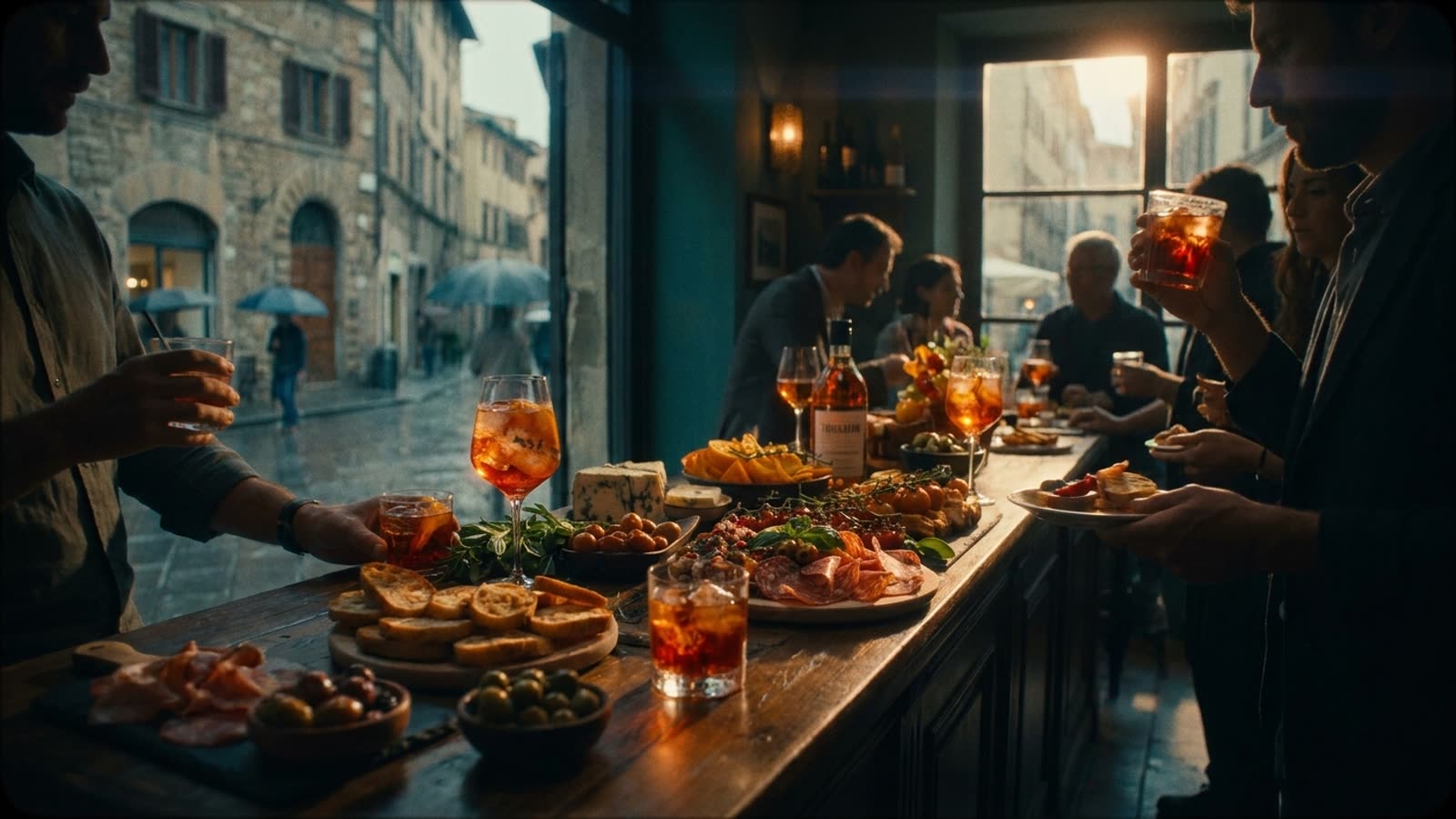
The aperitivo is not a drink. It is not a meal. It is a philosophy of time management disguised as a social ritual, and it may be the most civilized idea to emerge from European culture since the separation of church and state.
The premise is elegant in its simplicity: between the end of work and the beginning of dinner, there exists a liminal hour that most cultures fill with commuting, doomscrolling, or aggressive happy-hour drinking. Italians, particularly those in Milan and Turin, decided centuries ago that this hour deserved better. They invented a ritual around bitter, low-alcohol drinks and modest snacks, creating a structured pause that acknowledges the transition between productivity and pleasure.
The bitter truth
The aperitivo's origins trace to late 18th-century Turin, where Antonio Benedetto Carpano introduced vermouth to the Piedmontese court. The drink's bitter herbs were believed to stimulate appetite—aperire means "to open" in Latin—but the real innovation was social rather than digestive. By the mid-20th century, Milan had transformed the aperitivo into an institution, with bars offering elaborate spreads of olives, cured meats, and small sandwiches alongside spritzes and negronis.
What distinguishes the aperitivo from the Anglo-American happy hour is intentionality. Happy hour is about discounted alcohol and rapid consumption before returning to obligations. The aperitivo presumes you have nowhere urgent to be. It is explicitly anti-productive, a deliberate insertion of pleasure into the schedule rather than a rushed reward for labor completed.
Global translation
The ritual has migrated far beyond Northern Italy. Barcelona, Paris, and New York have all developed aperitivo cultures, though each translation reveals something about the importing society. American versions tend toward abundance, with bars competing to offer more elaborate food spreads. French interpretations emphasize the drinks themselves, often substituting pastis or kir for the traditional Campari. The Spanish, already possessing their own tapas tradition, have merged the two concepts into something distinctly Mediterranean.
The pandemic accelerated this adoption. Locked-down professionals, suddenly freed from commutes but still bound to screens, discovered they needed rituals to mark the boundary between work and not-work. The aperitivo offered a template: a specific time, a specific drink, a specific intention to stop being useful.
Our take
The aperitivo's spread represents something more significant than a cocktail trend. It is a quiet rebellion against the tyranny of optimization, a daily reminder that the point of efficiency is to create time for inefficiency. In a culture that has pathologized leisure and monetized relaxation, the simple act of sitting with a bitter drink and no agenda feels almost radical. The Italians understood something the rest of us are still learning: that the hours between obligations are not dead time to be filled, but the actual substance of a life well lived.