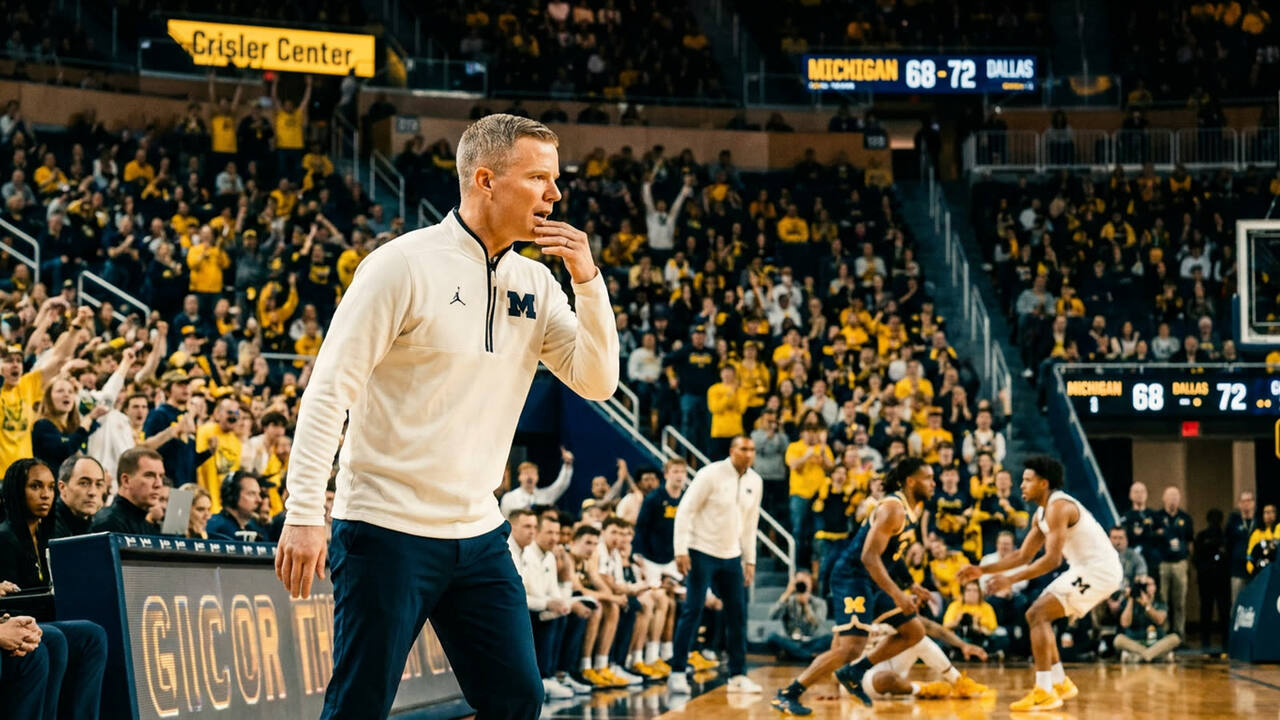
Dusty May spent exactly two seasons at Michigan before the Dallas Mavericks came calling, and the answer was apparently yes before the question finished leaving their lips.
The hire, first reported by ESPN on Sunday, represents both a coup for a Mavericks organization seeking stability after a turbulent stretch and a gut punch to a Michigan program that believed it had finally found its post-Juwan Howard identity. May, who built Florida Atlantic into a Final Four darling before accepting the Ann Arbor job, now becomes the latest in a growing line of college coaches who view the NCAA as a proving ground rather than a destination.
The Dallas calculation
The Mavericks are betting on process over pedigree. May has never coached an NBA game, never managed a roster of max-contract egos, never navigated the particular politics of a league where players hold more power than coaches. What he has done is build programs from rubble—first at FAU, where he transformed a commuter school into a legitimate mid-major power, then at Michigan, where he inherited a roster in disarray and immediately stabilized it.
Dallas owner Mark Cuban, who sold his majority stake but retains significant influence, has long favored unconventional hires. May fits the mold: a tactician who emphasizes player development and defensive schemes over star-chasing. The Mavericks, still built around Luka Dončić's generational talent, need a coach who can maximize role players and create a coherent system. May's college résumé suggests he can.
Michigan's familiar nightmare
For the Wolverines, this is becoming a tiresome pattern. The program has now lost two coaches in five years to circumstances beyond the usual firing-for-cause—Howard to suspension-related chaos, May to the NBA's gravitational pull. Athletic director Warde Manuel faces another search, another reset, another pitch to recruits that this time will be different.
The timing is particularly brutal. May had assembled a promising 2026-27 roster and was building momentum on the recruiting trail. Now Michigan must convince blue-chip prospects that the next coach will actually be around to develop them. In an era of transfer portals and NIL chaos, coaching stability is the one competitive advantage programs can theoretically control. Michigan cannot seem to achieve it.
The college-to-NBA pipeline widens
May joins a cohort that includes Michigan State's Tom Izzo (perpetually courted), Gonzaga's Mark Few (same), and the various assistants who have made the leap in recent years. The difference now is speed. May didn't need a decade of sustained excellence to attract NBA attention—two seasons and a Final Four appearance was enough.
This acceleration reflects the NBA's evolving priorities. Front offices increasingly value coaches who can teach, who can scheme, who can connect with young players accustomed to the college environment. The old model of promoting assistants or recycling failed NBA coaches is giving way to a more aggressive poaching of college talent.
Our take
May made the rational choice. The NBA offers more money, more resources, and freedom from the recruiting grind that consumes college coaches' lives. But his departure underscores a growing crisis in college basketball: the sport is becoming a developmental league for coaches as much as players, and the programs left behind are the ones paying the price. Michigan will survive—it always does—but the Wolverines faithful are entitled to wonder whether anyone they hire will stick around long enough to matter.