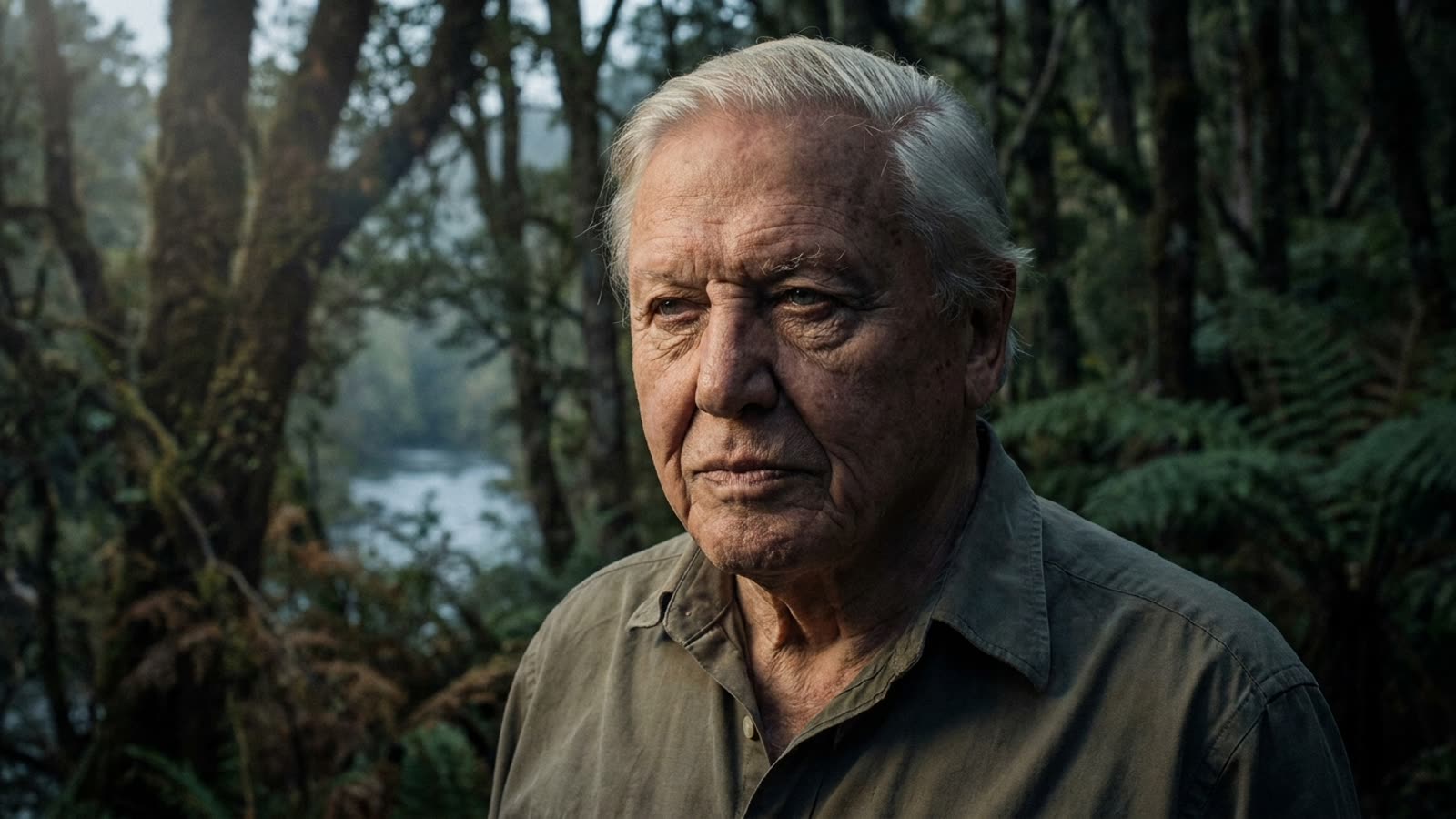
Sir David Attenborough, the most recognizable voice in the history of broadcasting, turned 100 on Friday. That sentence is not a metaphor. The man who narrated The Blue Planet, Planet Earth, and Life on Earth — who introduced gorillas to a generation, who said the word "extraordinary" in a way that made the word itself feel endangered — is, as of today, a centenarian. He was born in 1926. Charlie Chaplin was still making silent films.
The tributes began at midnight. King Charles and Queen Camilla released a personal photograph of Sir David at the Buckingham Palace garden with a handwritten note wishing him "a very happy hundredth, with our profound gratitude for a life given to the natural world." The BBC devoted its entire Friday morning schedule to a rotation of Attenborough documentaries. Google changed its doodle. The city of Leicester, where he grew up, lit its town hall green.
A career measured in species
Attenborough's first BBC documentary, Zoo Quest, aired in 1954. He has been working, in one form or another, ever since — a seventy-two-year career that spans the invention of color television, the collapse of the British Empire, the discovery of DNA's structure, the moon landing, the fall of the Berlin Wall, the invention of the internet, and the rise of climate change from a scientific footnote to the defining crisis of a generation.
He has filmed in every country on earth. He has been bitten by a snake, charged by a silverback, and, in a now-legendary 1975 BBC moment, cuddled by a family of mountain gorillas in Rwanda who decided that the short English man with the microphone was safe to sleep near. He has narrated over fifty major series. He has done all of it, for almost all of it, without a single public scandal, a single bad-faith controversy, or a single tabloid front page that was not a celebration.
The century mark is political, whether he likes it or not
Attenborough has spent the last two decades becoming, slowly and reluctantly, a climate campaigner. He has been careful about it — never strident, never explicitly partisan, always framing the crisis as something the species as a whole has to solve rather than a fight between political camps. But the century he is marking today is also the century in which the Earth warmed by more than a degree, lost half its wild mammal biomass, and acidified its oceans beyond anything seen in fifteen million years. He has documented it in real time.
In a recorded message released Friday morning, he did not dwell on his own longevity. "I have been very lucky," he said. "I have seen extraordinary things. I have also seen the natural world change, in my lifetime, more than it has in any other single human lifetime. What we do now matters. Please — do something."
Greta Thunberg, who has credited Attenborough as one of the two figures who shaped her early understanding of the climate crisis, posted a video message in response that ended with her simply saying, "Sir David. You gave us the language. Thank you."
The one thing he still wants
Asked by the BBC's Mishal Husain last week what he still hoped to see, Attenborough paused for almost ten seconds before answering. He did not name a species. He did not name a habitat. He said, quietly, "I would like to see a decade of good news."
That may be the most attainable birthday wish he has ever made public, and the most difficult one the rest of us have been handed.
Our take
There is nobody else like him, and there probably will never be anyone like him again. A century of life, seven decades of work, and a body of documentary film that has fundamentally shaped how humanity sees its own planet — that is not a career, it is a gift to the species. Happy birthday, Sir David. We owe you a better planet than the one we have, and we know it.