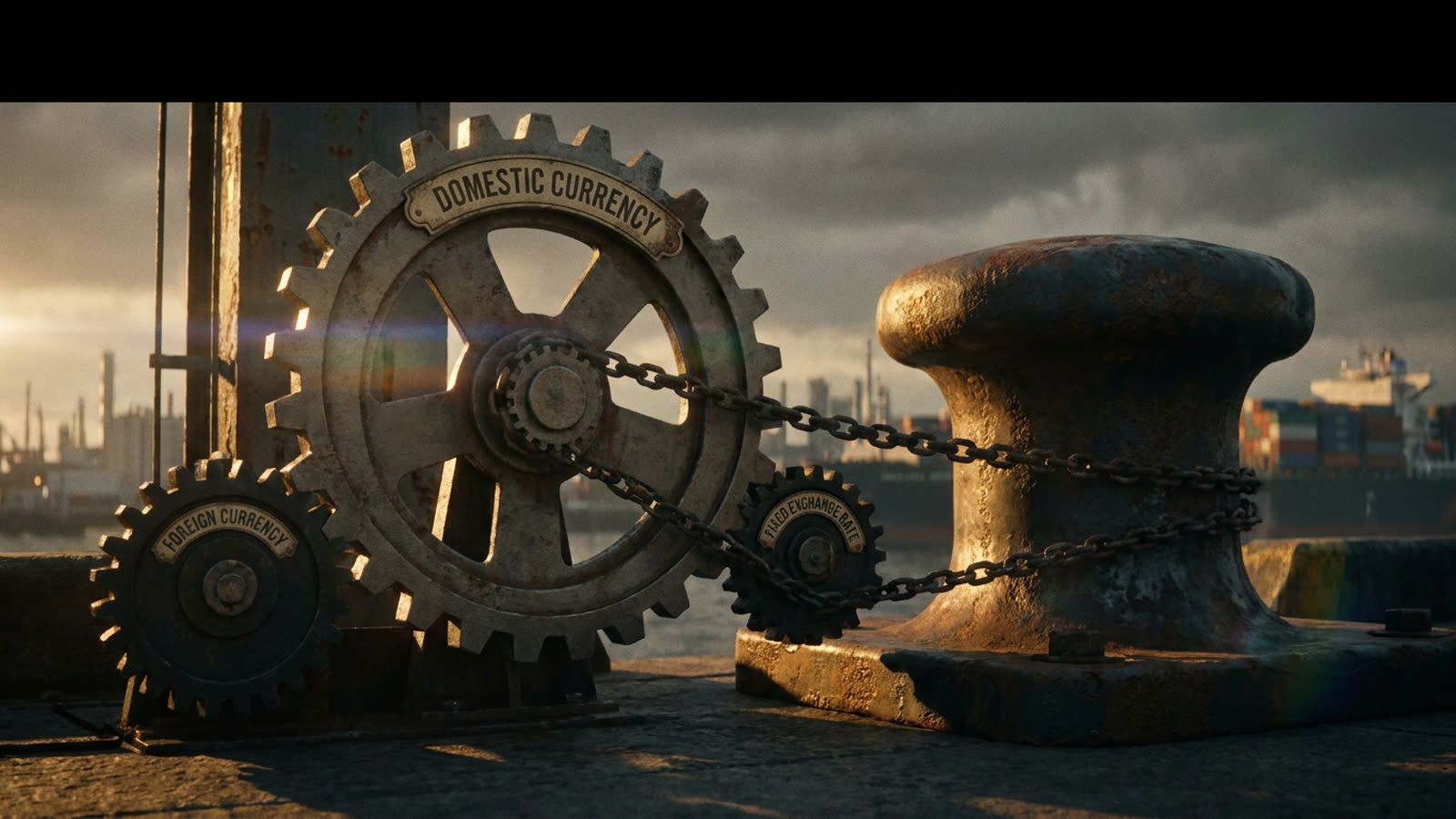
A currency peg is a promise that a government makes to the world: our money will always be worth exactly this much of your money. It sounds like stability. It often becomes a trap.
The appeal is obvious. Businesses can plan without worrying about exchange rate swings. Foreign investors feel protected. Imports have predictable prices. For small, trade-dependent economies, a peg to a major currency like the dollar can seem like borrowing credibility from a more stable neighbor. But the cost of that borrowed credibility is sovereignty over your own economic destiny.
The impossible trinity
Economists call it the trilemma: a country can have free capital flows, an independent monetary policy, or a fixed exchange rate — but never all three simultaneously. Choose a peg, and you must either restrict money moving across your borders or surrender control of your interest rates. Most countries choosing pegs opt to give up monetary independence, effectively outsourcing their central banking to whichever currency they've hitched their wagon to.
This works beautifully when your economy moves in sync with your anchor. It becomes catastrophic when it doesn't. If the United States raises rates to cool inflation while your pegged economy is sliding into recession, you must raise rates too — pouring gasoline on your own fire to maintain the exchange rate promise.
The speculators always come
Every peg carries within it the seeds of a crisis. The moment markets sense a government lacks the reserves or political will to defend the rate, speculation becomes a one-way bet. Traders can short the currency with limited downside — either the peg holds and they lose a little on transaction costs, or it breaks and they make fortunes. George Soros famously demonstrated this against the British pound in 1992, but the pattern repeats across decades and continents.
The defense is expensive and often futile. Central banks burn through foreign reserves buying their own currency. Interest rates spike to punishing levels to make speculation costly. The real economy suffers collateral damage while financial generals fight their currency war. When the peg finally breaks — and weak pegs almost always break — the adjustment is violent rather than gradual.
Why they persist
Despite the historical wreckage, pegs endure. Hong Kong has maintained its dollar peg since 1983, through Asian financial crises and political upheaval. Gulf oil exporters peg to the dollar because their primary export is priced in dollars, creating a natural hedge. Some countries use pegs as anti-inflation anchors, importing monetary discipline they cannot generate domestically.
The survivors share common traits: massive foreign reserves, economies genuinely aligned with their anchor currency, and political systems capable of absorbing the domestic pain that peg maintenance occasionally requires. They treat the peg not as a convenience but as a constitutional commitment.
Our take
Currency pegs are not inherently foolish — they are inherently demanding. The countries that maintain them successfully understand they have signed away flexibility in exchange for predictability, and they build their entire economic architecture around that trade-off. The countries that fail treat pegs as cheap credibility, a shortcut to stability without the underlying discipline. Markets eventually discover the difference, and the discovery is never gentle.