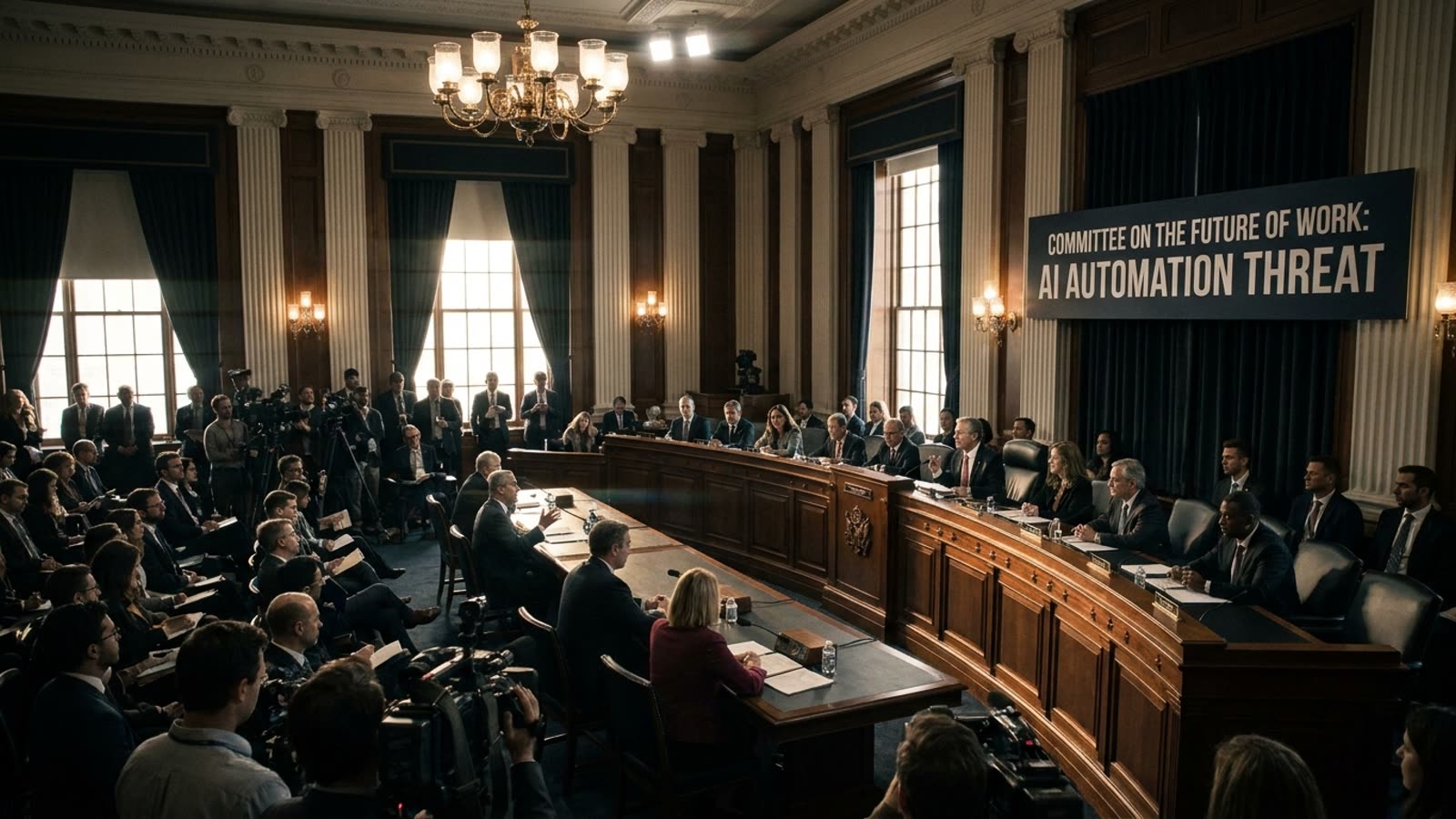
The legislative branch has spent years oscillating between AI boosterism and AI panic, rarely landing on concrete policy. Now a bipartisan group in Congress is proposing something that sounds almost quaint: beefing up unemployment insurance to cushion the blow when algorithms replace workers.
The bill, still in draft form, would extend benefit duration, raise payment floors, and create a dedicated fund for workers displaced specifically by automation. It is the first serious legislative acknowledgment that AI-driven job losses are not a hypothetical but an actuarial certainty — and that existing safety nets were designed for cyclical layoffs, not structural obsolescence.
The numbers that spooked the Hill
Private estimates vary wildly, but the Congressional Budget Office's internal modeling — portions of which have leaked to sympathetic staffers — suggests that 8 to 12 million American jobs face "high exposure" to generative AI displacement by 2030. That is not a recession; it is a permanent redrawing of the labor map. The bill's sponsors have cited these figures in closed-door briefings, arguing that the current unemployment system, which averages 26 weeks of benefits and replaces roughly 40 percent of prior wages, cannot absorb a shock of that magnitude.
The proposed reforms would push benefit duration to 52 weeks for automation-displaced workers, raise the wage-replacement ratio to 60 percent, and create a federal reinsurance backstop for state funds. The price tag is substantial — early estimates run between $40 billion and $70 billion over a decade — but sponsors argue it is cheaper than the alternative: a political crisis when millions of white-collar workers discover that their skills have depreciated overnight.
Why this bill exists now
Timing matters. Midterm elections loom, and both parties sense that AI anxiety is migrating from tech-industry chatter to kitchen-table concern. Republicans backing the bill frame it as pro-worker without being anti-business; Democrats see it as a down payment on a broader social contract renegotiation. Neither side wants to be caught flat-footed if a major employer announces a five-figure AI-driven layoff before November.
There is also a defensive logic. By proposing a relatively modest intervention now, Congress can claim it acted — and deflect calls for more aggressive measures like universal basic income, robot taxes, or mandatory retraining sabbaticals. The bill is, in that sense, a pressure valve as much as a policy.
What it does not do
The bill does not address the deeper question: what happens after the benefits run out? Unemployment insurance assumes workers will find new jobs. If AI compresses entire occupational categories — paralegals, junior analysts, customer-service representatives — the problem is not temporary income loss but permanent skill mismatch. Retraining programs have a dismal track record; the bill includes modest funding for them but no structural reform.
Nor does it touch the employer side. Companies face no obligation to disclose AI-driven workforce reductions, no requirement to fund transition assistance, no penalty for rapid automation without notice. The bill puts the burden on the public fisc, not on the firms capturing the productivity gains.
Our take
This is the legislative equivalent of handing out umbrellas before a hurricane. Useful, yes. Adequate, no. The bill deserves to pass — extended benefits are better than nothing, and the political symbolism of bipartisan action on AI displacement has value. But no one should mistake it for a solution. Congress is acknowledging a problem it does not yet know how to solve, and buying time with money. That is not cynicism; it is realism. The real policy fight — over who pays for automation's winners and losers — has barely begun.