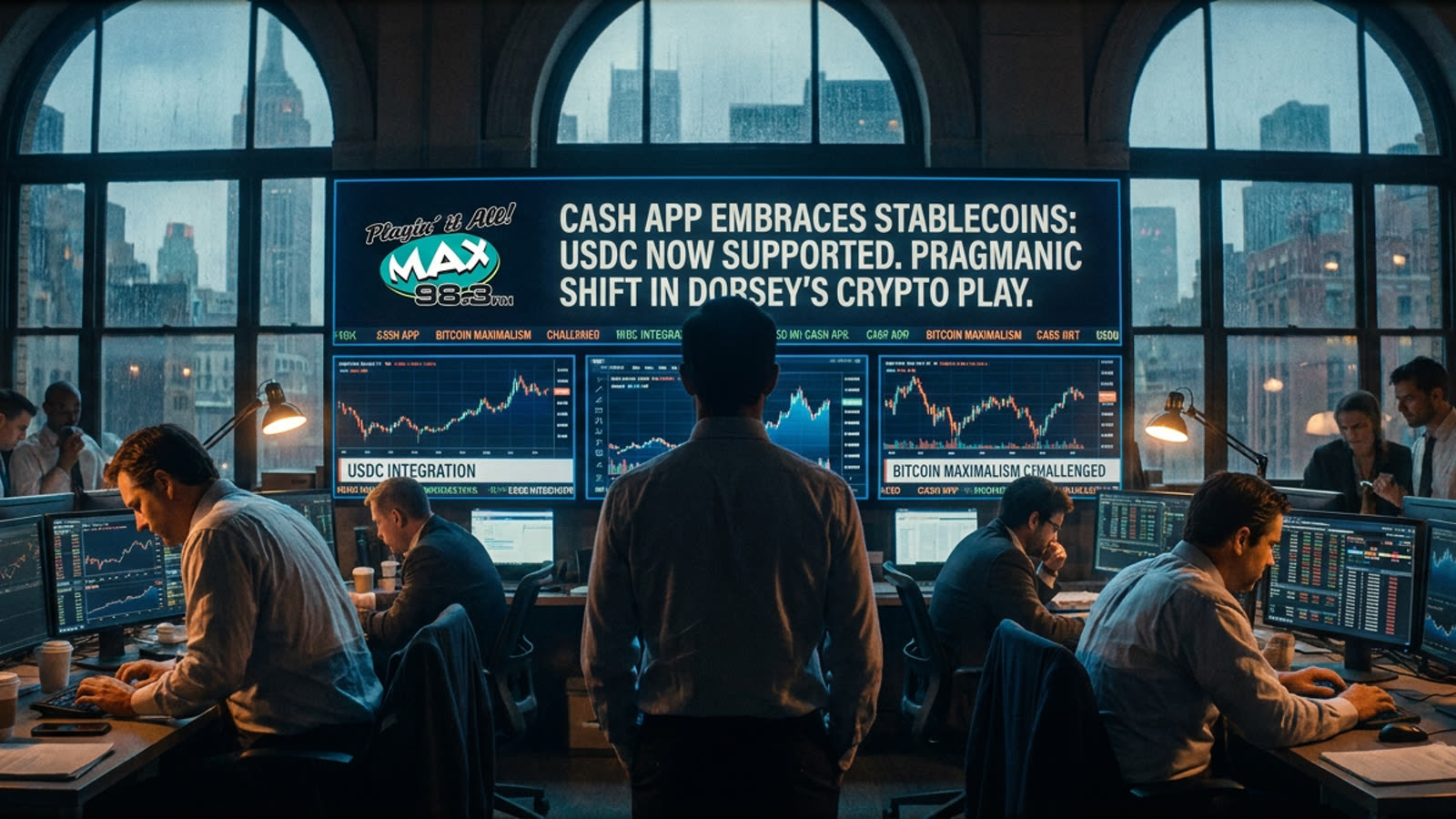
Jack Dorsey has spent years positioning himself as Bitcoin's most prominent corporate evangelist—dismissing Ethereum as a security, calling altcoins distractions, and insisting that Bitcoin alone deserves serious attention. So it is worth noting that Cash App, the consumer payments arm of his company Block, now supports USDC, the dollar-pegged stablecoin issued by Circle on Ethereum and other chains.
The move is not a betrayal of principle so much as an acknowledgment of market reality. Stablecoins have become the connective tissue of crypto commerce, facilitating everything from remittances to on-chain trading settlements. USDC alone has a circulating supply exceeding $30 billion, and the broader stablecoin market has been steadily gaining share against Bitcoin as the preferred medium of exchange within crypto ecosystems. Users want dollar-denominated stability for everyday transactions; they want Bitcoin for speculation and savings. Cash App is now equipped to serve both impulses.
The pragmatist's compromise
Dorsey's public commentary has often framed Bitcoin versus everything else as a binary choice. Yet Block's actual product decisions tell a more nuanced story. The company already supports Lightning Network payments and has invested heavily in Bitcoin mining hardware. Adding stablecoin support does not contradict that thesis—it complements it. A payments app that only offered volatile assets would struggle to compete with Venmo, PayPal, and the growing roster of fintech players integrating crypto rails. USDC gives Cash App a stable unit of account that users can hold, send, and convert without timing the market.
The timing also matters. Mastercard just secured a New York BitLicense to expand its stablecoin infrastructure. SoFi launched its own dollar-pegged token. Traditional finance is no longer waiting for crypto to mature—it is building the plumbing itself. Cash App's stablecoin integration is defensive as much as opportunistic.
What Dorsey actually said
Dorsey has previously criticized stablecoin issuers as "gatekeepers" who replicate the permissioned structures Bitcoin was designed to circumvent. That critique remains philosophically coherent even as Cash App adopts the product. Dorsey can argue that offering USDC does not endorse its architecture—it merely meets users where they are. Whether that distinction satisfies Bitcoin purists is another matter. The maximalist community has never been forgiving of perceived compromises.
Our take
Dorsey's ideological rigidity has always been more rhetorical than operational. Block is a publicly traded company with shareholders who expect growth, and growth in payments means meeting the full spectrum of user demand. Stablecoins are not a threat to Bitcoin; they are a parallel track serving different use cases. Cash App's integration is less a pivot than a product expansion, and it positions Block to compete seriously as stablecoin adoption accelerates. The Bitcoin faithful may grumble, but the market will not care.