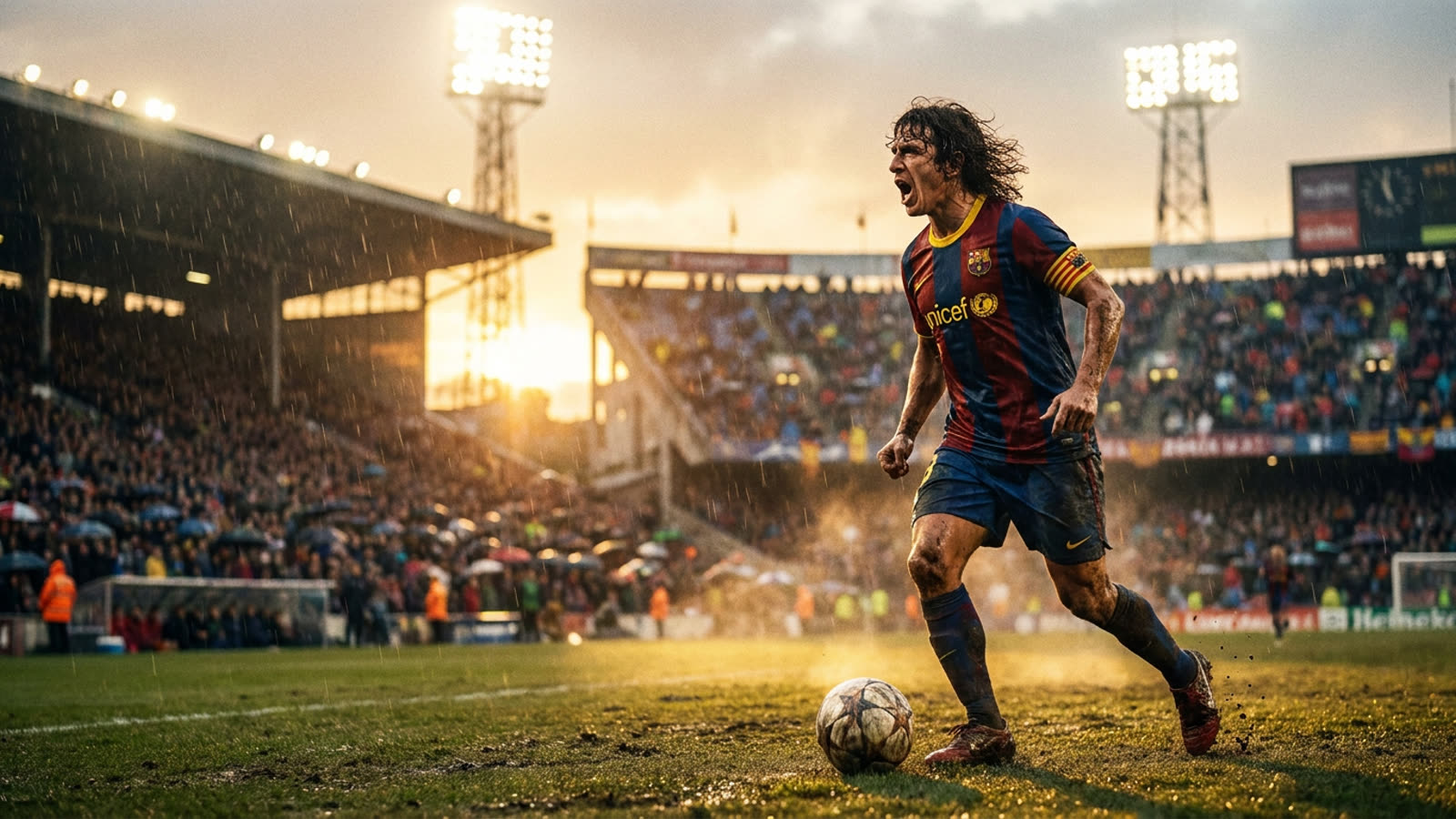
There is a particular kind of player who makes coaches nervous and teammates brave. Carles Puyol was that player for the better part of fifteen years, and Spanish football has spent the decade since his retirement trying to replace something it never fully understood in the first place.
The numbers tell a misleading story. Puyol won everything—six La Liga titles, three Champions Leagues, a World Cup, a European Championship—but so did teammates with more elegant footwork and better passing range. What the statistics cannot capture is the psychological architecture of those teams, the way Puyol's presence allowed more gifted players to take risks they would never have attempted alone.
The anti-modern defender
Contemporary football academies produce defenders who can play as auxiliary midfielders, comfortable on the ball, positionally disciplined, allergic to unnecessary contact. Puyol emerged from a different tradition. His game was built on anticipation and aggression, on arriving at the point of danger a half-second before the attacker expected anyone to be there.
This was not recklessness. Watch the 2010 World Cup semifinal header against Germany—the goal that sent Spain to their first final—and you see a player who had calculated the trajectory before the corner was taken. The leap, the timing, the willingness to attack a ball surrounded by larger bodies: this was intelligence expressed through physical commitment rather than technical refinement.
Barcelona's tiki-taka era is remembered for its poets—Xavi, Iniesta, Messi—but poetry requires protection. Puyol provided it, often at considerable personal cost. His injury record in the final seasons tells its own story about what that style of leadership demands from a body.
What captaincy actually means
The armband in modern football has become largely ceremonial, handed to the longest-serving player or the one with the most commercial value. Puyol wore it differently. Teammates from that era consistently describe the same phenomenon: matches where the technical plan had failed, where the opposition had solved Barcelona's patterns, and Puyol simply refused to let the team lose.
This is not a quality that can be coached or recruited. It emerges from some combination of competitive fury and tribal loyalty that football's increasingly transactional culture struggles to cultivate. Players move clubs every few seasons now, accumulating experiences rather than roots. Puyol spent his entire career at one club, and that continuity produced something that free agency cannot replicate.
The succession problem
Barcelona has cycled through center-backs since Puyol's retirement, some technically superior, none capable of replicating his effect on the dressing room. This is not a criticism of the players who followed—Gerard Piqué was a more complete defender in most measurable respects—but an acknowledgment that certain qualities resist measurement entirely.
Spain's national team has encountered the same absence. The 2010 World Cup squad possessed an embarrassment of technical riches, but it also possessed a player willing to bleed for teammates he had known since childhood. The generations that followed inherited the technique without the fury.
Our take
Football analytics has made the sport smarter and, in some ways, duller. We can now quantify defensive actions with extraordinary precision, but we still cannot measure whatever it was that made Puyol's teammates believe they were invincible. Perhaps that is the point. Some forms of value exist precisely because they resist quantification, because they emerge from commitment rather than calculation. The sport produces plenty of excellent defenders. It rarely produces players willing to treat every challenge as a referendum on their own character. Puyol was that rarer thing, and Spanish football is still learning how much it cost to let him go.