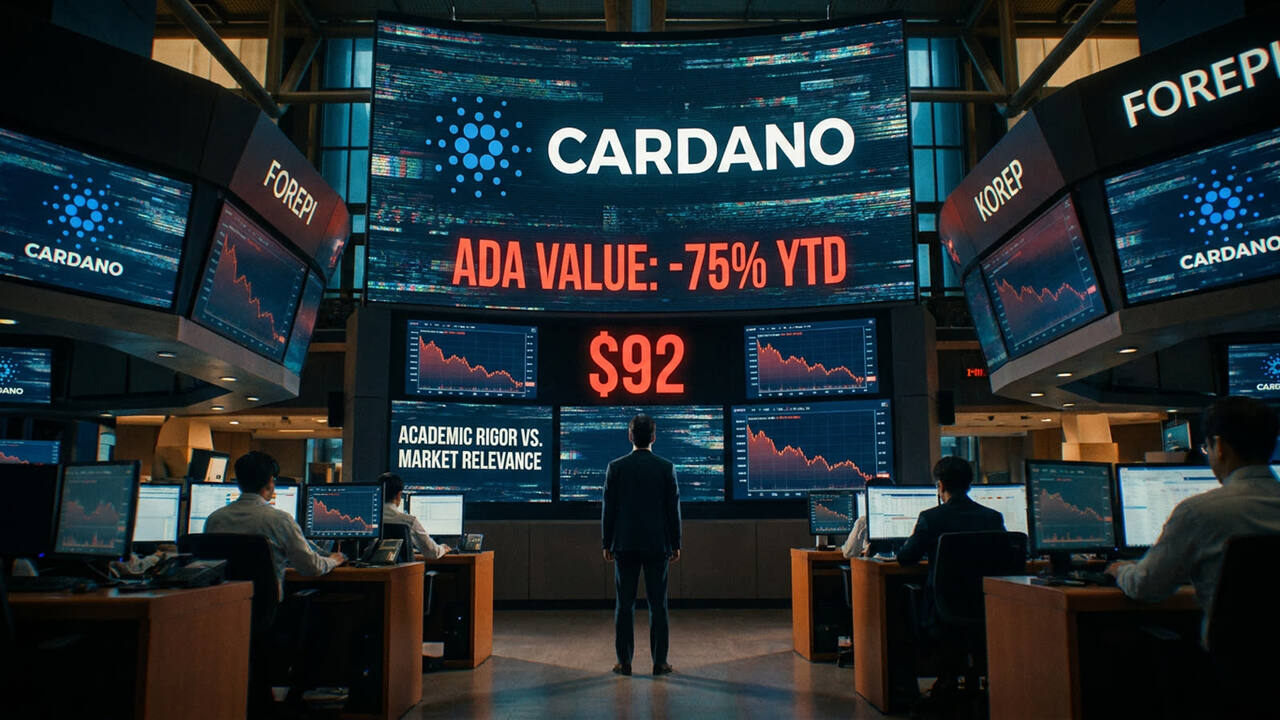
A cryptocurrency that built its identity on peer-reviewed research and formal verification now trades at roughly seventeen cents, down nearly seventy-three percent from this time last year. Cardano's ADA token ticked up marginally in the past day, but the modest green candle does nothing to obscure the broader trajectory: a blockchain that once commanded a top-five market cap has spent the better part of two years hemorrhaging value while competitors with less rigorous pedigrees have thrived.
The Cardano story was always about patience. Charles Hoskinson, who co-founded Ethereum before departing amid internal disputes, pitched a blockchain that would do things properly—peer-reviewed papers before code, formal methods before deployment, a roadmap named after literary figures that stretched years into the future. The approach attracted a devoted community that treated each academic milestone as vindication. But markets have a way of testing thesis statements, and the test has not been kind.
The execution gap
Cardano's technical achievements are real. The Ouroboros proof-of-stake protocol remains one of the most rigorously analyzed consensus mechanisms in the industry. The Plutus smart contract platform, built on Haskell, offers guarantees that Solidity developers can only envy. Yet none of this has translated into the kind of developer activity or decentralized-finance volume that sustains token valuations. Cardano's total value locked in DeFi protocols remains a fraction of what Ethereum, Solana, or even newer entrants like Sui command. The academic papers keep coming; the users largely do not.
The narrative problem
Crypto markets are driven by stories as much as fundamentals, and Cardano's story has become difficult to tell. The "Ethereum killer" framing that once generated excitement now sounds dated—Ethereum itself has transitioned to proof-of-stake and developed a thriving Layer 2 ecosystem. Meanwhile, chains like Solana captured the high-throughput narrative, and newer projects have absorbed the speculative energy that might once have flowed to ADA. Cardano finds itself in an awkward middle ground: too slow for the traders, too academic for the builders, too established to generate the excitement of a new launch.
The Hoskinson factor
Charles Hoskinson remains one of crypto's most visible and polarizing figures, a prolific communicator whose YouTube streams and Twitter presence keep the faithful engaged but also generate controversy. His recent forays into political commentary and his combative relationship with critics have become inseparable from the Cardano brand. For believers, he is a visionary playing a longer game than his detractors understand. For skeptics, he is a distraction from the chain's fundamental challenge: proving that methodical development can compete with move-fast-and-break-things pragmatism.
Our take
There is something admirable about Cardano's refusal to cut corners, its insistence that blockchain infrastructure should be built on solid foundations rather than duct tape and hope. But admiration does not pay validators or attract developers, and the market is rendering its verdict with brutal clarity. ADA may yet find its moment—perhaps regulatory clarity will favor its compliance-friendly design, or a killer application will finally emerge from all that peer-reviewed theory. For now, though, Cardano serves as a case study in the limits of being right on paper. Sometimes the tortoise does not win the race; sometimes it just arrives to find the spectators have gone home.