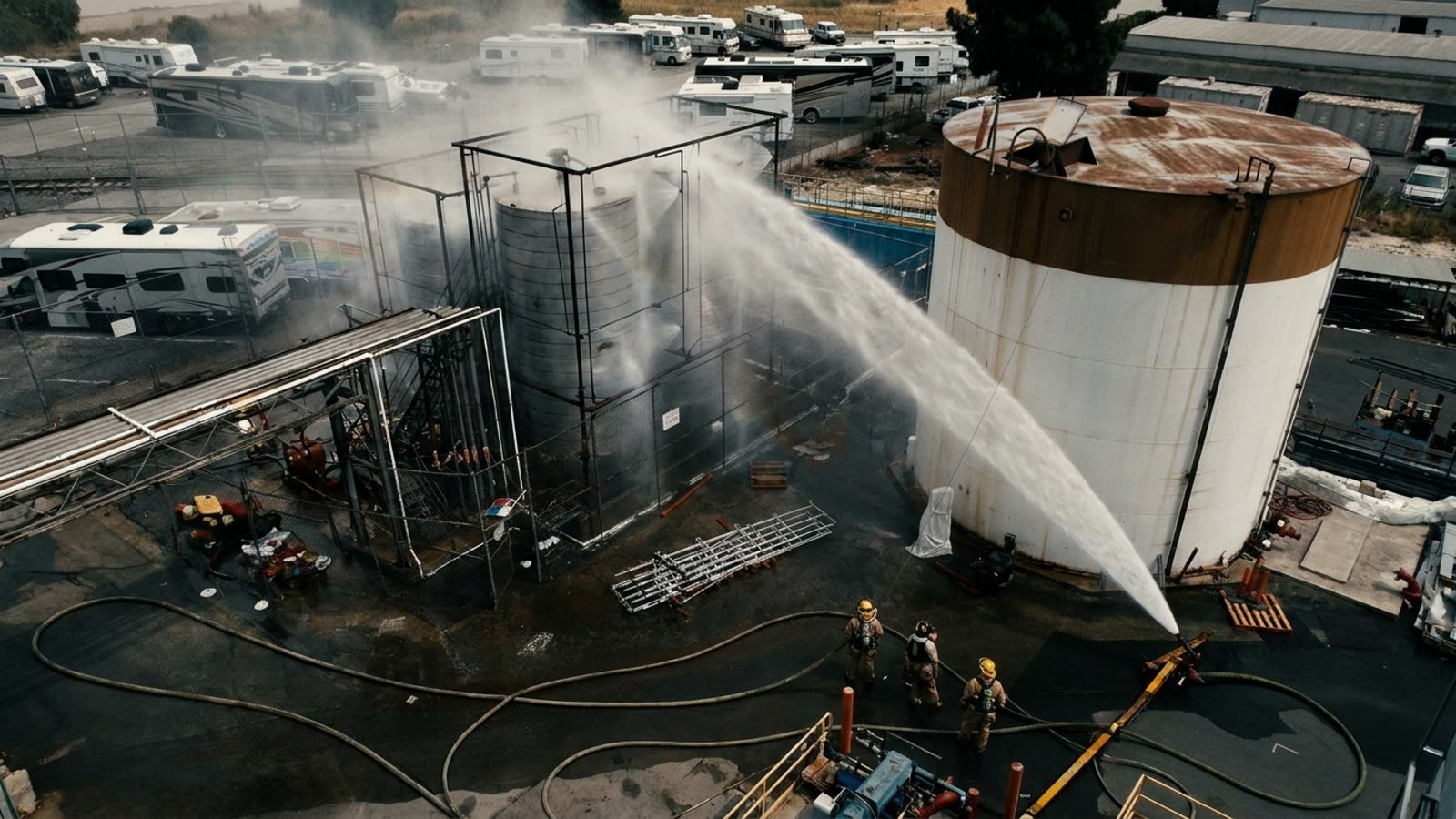
A tank containing hazardous chemicals is overheating in California, and the best response officials can muster is to race against thermodynamics while 50,000 people wait in evacuation limbo. The incident, unfolding in real time, is less a freak accident than a preview of what happens when industrial infrastructure ages faster than the systems meant to maintain it.
The details are grimly familiar to anyone who tracks American industrial safety: a containment vessel, a toxic payload, a failure mode that wasn't supposed to happen, and a scramble to prevent escalation. What distinguishes this event is its visibility—tens of thousands displaced, emergency crews improvising cooling measures, and a ticking clock that no one can precisely read.
The economics of deferred maintenance
American industrial facilities are aging. The average chemical plant in the United States is over 25 years old, and many storage and processing systems date to an era of different safety standards and regulatory expectations. Upgrading these facilities costs money—money that competes with shareholder returns, operational expenses, and the persistent corporate temptation to defer maintenance until next quarter.
The calculus is straightforward until it isn't. A tank that functions adequately for decades can fail catastrophically when materials degrade, monitoring systems lag, or climate conditions push equipment beyond design parameters. The cost of prevention is predictable; the cost of failure is not.
Emergency response in an era of budget constraints
Local emergency services across the country have been stretched thin by a decade of municipal budget pressures. When a chemical emergency requires specialized hazmat capabilities, cooling equipment, and sustained evacuation management, many jurisdictions find themselves improvising with whatever resources happen to be available.
The California incident is unfolding in a state with relatively robust emergency infrastructure. In regions with fewer resources, similar failures could escalate faster and resolve slower. The federal government's role in industrial safety oversight has been subject to political oscillation, with regulatory agencies alternately empowered and constrained depending on the administration.
Climate as accelerant
Rising ambient temperatures complicate the engineering assumptions built into chemical storage systems designed decades ago. A tank rated for certain thermal conditions may behave differently when baseline temperatures creep upward and heat waves intensify. This isn't speculation—it's thermodynamics applied to infrastructure that wasn't designed for 2026's climate.
Insurers have begun pricing this reality into industrial coverage, but the adjustments lag behind the risk. Companies face higher premiums without necessarily investing the proceeds in upgrades that would reduce the underlying hazard.
Our take
Fifty thousand evacuees are the visible cost of this incident. The invisible cost is the erosion of public confidence in the systems that store, transport, and process the hazardous materials modern economies require. California will cool this tank or it won't, and either outcome will fade from headlines within weeks. But the underlying condition—aging infrastructure, constrained budgets, shifting climate baselines—will persist until the next tank, the next evacuation, the next improvised response. The question isn't whether this will happen again. It's where, and whether anyone will have learned anything.