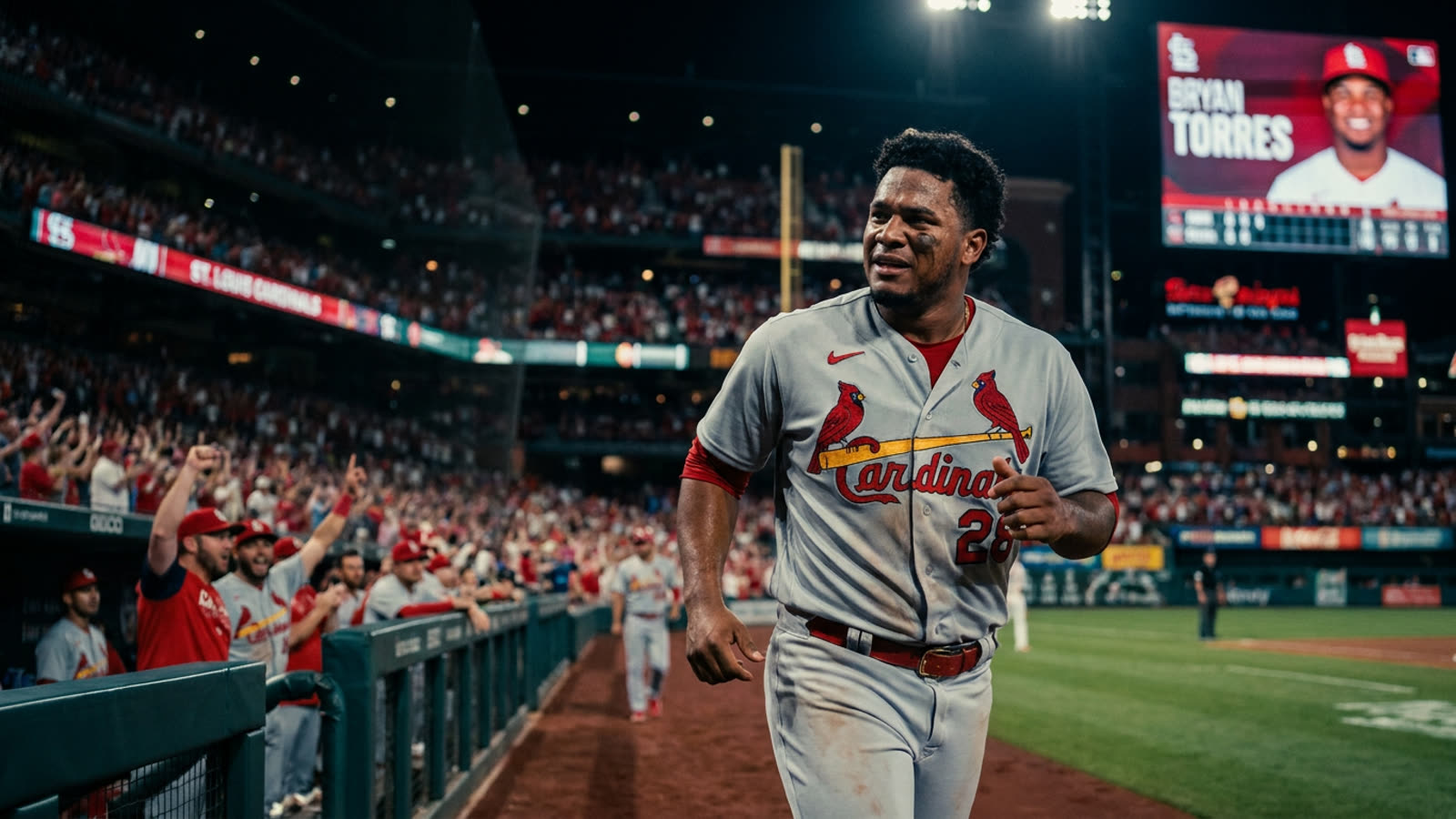
The arithmetic of professional baseball is brutal: thousands of players drafted each year, a handful who make it, and an actuarial cliff that arrives somewhere around age 26. Bryan Torres, who turned 28 in March, was supposed to be on the wrong side of that math. Instead, on Friday night at Busch Stadium, he deposited his first major-league pitch into the left-field seats and rounded the bases with the kind of controlled emotion that suggested he'd been rehearsing this moment for a very long time.
The Cardinals called up Torres from Triple-A Memphis earlier this week, a roster move that barely registered outside the organization. He'd spent parts of nine seasons in the minors, shuffling between affiliates, surviving the pandemic's minor-league contraction, and watching younger prospects leapfrog him on depth charts. His career minor-league slash line was respectable but unremarkable—the profile of a player who does everything competently and nothing spectacularly.
The debut that defied the spreadsheet
Torres entered Friday's game as a pinch-hitter in the seventh inning, a low-leverage spot that typically produces forgettable at-bats. The opposing pitcher, working ahead in the count, left a fastball over the middle of the plate. Torres didn't miss. The ball traveled 402 feet, and Torres's teammates mobbed him in the dugout with the performative enthusiasm teams reserve for moments that transcend the box score.
What made the scene genuinely affecting was Torres's visible struggle to maintain composure. He'd told reporters earlier in the week that his parents had never seen him play professionally—they'd remained in Venezuela while he chased an increasingly improbable dream through bus rides across the American South. They were watching Friday, somewhere, and Torres knew it.
Why these stories still matter
Baseball's analytical revolution has made the sport more efficient and, in some ways, less romantic. Teams now understand with actuarial precision when a prospect's window has closed. The 28-year-old journeyman who finally gets his shot is increasingly rare because organizations have learned that roster spots are finite resources better allocated to younger, higher-ceiling players.
But the sport's appeal has always rested partly on its capacity for improbable narratives. Torres's homer won't change the Cardinals' playoff odds or alter any projection models. It will, however, circulate through clubhouses across the minor leagues, offering a data point of hope to players who've been told their time has passed.
Our take
Torres may never hit another major-league home run. He may be back in Memphis by June. None of that diminishes what happened Friday night. Baseball's best moments have always been the ones that resist the spreadsheet—the veteran who hangs on just long enough, the prospect who arrives a decade late. Torres earned his moment the hard way, and the game is marginally better for having witnessed it.