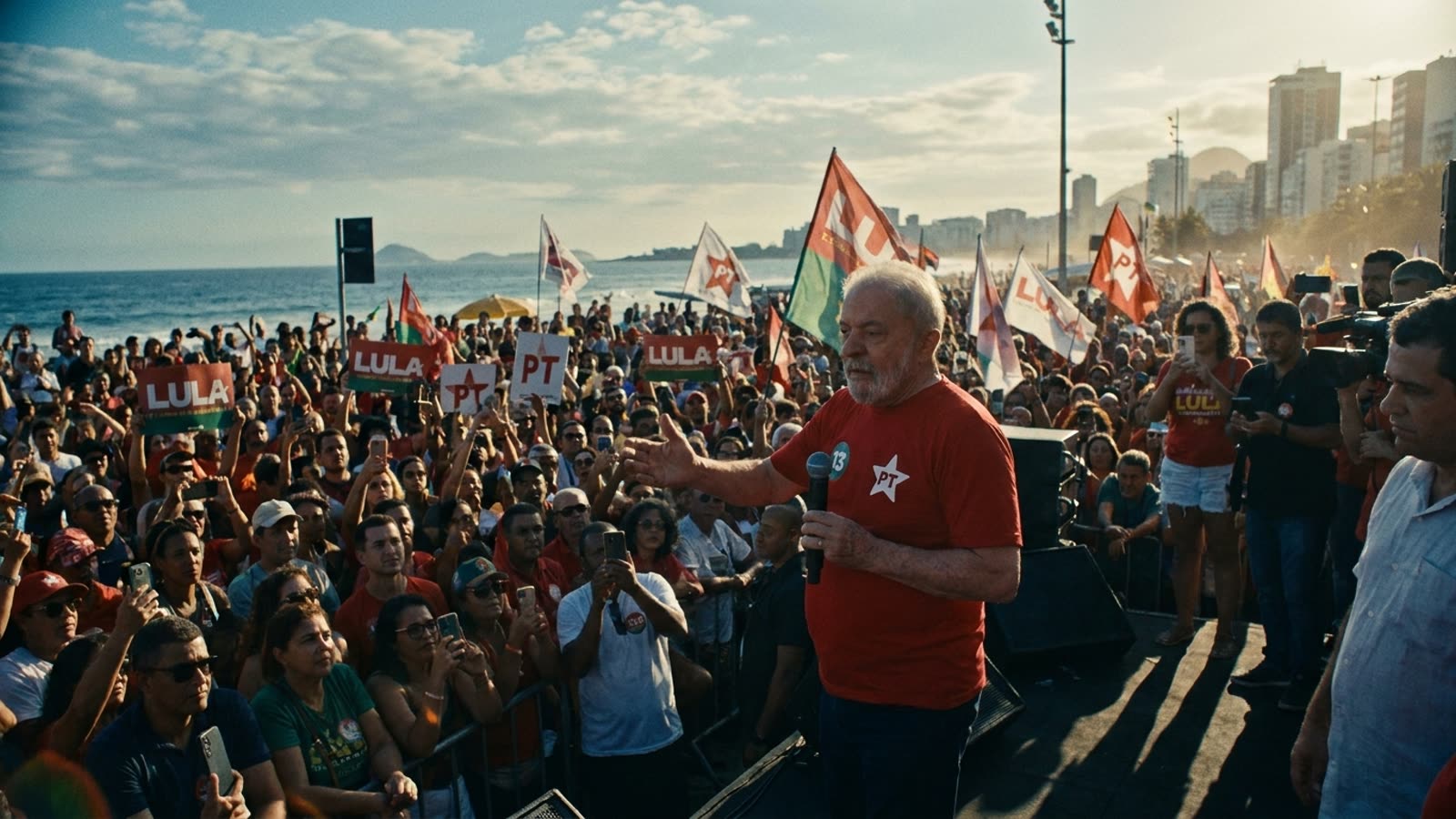
The images from Rio de Janeiro on Saturday evening carried the unmistakable choreography of a campaign that knows the stakes: tens of thousands of red-clad supporters streaming onto Copacabana beach, the iconic mosaic promenade transformed into a sea of Workers' Party flags, and Luiz Inácio Lula da Silva at the microphone warning that Sunday's vote is not merely an election but a civilizational choice. He is not entirely wrong.
Brazil's runoff pits the 80-year-old Lula—back in office since 2023 after his corruption convictions were annulled—against Flávio Bolsonaro, the senator and eldest son of the former president who tried to overturn his own defeat four years ago. The younger Bolsonaro has run a disciplined campaign that distances itself, rhetorically at least, from his father's January 2023 riot while doubling down on the same evangelical-agribusiness coalition that made Jair Bolsonaro a phenomenon. Polls give Lula a narrow lead, but anyone who watched 2022's razor-thin result knows that Brazilian surveys are suggestions, not prophecies.
The Copacabana gambit
Lula's decision to close his campaign on Rio's most famous beach was strategic symbolism. Rio de Janeiro state swung hard for Bolsonarismo in 2022 and remains hostile terrain for the left; Flávio himself represents it in the Senate. By filling Copacabana, Lula's campaign sought to demonstrate that the opposition cannot take even its strongholds for granted—and to generate drone footage that will saturate Brazilian social media through Sunday morning. The crowd size, estimated by organizers in the tens of thousands, was impressive but not unprecedented; what mattered was the optics of a president still capable of summoning a movement.
What Flávio represents
Flávio Bolsonaro is not his father, and that is both his weakness and his strength. He lacks Jair's crude charisma and talent for provocation, but he also lacks the legal baggage; the elder Bolsonaro remains ineligible to run until 2030. Flávio has positioned himself as the heir who can deliver the same policies—gun liberalization, Amazon development, alignment with agribusiness—without the carnival of scandal. His campaign has been notably quieter, relying on WhatsApp networks and church pulpits rather than stadium rallies. The question is whether Bolsonarismo can survive without the original Bolsonaro's ability to dominate every news cycle.
The institutional backdrop
Brazil's institutions held in 2023, barely. The Supreme Court moved aggressively against the January rioters, and the military declined to back a coup. But the underlying polarization has not dissipated; if anything, it has calcified. Lula's government has struggled with a hostile Congress, sluggish growth, and persistent inflation. A Bolsonaro victory would be interpreted across the hemisphere as proof that the populist right can win even after an attempted insurrection—a lesson not lost on observers in Washington, Buenos Aires, and Mexico City.
Our take
Lula's Copacabana rally was a reminder that he remains, at 80, the most formidable campaigner the Brazilian left has ever produced. But rallies do not vote; the interior does, and the interior is Bolsonaro country. Sunday's result will likely be close enough that both sides claim legitimacy grievances, setting up another cycle of institutional stress. Brazil is not on the brink of collapse, but it is on the brink of something—a permanent state of contested democracy where every election is treated as an existential emergency. That may be the real legacy of the Bolsonaro era, regardless of who wins.