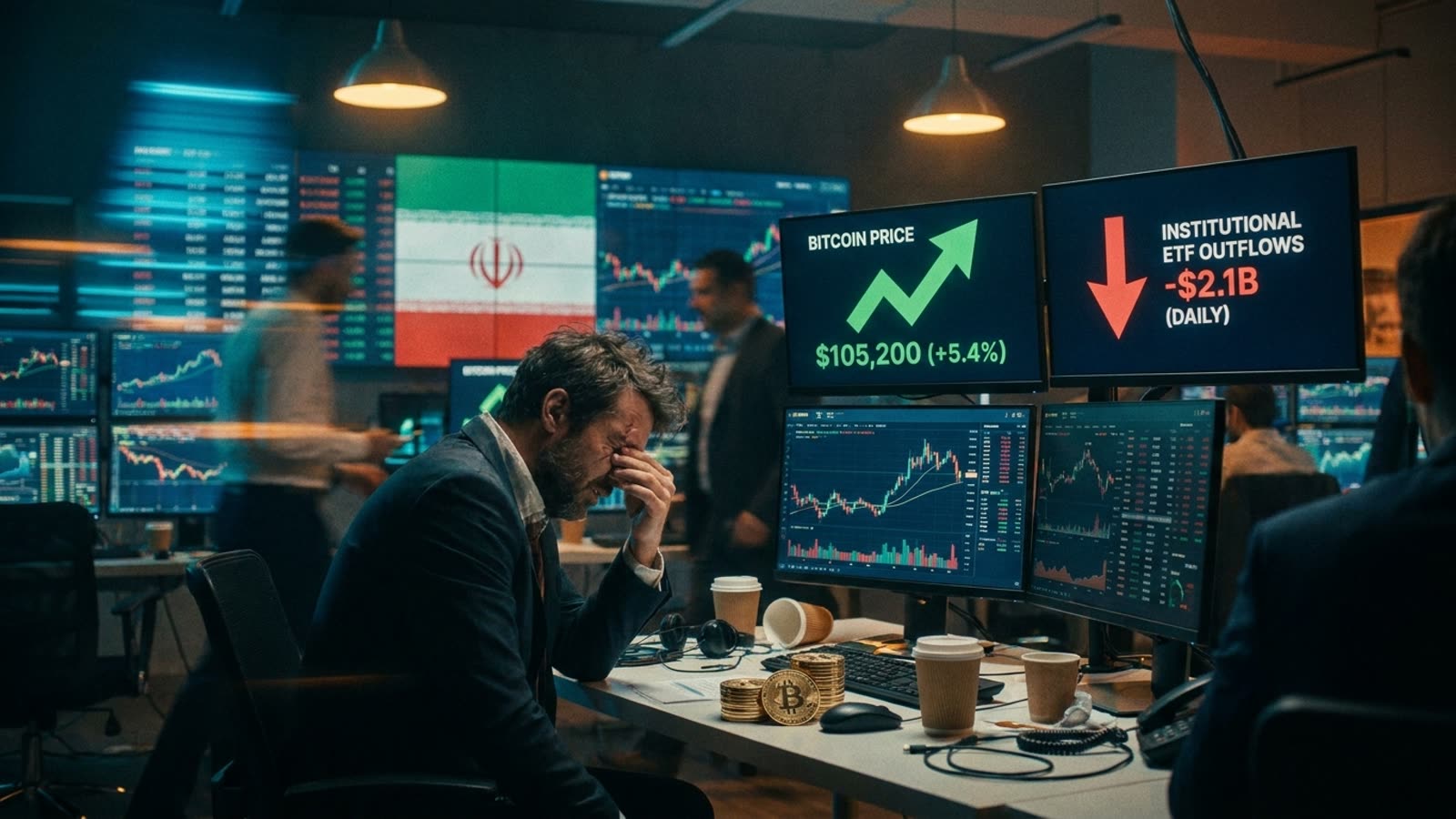
Bitcoin's response to the US-Iran ceasefire announcement crystallizes the asset's fundamental incoherence: it rallied sharply on news of reduced global conflict while simultaneously watching institutional money sprint for the exits. The price spike past $105,000 occurred against a backdrop of ETF outflows measured in billions, a divergence that would be inexplicable for any conventional asset class but has become Bitcoin's defining feature.
The ceasefire, announced after intensive G7 diplomacy, theoretically reduces the kind of geopolitical uncertainty that Bitcoin maximalists claim their asset hedges against. Yet Bitcoin surged anyway. The rally suggests traders are treating it as a risk-on asset — one that benefits when global tensions ease and capital flows toward speculative bets — rather than the digital gold its proponents have spent a decade marketing.
The ETF exodus complicates the narrative
The institutional outflows present the more troubling signal. Spot Bitcoin ETFs, which were supposed to mark crypto's graduation into mainstream finance when they launched in early 2024, have been bleeding capital at an alarming rate. Billions have departed in recent weeks, suggesting that the very investors Bitcoin needed to validate its maturation thesis are reconsidering the trade entirely.
This creates an awkward situation for the asset. Retail enthusiasm, evidenced by the ceasefire rally, remains intact. But institutional conviction — the patient, thesis-driven capital that was supposed to provide price stability and legitimacy — appears to be evaporating. Bitcoin is left with the worst of both worlds: the volatility of a speculative retail asset and the headline risk of institutional abandonment.
What the divergence reveals
The split between price action and fund flows illuminates Bitcoin's unresolved identity. Is it a hedge against chaos, which should fall when the world calms down? A risk asset, which should rise when investors feel confident? A currency, which should be stable? Or simply a vehicle for speculation, which moves on momentum regardless of fundamentals?
The honest answer is that Bitcoin remains all of these things to different constituencies at different moments, which is another way of saying it is none of them reliably. Seventeen years after Satoshi Nakamoto's white paper, the asset still lacks a coherent use case that would allow investors to model its behavior.
Our take
The Iran ceasefire rally is less a vote of confidence in Bitcoin than a reminder of how reflexively traders reach for it whenever headlines move. That instinct, divorced from any consistent thesis, is precisely why institutional money is leaving. Bitcoin has achieved remarkable longevity without ever settling the question of what it actually is. The ETF outflows suggest that patience for ambiguity may finally be running thin.