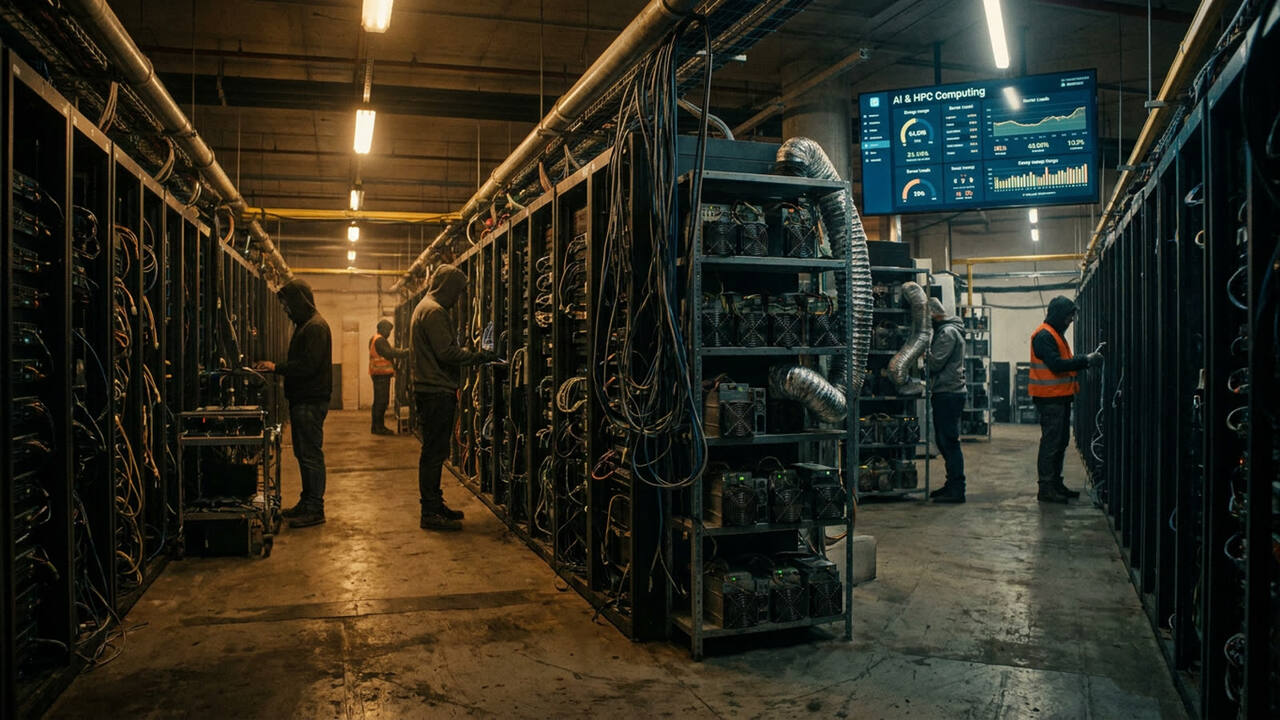
The most valuable asset in bitcoin mining was never the coins—it was the electricity contracts. That thesis, once contrarian, is now consensus on Wall Street, and Bernstein's latest research quantifies just how dramatically the power dynamics have shifted.
The investment bank projects that bitcoin miners with significant energy infrastructure will see their AI-related revenue streams eclipse traditional mining income within three years. Companies like Core Scientific, Riot Platforms, and Marathon Digital have spent years securing cheap, long-term power purchase agreements in remote locations—exactly the kind of stranded capacity that hyperscalers and AI labs are now fighting over.
The arbitrage nobody saw coming
Bitcoin mining has always been a brutal business: razor-thin margins, volatile revenue, and the quadrennial halving events that cut block rewards in half. The April 2024 halving forced miners to find new economics or die. What they discovered was that their real competitive moat—multi-hundred-megawatt substations connected to cheap power in Texas, North Dakota, and rural Georgia—was suddenly worth more as real estate than as mining capacity.
Nvidia's chips generate heat. Training runs consume power at scales that would make a small city blush. And the AI boom has created a two-year backlog for new data center construction. Miners, sitting on permitted, grid-connected facilities, found themselves holding the keys to the kingdom.
Bernstein's numbers
The research note, circulated to institutional clients this week, models a scenario where miners hosting AI workloads could generate $15-20 per megawatt-hour in hosting fees, compared to $8-12 in equivalent bitcoin mining revenue at current prices and difficulty levels. For a 500-megawatt facility, that spread compounds into hundreds of millions in annual incremental revenue.
Core Scientific has already signed a 200-megawatt deal with CoreWeave. Riot is in negotiations with multiple hyperscalers. The market is repricing these companies not as crypto plays but as energy infrastructure assets—a category that commands far more stable multiples.
Our take
The irony is almost too perfect: an industry built on decentralization is finding its salvation by becoming landlords to the most centralized computing operations on Earth. Bitcoin maximalists may grumble, but the miners' shareholders won't. This is what adaptation looks like—and it suggests the real legacy of the crypto mining boom may be a distributed network of AI-ready data centers that no one planned to build.