The transformer did not discover intelligence. It reorganized it into matrix math the hardware could eat, replacing step-by-step recurrence with all-at-once attention and turning sequence learning into a throughput business. That simple refactor—conceptual elegance tied to industrial practicality—moved AI from bespoke systems to a general-purpose stack. The last decade of progress is less a mystery than a consequence: when a method aligns with GPUs, data pipelines, and cloud balance sheets, it compounds.
What actually changed
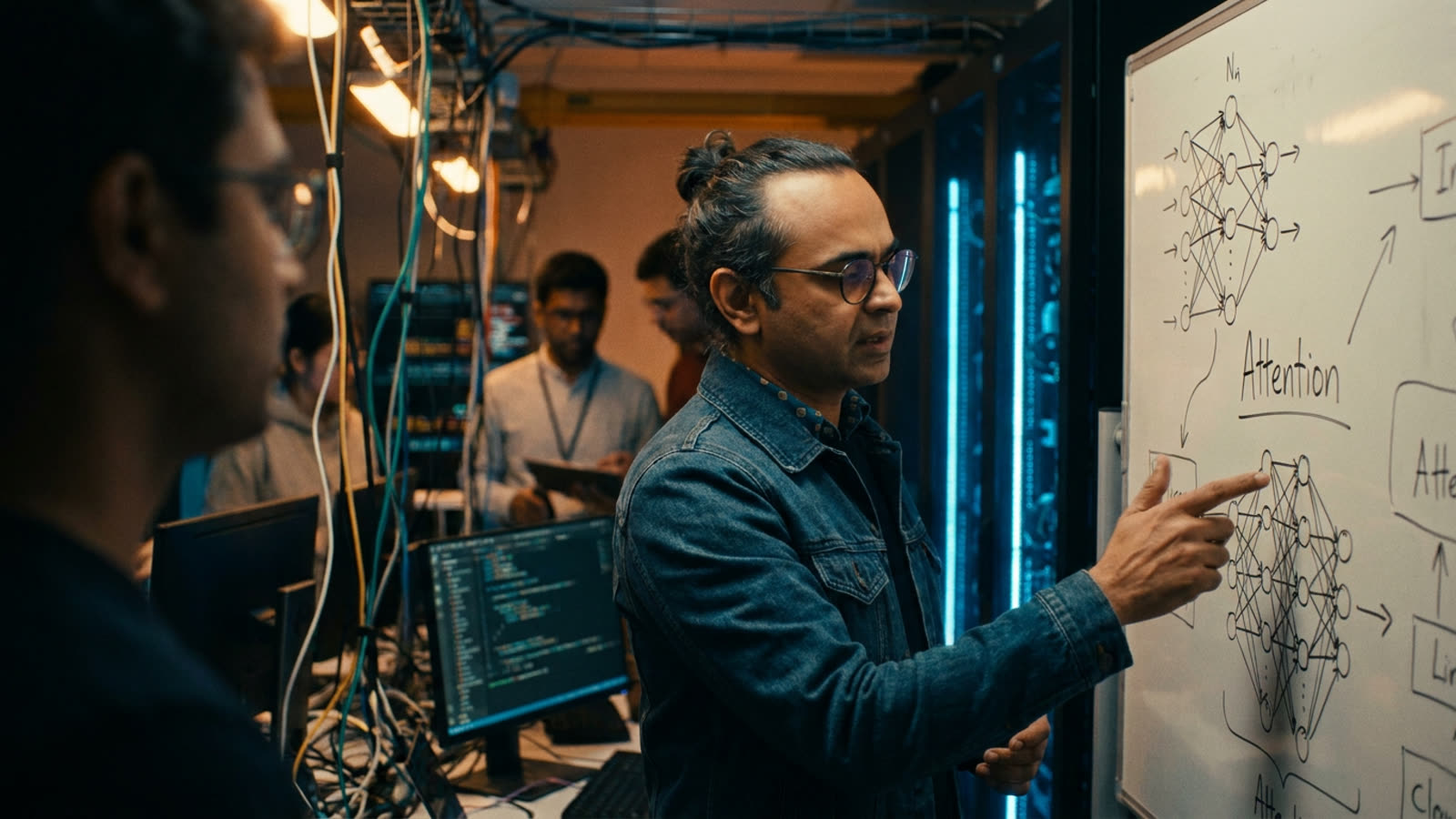
Self-attention let models weigh relationships among all tokens simultaneously, sidestepping the bottlenecks of recurrent networks. Positional encodings restored order, multi-head attention stabilized learning, and the result was a structure that scaled cleanly with parallel hardware. First it remade machine translation. Then, with pretraining on broad text and light task-specific tuning, it generalized: one architecture for many domains. Vision adopted it with patches in place of words; audio and multimodal systems followed. The critical leap was not mystical emergence but a reproducible recipe—data, compute, optimization—that organizations could standardize.
The industrial aftermath
A paper became a platform. Pretrain-then-adapt turned into the “foundation model” supply chain: data curation and deduplication at the front; training runs scheduled around accelerator clusters; checkpoints, adapters, and safety layers for downstream teams. Around it grew an ecosystem—vector databases, retrieval-augmented generation, evaluation harnesses, prompt tooling—that professionalized what started as clever hacks. Open-source communities reproduced and reinterpreted the design, compressing costs and spreading competence. The transformer’s grammar—embeddings, attention blocks, residuals—became the lingua franca across research, product, and operations.
The limits hiding in plain sight
Scale is a ladder and a leash. The architecture loves data and compute; both are finite and politically charged. Training hunger competes with power and cooling constraints. Data quality, licensing, and bias issues move from footnotes to front-page risk. Longer contexts and tool use mitigate gaps, but inference latency, memory footprint, and reliability under distribution shift remain practical ceilings. Models that appear to reason often pattern-match convincingly until stakes rise. Hence the turn to retrieval, verifiable program calls, and domain-grounded adapters—not to abandon attention, but to tether it to sources of truth and tighter feedback loops. There is also the synthetic-data paradox: models learning from their own exhaust risk error amplification without careful filtering.
Our take
The transformer is AI’s steam engine: not the destination, but the device that made the modern factory possible. It will persist as the default substrate while the frontier moves toward better memory, grounding, and verifiable action. The next real leap will look familiar—still attention at the core—augmented by systems thinking outside the network: data governance, retrieval, tooling, and small, specialized models at the edge. Until a new architecture finds the same harmony with hardware and economics, attention remains the house style of machine intelligence.